Showing posts with label Altar Girls. Show all posts

Wednesday, November 29, 2017

The psychology of Ecclesiastical Incompetence

IMG_0705
Bishop Mark Jabale at the LMS Annual Requiem in Westminster Cathedral
Guide to this series:
The Psychology of the Rigid Personality
The Psychology of Military Incompetence
The Psychology of Ecclesiastical Incompetence
The Psychology of Traditionalism

The reason I've been writing about Norman Dixon's theory of 'rigid' personalities and military incompetence, is that the Church has certain interesting parallels with the military. The Church is hierarchical and authoritarian; the Church's training institutions are places where people can enjoy the predictability of institutional life (particularly in religious communities) and the rewards of conformism. It is inevitable, therefore, that the Church, like the army, will attract conformists, and that good superiors in both cases must be on the look-out for those whose conformity to the necessary discipline of the institution hides a debilitating lack of self-confidence. Priests lacking in self-confidence will be useless in the field, so if they don't gain the necessary maturity they must be weeded out. Things will go very wrong if, on the other hand, the conformists gain the upper hand. In that scenario it is the self-confident ones who will be weeded out, and pastoral effectiveness will suffer across the board.

The tensions just described are built into the nature of things, and so the psychology of the use of authority in the Church, and especially in seminaries, could remain constant, in certain ways, through the Vatican II revolution. Institutions which had been taken over by conformists under the Old Regime could change their theology without, necessarily, changing their psychological dynamic, for the New Regime. Liberals might think that their 'let-it-all-hang-out' ideology had banished the authoritarianism/ conformism pattern of the past, but it didn't: it simply meant that instead of conformism meaning slavish adherence to late 19th century neo-scholasticism and the ruthless weeding out of liberals, it now meant slavish adherence to Hans Kung and his friends and the ruthless weeding out of conservatives. And indeed, since the products of such a system were priests who were conformists first, and conservatives or liberals second, a change of ideology would not even necessarily require a change of personnel.

I put forward these theoretical observations as a way to interpret certain historical patterns. Not all Catholic seminaries and communities were or are the same; nor were all the products of these institutions the same, with people bucking the trend in both good and bad ways. Nevertheless, I think few will dispute generalisations such as the following:

Saturday, May 14, 2016

Female deacons: why not?

IMG_1338
A male-dominated sanctuary at the LMS Priest Training Conference at Prior Park.
It is often pointed out that there are women described as 'deacons' in the early Church. Indeed, they continued to exist in the East into the 9th century. It's all there in the Catholic Encyclopedia.

This shouldn't be alarming, however, once a few pertient facts are remembered. These ladies were not ordained into the order of deacon: it was a non-sacramental ministry with distinct functions from that of ordained deacons. They would, for example, assist women who were being baptised when this meant full immersion. They ceased to exist because their special functions, like the one just mentioned, ceased to be necessary, after a period in which it it had been just an honorary role. There is no reason to imagine they existed in the primitive Church in a formalised way: there is no reference to them in Acts or St Paul's letters, though naturally women worked for the Church in all sorts of ways, by contrast with the order of (male) deacons, who were clearly quite significant.

This role could in principle be revived, as Pope Paul VI revived (or tried to revive) various other roles, like Lector and Acolyte, which had become simply steps on the way to ordination to the priesthood, and the permanent diaconate. It wouldn't be so easy to revive the things which they used to do, but maybe they could do something else. After all, women do all kinds of things in the Church.

Tuesday, January 27, 2015

On men taking back the Church

IMG_0519
Solemnity, discipline, beauty, awe. The Dominican Rite in Oxford.

Further to the debate about masculinity and the liturgy, and an article about Cardinal Burke's remarks on related issues (which quotes me) by Tim Stanley in the Catholic Herald, Madeleine Teahan asks a pertinent question:

An implicit difference in expectation is the glaring irony at the heart of Cardinal Burke’s argument: namely, that men are passive victims of radical feminism, bad liturgy and poor catechesis. It’s as if they are a sex who are done unto; totally enfeebled and powerless to fight back. Doesn’t this portrayal undermine the typically masculine capacity for chivalry and strength that Cardinal Burke also refers to?

It's not that Miss Teahan denies that men are absent from our churches, it is just that she thinks the blame should be assigned squarely to the victims of poor catechesis and bad liturgy, and not to those who create those things. Perhaps she has in mind that passage in the Gospel where Jesus says that anyone who causes scandal to (i.e., causes to sin), one of these 'little ones' puts a millstone round the little ones' necks and gets away scot free.

No, wait...!

Tuesday, June 11, 2013

Was the true Council betrayed? Reply to 'Savoranola'

The real Savoranola
The real Savoranola would have given pretty short shrift to the individual who has taken on his name for the purpose of making anonymous swipes at orthodox Catholics in blog comms boxes (not to be confused with @frasavonarola), but I think it is worth making a response to the more substantive part of what he's put under yesterday's post, since (as he says), he speaks for many, though perhaps not quite as many as he imagines (and pretty few under 70):

'I think you should know that there are probably many many Catholics who have for a long time been dismayed by the way in which the great and inspiring vision of Vatican II for the renewal of the Church has been betrayed and undermined by members of the hierarchy (who is really being disloyal to the authority of the Church?) and are very grateful that there are people like Basil Loftus who still uphold that vision and are given a platform by the Catholic Times.' 

The great liberal myth of the Betrayal of the Council is that, when the Holy Ghost descended upon the Council Fathers, the 'Curia' (boo! hiss!) and the 'hierarchy' (boo! hiss!) clamped down and did not allow the wonderful things, which the Council demanded, to happen. The result being that the Council has never been fully implemented, and the fruits have not developed as they should. This is the kind of story you'll find on the little-visited websites of groups such as 'Catholics for a Changing Church'.

One difficulty they always have is quoting Council texts to support their case. When they try to do this, either it is a rather vague and general aspiration, or it is something they have taken out of context. For the fact is, looking at the texts, it is abundantly clear that the reforms which followed the Council went much further than had been intended by the Council Fathers: so, far from the process of Reform demanded by the Council being stifled by the wicked hierarchs after the Council had closed, it would be more accurate to say that it was hijacked by zealots who took the changes to extraordinary lengths. And then, of course, there was a lot of disobedience to the new rules, also in a liberal direction.
Cardinal Ottaviani: legendary
opponent of Conciliar liberalism

Let me give a few examples. The Council gave permission for a 'greater use of the vernacular' in the Mass (Sacrosanctum Concilium 63). The context makes it clear that it was the 'people's parts' which were under consideration, and this is reflected by the very earliest reforms, which allowed the use of the vernacular in the parts of the Mass where there is a dialogue between priest and people, and the readings. When the Dominican Cardinal Browne said, in the Council, that if the vernacular were allowed in part, it would take over, the other Council Fathers laughed at him. Yes, they laughed at the idea that the Canon of the Mass should be translated. They didn't make it explicit that it must not be, but it clearly wasn't what they intended to happen. If we want to know what the Council documents say, we look at them and read, in the same section (63) quoted above: 'Latin is to be retained'.

So what happened was that the people implementing the reform persuaded Pope Paul VI to permit a reform far, far more radical than that considered by the Council Fathers. Is this what 'Savoranola' means by the 'vision' of the Council being 'betrayed and undermined by members of the hierarchy'?

A very similar process took place with Communion under Both Kinds. The Council (SC55) said that it could be allowed in certain highly restricted cases:

The dogmatic principles which were laid down by the Council of Trent remaining intact, communion under both kinds may be granted when the bishops think fit, not only to clerics and religious, but also to the laity, in cases to be determined by the Apostolic See, as, for instance, to the newly ordained in the Mass of their sacred ordination, to the newly professed in the Mass of their religious profession, and to the newly baptized in the Mass which follows their baptism.

And so it is no surprise to see in 1970 a document (Sacramentale Communione) implementing this pointing out

'This faculty should not be granted on occasions when there are large numbers of communicants'.

It was persistent disobedience to this, particularly by the then bishops of the United States, which eventually forced the Vatican to give up trying to enforce this restriction. What happened in practice is a far more radical step that anything imagined by the Council Fathers.

An even more radical category of changes includes Altar Girls, Communion in the Hand, Extraordinary Ministers, and Mass 'facing the people': none of these were so much as mentioned in the Council texts. The liberal hotheads might imagine that these innovations were in the 'spirit of the Council'; it all gets rather vague at that point. But what they can't claim is that what the Council demanded was, wickedly, suppressed by dreadful conservatives like Cardinal Ottaviani. What the Council actually demanded, in black and white, in the texts, is something rather limited and mild, compared to what actually happened.

The internet is the great boon for us on the subject. Everyone can see the documents for themselves, they can link to them, they can put dubious quotes into context, they can dig out the more obscure things which the Vatican website prefers not to publish from other sources (such as EWTN). The difficulty of getting hold of the real documents made possible the wholescale misrepresentation of the Council by the liberals which dominated public consciousness for decades. I'm sorry, 'Savoranola': you can't do that any more.
IMG_1537
The Mass of the Council: at the LMS AGM on Sunday, St George's Cathedral, Southwark
For more on many of these issues see the FIUV's short and well-documented Position Papers:

Thursday, January 17, 2013

Lofus: the charge sheet, an introduction

Perhaps the most harmful thing Mgr Basil Loftus does in his lengthy columns is disinformation. Writing at length, with a scattering of references to canon law and Conciliar documents, he makes what looks like a plausible case for the inverse of the truth. This is harmful because it reinforces false assumptions about the teaching of the Church, and distorts the basis of debate. We should be able at least to agree on matters of Church law, or what documents say, but Loftus, taking advantage of the fact that few of his readers are experts in these things, and few will trawl through the original documents to check, is able to lend his authority (I'm a Monsignor, you know!) and that of the Catholic Times, to completely false claims.
Paul VI: never lifted the prohibition on CITH

Here I'll look at two columns from some time ago, which are available online, which illustrate his modus operandi.

I've already explained what was wrong with what he said about altar girls. He did exactly the same thing about Communion in the Hand. Just after the Motu Proprio was issued in 2007, he wrote:

The reception of Communion on the tongue was never a matter of rubrics - but of habit or custom.

After defending this method to the exclusion of Communion in the hand, in 1969, the Holy See the following year relaxed the practice and permitted Communion in the hand.


The 1969 document he mentions is (presumably) the Instruction Memoriale Domini. This does indeed reaffirm the illegality of Communion in the Hand, and on the basis of 'custom': 'this manner of communicating, ...is now to be considered as prescribed by custom'. Why does Loftus stress the distinction between 'custom' and 'rubrics'? The custom is binding. Communion on the tongue is prescribed.

The next little trick is to say that the Holy See permitted Communion in the Hand 'the following year'. This would be bizarre if true. So Paul VI said CITH was forbidden one year, and allowed the next? No: the exceptions to the general rule against CITH are made in the very same document, even if the first permissions made under the conditions it set out weren't given until 1970. Where the practice of CITH had become established, and with a two-thirds majority of the bishops of the country asking for it, and with the express permission of the Holy See, CITH can be allowed. In other words, where it happens (ok, so everywhere), it is under a derogation from the law of the Church. It is an indult, and as Redemptionis Sacramentum makes clear, this is always on the condition that it does not lead to a profanation of the sacrament (section 92).

The provisional and precarious nature of CITH is something which Loftus wants to disguise. So his words quoted above, while technically correct, are grossly misleading, and presumably designedly so. 

He goes on in the article to say that CITH, lay readers, the 1970 Lectionary, and communion under both kinds are all perfectly ok at the Traditional Mass. The 2010 Instruction Universae Ecclesiae makes it clear that this is not so, the 1962 Missal has its own liturgical law. It was because of people like Loftus that this Instruction was necessary. But the fact is that it is perfectly obvious to anyone not desperately trying to justify the opposite conclusion:  the right to use the 1962 Missal includes the instructions at the front of that Missal, about not having altar girls, the readings given for each Sunday and feast, and the customs which pertain to it.


The second issue is the right to dissent from Church teaching. In a column appearing in December 2009, he suggested that the Syllabus of Errors was overturned by Vatican II, on the subject of freedom of conscience. I've blogged before about this claim being made in a Tablet editorial, so I can refer readers to that and be brief.
Pius X: not contradicted by VII

Loftus quotes Vatican II's Dignitatus Humanae as follows:

'In all his activity a man is bound to follow his conscience faithfully, in order that he may come to God for whom he was created. It follows that he is not to be forced to act in a manner contrary to his conscience. Nor, on the otherhand, is he to be restrained from acting in accordance with his conscience, especially in matters religious.'

So far so good. Then he characterises the rationale of previous teaching, as per the Syllabus of Errors, as follows:
'no-one is forced in conscience to be a Catholic, but once someone has chosen to follow Christ within the Catholic Church, then they must follow the rules of that club. So the power of the magisterium, the teaching authority of the Church, takes precedence over the primacy of conscience within the Church.'

This is not quite right but is close enough for present purposes (see here for a better analysis). What is important is that the two quoted positions are only incompatible if you reject the Church's teaching on what conscience actually is. Of course the teaching of the Church takes precedence over the conscience of a Catholic: a Catholic's conscience is formed by the teaching of the Church. Where else is it going to take its principles from? Cosmopolitan? A properly formed conscience is one which is formed by exposure to the truth.

Loftus then goes into a long digression about the Temporal Power of the Popes - the papal states. I've blogged about that issue here, but I can't for the life of me see its relevance here. But with this as a kind of diversionary tactic, and via the bizarre claim that Garibaldi's (failed) attempts to stimulate an uprising in the Papal States were inspired by the Holy Ghost, he ends with a long quotation from John Courtney Murray, who was involved in the drafting of Dignitatis Humanae but whose view, which really was inconsistent with the immemorial teaching of the Church, was not, in the end, adopted:
'A more detailed examination of the rights of conscience within the Church is well overdue: “inevitably, a second great argument will be set afoot now on the theological meaning of Christian Freedom. The children of God, who receive this freedom as a gift from their Father through Christ in the Holy Spirit, assert it within the Church as well as within the world, always for the sake of the world and the Church. ..." '

Well that may be what John Courtney Murray thought, and it appears to be what Loftus wants us to think, placing it as a conclusion to his column. But what Holy Mother Church wants us to think is something quite different. As far as the consistency of Vatican II with the previous teaching, this is the passage of Dignitatis Humanae which Loftus does NOT want his readers to see:

Alexander Pope: had seen this type before...
Religious freedom, in turn, which men demand as necessary to fulfill their duty to worship God, has to do with immunity from coercion in civil society. Therefore it leaves untouched traditional Catholic doctrine on the moral duty of men and societies toward the true religion and toward the one Church of Christ.

Shall I go on? I hardly think it is necessary. Loftus has a sort of apostolate to mislead, in very much the manner described by Alexander Pope (Epistle to Dr Arbuthnot):
Damn with faint praise, assent with civil leer,
And without sneering, teach the rest to sneer;
Willing to wound, and yet afraid to strike,
Just hint a fault, and hesitate dislike.

Thursday, January 10, 2013

Shaw vs. Loftus on Altar Girls, round two

I am only now blogging about the latest round of the thrilling exchange between me and Mgr Basil Loftus, because my copy of the The Catholic Times from last weekend has not been delivered. A conspiracy, I expect. In any case, I've now got my mits on a copy of the letters page, and my letter is accompanied by a response from old Lofty more than twice the length. And which I certainly don't have the time to type out here, any more than my readers have the time to read the wretched thing.

In response to my first letter, Loftus wrote (including odd punctuation):

IMG_0275
Servers at Solemn Mass at the SCT Summer School, Pantasaph

'It is perverse of Dr Shaw to suggest that female altar servers need "serious reasons at the discretion of the bishop and celebrant", The contrary is true - they may only be excluded for such reasons - scandal would be an example.'

Since this is plain enough, and completely false, I thought it best to focus on it for my reply.

Mgr Basil Loftus (Letters, 23rd December) claims that there is a presumption in favour of permitting female altar servers, and they may only be excluded for a good reason. He should read the statements made by successive Prefects of the Congregation of Divine Worship, Cardinals Javierre Ortas and Estévez, in 1994 and 2001 respectively, which make it quite clear that the presumption of the law is against female servers: bishops may permit them; if they do not, they remain forbidden, as indeed they do to this day, for example in the diocese of Lincoln, Nebraska, in the USA.

Cardinal Estévez made the further point that 'such an authorisation may not, in any way, exclude men or, in particular, boys from service at the altar, nor require that priests of the diocese would make use of female altar servers': so females, but not males, need a double permission, from both bishop and celebrant.

Both statements underline the point that it 'will always be very appropriate to follow the noble tradition of having boys serve at the altar'; by contrast the justification for permitting female servers must be sought, if anywhere, in 'specific local reasons' (1994) or 'pastoral advantage in the local pastoral situation' (2001).
IMG_8205
Low Mass in St Peter's, sadly without a server: things aren't as well organised as they should be.


Mgr Loftus may have his own interpretation of Canon Law, but it is the Congregation for Divine Worship, not Mgr Loftus, which has 'the mandate received from the Supreme Pontiff to provide directives to illustrate what is laid down in Canon 230 #2 of the Code of Canon Law and its authentic interpretation', in the words of Cardinal Javierre Ortas. Mgr Loftus can think what he likes, but these directives are binding.

In his long response, Loftus denies that he said what I said he said. This being so, you'd think he'd not need to spend so long disagreeing with me... However he is clearly still fond of the idea that altar females should be allowed absent some special justification, and comes up with two bizarre arguments to help him.

First, he keeps reiterating that the response of the Council for the Interpretation of Legislative Texts said that the 1983 Code of Canon Law does not rule out female servers. True, but irrelevant: the text of the code is not the only binding norm in play here. The law of the Church, in relation to the liturgy, is mainly outside the Code, notably you find it in the General Instruction of the Roman Missal, but it also includes whatever rules the Congregation for Divine Worship sees fit to promulgate. That is (in part) what the Congregation exists to do. In the old days the Congregation for Rites issued collections of its 'authentic decrees' so everyong could keep up. It is a little more haphazard now, but the 'directives' of the CDW are well-enough known on this subject. And as I emphasise, the CDW was explicitly asked to come up with 'directives' on this subject when the presumed meaning of the Code of Canon Law changed. For the new situation in Canon Law, we needed freshened up Directives from the CDW.

Secondly, he appeals to the principle 'custom is the best interpreter of laws'. Again, true but irrelevant. In Canon Law customs are regarded as at least 30 years old, so anything dating from the 1990s has another decade to go. But anyway, there is no need for a customary interpretation, when we have the directives of the CDW, which are perfectly clear. Finally, however, what is the custom? How has the rule been interpreted since 1994?

The answer is: any dioceses or individual parishes who do not want altar girls have continued to be free not to have them. If there was an established interpretation of the law which showed that girls could be excluded only for special reasons, the young ladies of the diocese of Lincoln, Nebraska, would long ago have taken their bishop to book. The same goes for the many parishes, in England for example all the Oratories, which have never had altar girls, or have stopped having them. No one has a case against them, because they are allowed to do what they do by these directives of the CDW.

Mgr Basil Loftus has created a sort of parallel universe for himself, in which his favourite bits of Vatican II, Canon Law, and odd snatches of other documents assume a distorted meaning and inflated importance, and everything else, however authoritative, is obliged to fit in with them. The real world is rather different. The dangerous thing about people like Loftus is that he can give less literate liberals pompous justifications for their views. To most people, however, who are aware of his existence, he appears as a national joke.

If you do a Google search for 'Basil Loftus', the top seven hits are Catholic critiques of him, from seven different sources. I've heard that the trads have the upper hand on the net, but this is extraordinary, particularly as the The Catholic Times has no internet presence - zilch - and it is impossible to read his Times articles online or link to them.

But actually the weirdest thing about Mgr Loftus is the little-known fact that his late father was a member of the Latin Mass Society. Family reunions must have been interesting.

Wednesday, December 19, 2012

Loftus on women

The Catholic Times rejoices in the contributions of Mgr Basil Loftus, whose columns I find painful to read. I forced myself to do the other week, however, as he was addressing both the ordination of women and altar girls. With jaw-dropping logic, he admitted that having altar girls was part and parcel of the women's ordination agenda, and simultaneously claimed that, since the ordination of women was off the menu for the moment, having altar girls, including at the Traditional Mass, was all the more important. Any old stick is good enough to beat the tradition, and if it breaks, then you have two!

I sent in a letter, which they didn't print. They never print my letters. It is interesting that The Tablet allows me a right of reply, but Kevin Flaherty of that esteemed organ, The Catholic Times, which must be read by about twenty people, does not. Here it is.

Mgr Loftus ('Tackling anti-feminist prejudice', 9th December) makes a number of questionable claims. Most importantly, the claim that that impossibility of ordaining women is not taught infallibly by the Church is simply false. As the Congregation of the Doctrine of the Faith explained back in 1995, it is a matter of the 'ordinary' magisterium: it has always been taught, it is reiterated today, it cannot be false.

He is disingenuous when he says that the permission for female servers took the form of a decision that the existing rule did not exclude females. The rule in question was the 1983 Code of Canon Law: the 1917 Code was quite unambiguous, as has been nearly two millennia of legislation, since at least the Council of Laodiciea in the 4th Century, and the Roman Missal of 1962 which governs what is allowed in the Extraordinary Form. The Pontifical Commission Ecclesia Dei has made it abundantly clear that females may not serve in the EF.

Most fundamentally, Mgr Loftus suggests that there are no arguments against the ordination of women to the priesthood, other than the example of Our Lord's choice of Apostles. Blessed Pope John Paul II made an extended argument in Mulieris Dignitatem (1988), and it applies to servers as well as the clergy whom they assist so closely. Allowing female servers obscures this argument, and it is natural therefore that they only be allowed for serious reasons and at the discretion of both bishop and celebrant.

The argument takes its start from the naturally (not just culturally) 'spousal' character of women, who can represent the Church as bride more perfectly than men. Men can better represent the Bridegroom, especially in His priestly role. This complementarity is reflected in human marital relations (Eph 5.23).

2011 04 09_8861
Mass at the SCT Family Retreat 2011
Bl John Paul II quotes Lumen Gentium in reminding us that Our Lady is the 'figure' of the Church. I see no prejudice in his offering them this example.

Loftus is a frustrating person to critique because he makes so many preposterous claims in quick succession (and he has a long column to play with) that it is hard to know where to start, or when to stop. Maybe the best approach is ridicule, as practiced on him by Eccles and Bosco. He shot to fame in 2010 for threatening an elderly priest, Fr Michael Clifton, into shutting down his blog, and shouting down the phone at Fr Ray Blake, for the crime of calling Loftus a heretic. (In Fr Blake's case, the crime was committed by a commenter on his blog.) You'd think Loftus wouldn't mind that particular accusation. But to be on the safe side, all I'm going to say about Loftus' orthodoxy is that, while I'm not his superior and so unable formally to pronounce judgement, the prima facie case against him appears powerful.

Actually there's no need to worry about legal threats from this relic, the courts refuse to make the judgement about whether accusations of heresy are 'fair comment' or not. A point I suspect Loftus knew perfectly well when he tried his bully tactics.

A rare photograph of Mgr Basil Loftus
Well, Monsignor, you can't scare me.


Postscript: It is a strange fact that Google Image searches can find no pictures of the great man from the search term  'Basil Loftus' or the obvious variants. Instead, puzzlingly, you get images like this one, on the left. Basil? Is it you?

Friday, August 12, 2011

The Reform of the Reform, and a more peaceful alternative

The term 'Reform of the Reform' (RotR?) most obviously means reforms made to the 1970 Missal by the Holy Father, of which the prime example is the new English translation. By extension, when priests choose options within the 1970 Missal, or put a stop to liturgical abuses, with a view to resacralising the liturgy, they can be described as supporting or acting on the RotR. In this post I'm not talking about legislative reform, just practical changes within the context of the current rules. Now I'm in favour of changes to the way the 1970 Mass is said, and for that matter to changes to the rules governing it, which are aimed at increasing the awareness of ordinary Catholics that the Mass is a sacred thing, that God is Holy, and that we approach the Blessed Sacrament with fear and trembling. Readers of the Tablet newspaper may think these things are thoroughly bad, but I'm not addressing them today.
2011 07 10_0486

I'm in favour of these things because they are good in themselves, and because making people aware of these things ipso facto undermines objections to the Church's liturgical traditions. People say: surely it is bad to emphasise the difference between priest and people? Surely it is unnecessary to grovel before the Blessed Sacrament? Surely the most important thing with a liturgical text is that it is instantly understood by an uncatechised 5 yr-old? It is the 'surely' which is the most irritating part, since the claims run counter to the whole tenor of the Church's liturgy, and the Temple liturgy before that, since at least the time of Moses. We need to expose Catholics to a liturgy in which makes these platitudes seem less obvious: to introduce them to the idea that what we are engaged in is worship, in which sacred gestures, clothes, postures and languages are actually appropriate.
2011 07 10_0491

So Reform of the Reform gets the thumbs up from me. The practical question is whether a priest is better off making incremental changes to his existing parish Masses in the direction of resacralisation, or introducing the Extraordinary Form. And although these are not mutually exclusive, the debate gets interesting here.

For this is where the argument I noted in my last post come in. To repeat it, I have heard it said:

1. People will hardly notice the difference between Latin OF and the EF.

2. People who will happily accept the Latin OF will be very upset about having the EF imposed on them.

3. The differences between OF and EF are of no real importance (conclusion from 1).

4. It is not worth causing a row in the parish by using the EF when you can bring in the Latin OF instead (conclusion from 2 and 3).

Now what looks thoroughly silly when set out on the screen can actually dominate one's thinking if one isn't careful, and this seems to be happening with some proponents of RotR. The EF - they say - is a bridge too far, we'll never get people to accept it - or, at least, not soon. But we can do something: we can improve the Novus Ordo right away, and keep on doing this till it's practically indistinguishable from the Traditional Mass. Er, right.
2011 07 10_0497

The problem is that the objections which people have to the EF are exactly the same as the objections they have to the 'practically indistinguishable' OF. And they will raise those objections at every step of the journey from the familiar OF to the Reform of the Reform OF. So the first question comes down to this: is it better to have a decade of trench warefare over 100 incremental changes, or a month of high-intensity conflict when you've introduced all the changes at once? The World War I Western Front, or 'shock and awe'? Whether the end result of the changes is a Latin Novus Ordo with all the bells and whistles, or the TLM, is less important - and if you really think they are indistinguishable, then it's not important at all.

It is far from obvious that the trench warfare option is always preferable. I suppose the answer will depend on local conditions, including the character of the priest. But actually it is the wrong question. Because you almost never have only one Mass in a parish to consider.
2011 07 10_0503

John Hunwicke, writing in the current Mass of Ages (the magazine of the Latin Mass Society), gives the example of Anglo-Catholics in the 1930s who imposed the Roman Rite on unsuspecting parishoners in place of the Book of Common Prayer, and faced an unsurprisingly strong reaction. (One parishoner placed a dead donkey on a vicar's doorstep.) Isn't it better, he asks, to move gradually? Not necessarily, as I've just explained, but the real point is that Catholic parish priests are in a completely different situation. In a 1930s Anglican parish you'd only have one Communion service (if that) on a Sunday, with Matins before it and Evensong in the evening. The Anglo-Catholic vicar's obvious move was to change from the Prayer Book to the Roman Rite for this one service. But in a modern Catholic parish you will have two or three Masses on a Sunday, and many have more. No Catholic priest today, wanting to increase the sacrality of his services, is going to change all of them to the TLM overnight. He will either change one of them, or, more likely (if the time in the parish timetable exists, and if he has the energy), create a new Mass slot and put the EF in that.
2011 07 10_0510

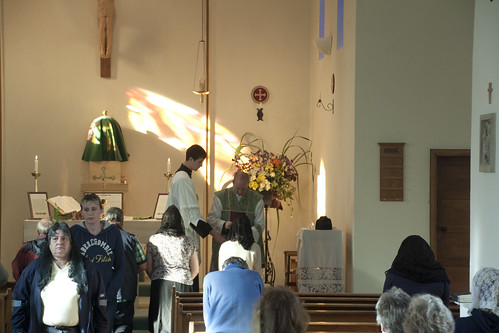
So a new priest arrives in a parish with, say, two or three Sunday Masses, which each seem to him seriously deficient from the point of view of sacrality. There are entrenched groups of liturgical planners, people composing bidding prayers, folk musicians, Extraorinary Ministers of Holy Commuion, lay readers, altar girls, and leaders of children's liturgies, in each of these Masses, and they all know the Bishop's postal address, and probably his phone number too. So what does he do? The RotR crowd would suggest: introduce a bit of Latin, a bit of chant, use the Roman Canon, encourage communion on the tongue, get rid of the guitars, cut down and then eliminate the EMHCs, and then more, and more, and more, along the same lines.
2011 07 10_0512

Following this advice with vigour will lead to one or both of two things for the priest: a nervous breakdown or a transferral to Outer Mongolia by the bishop. Following this advice with sensitivity and astuteness, low cunning and the weapons of spiritual warfare, will perhaps lead to the priest making gradual progress and suffering a bloodless martyrdom in the process. But there is an alternative: introduce the Traditional Mass into a currently vacant spot.

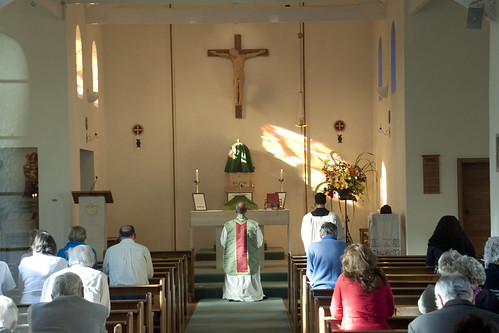
Suddenly, you are building on a greenfield site. There are no entrenched special interests. If anyone asks why you are using Latin or Chant or the Roman Canon or only male servers you say 'I'm afraid I have to - it is part of this Form of the Mass.' People who don't like it won't go. But as time goes on it will gather a congregation and gradually the priest has allies in the parish, people who will do things for him and defend him from attack. And they, and the Traditional Mass itself, will have a gradually transformative effect on the whole parish.
2011 07 10_0521

People will still complain, because some people just hate the Traditional Mass. But to complain to the bishop 'Fr X has introduced an EF Mass to which I never go' is so obviously absurd, and what the priest has done is in such obvious accordance with Summorum Pontificum, that the priest is in a vastly stronger position than in the RotR scenario.

Of course there are complications. In some parishes it is impossible to introduce an entirely new Mass, though the general principle remains: by leaving most of the Masses more or less intact, having one EF Mass will attract less, and less reasonable, criticism. Again, there may be things happening in those OF Masses which simply must be stopped without delay: serious liturgical abuses. But in dealing with these the priest is in a much stronger position than when trying to get the folk group to learn Gregorian Chant. After all, whether we like it or not, Chant is not obligatory in the Ordinary Form.
2011 07 10_0485

The point here is not that this strategy creates a perfect situation overnight. But given that we all understand that it will take a lot of time to get the liturgy in the parish where we want it to be, what kind of policy will work best? To make a frontal attack on the vested interests in their entrenched positions, or to outflank them: doing something it is harder for them to oppose, but will have just as much, and probably far more, effect on the overall liturgical atmosphere of the parish as time goes on.

The general point is this: jumping straight into the Traditional Mass is actually a way to resacrilise the liturgy in a parish in a more serene manner than attempting to steer existing OF Masses in the Reform of the Reform direction. You are less likely to have people complaining to the bishop. You are less likely to have people lapsing or going to other parishes. It is not a choice between 'shock and awe' and the Western Front: there is an alternative, and unsurprisingly the priests saying the EF in England and Wales today have all done exactly what I have described.

It remains to those many priests, not yet committed to the Extraordinary Form, who are concerned about sacrality, to realise that the best way to address the problem is not by arguing with the liturgy committee, the folk group, and Uncle Tom Cobley about having the Sanctus in Latin this week, but by learning the Traditional Mass, and introducing it into parish life as something in addition to, not instead of, the Ordinary Form. This won't solve all your problems overnight, but it will set things moving in a positive direction.

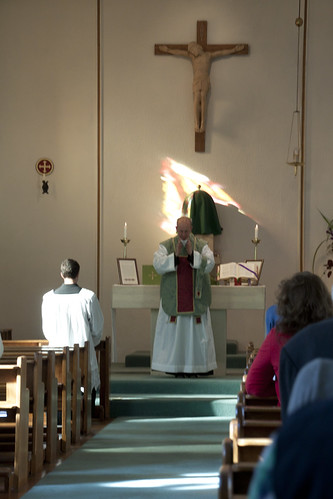
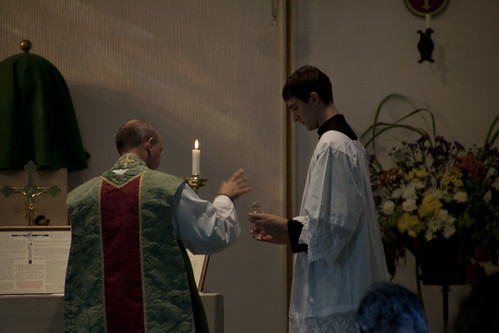
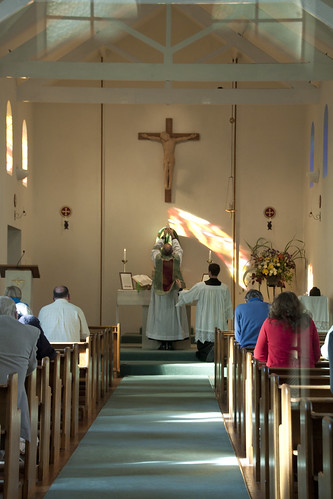
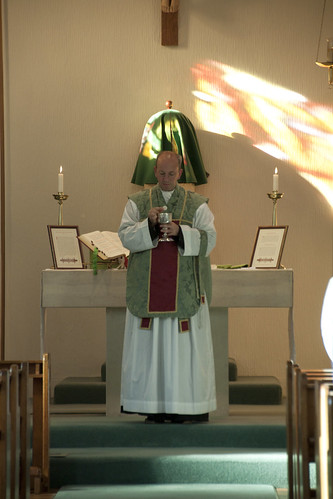
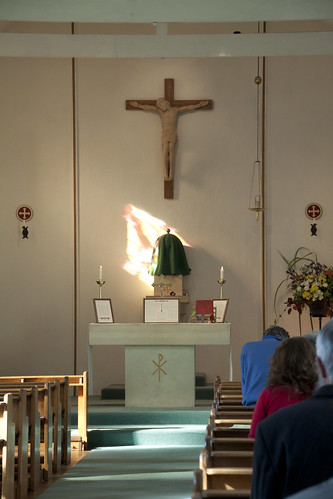
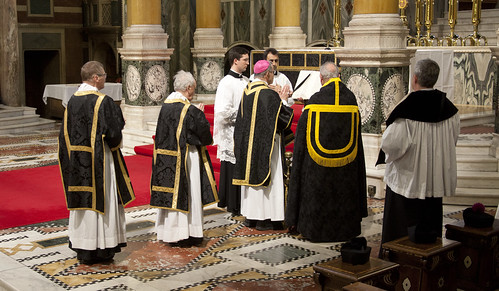
Photos (apart from the military ones!): Low Mass on a Sunday evening in St George's Warminster, said by Fr Bede Rowe, the LMS Regional Chaplain for the Southwest. Fr Rowe introduced this Mass in addition to his other masses soon after arriving in the parish. See my post here.
Tuesday, June 28, 2011

Gloria TV on The Tablet and altar girls

Just watch this, it will brighten your day (unless you are the person deputed by The Tablet to watch my blog).

Especially from just over half-way through.

She really enjoys saying that last paragraph of Annie Mackie-Savage's letter.

Friday, June 24, 2011

Is The Tablet misogynistic?

Below is a letter published today in The Tablet, in response to their leading article (and other articles) on the use of Altar Girls at the Traditional Mass, from Annie Mackie-Savage, the Latin Mass Society Representative for the diocese of Arundel and Brighton. The bit in red is the bit they refused to print.


As a woman who acts as a local representative in Arundel and Brighton of the Latin Mass Society, I find your claim (Leader, 18 June) that not allowing female altar servers at the Extraordinary Form insults me is quite absurd.

I challenge you to provide your readers with evidence for this bizarre claim that the tradition of male altar service has anything to do with “ritual uncleanliness” (sic). On the contrary, this tradition is quite obviously a reflection of the fact that only men can be ordained as priests, and it is because male service at the altar emphasises the different roles of the sexes in relation to the sacrifice of the Mass that it has special value. The Extraordinary Form of the Mass represents the preservation for future generations of this and many other venerable traditions, and it is for this reason described by Pope Benedict as a “treasure” for the whole Church.

Before you reject these traditions as ‘insulting’ you should reflect on the fact that they formed the basis of the liturgical life of women, as well as men, for countless centuries. Is it not more insulting to women to picture us as helpless and passive oppressed victims of a misogynistic Church for nineteen centuries? Give us a little more credit than that.

Annie Mackie-Savage
Eastbourne, East Sussex

Monday, June 20, 2011

Repentant Fogeys

The strange attitude of Dr John Casey to the use of altar girls at the Traditional Mass (displayed in The Tablet) set me wondering, as they say, about where he is 'coming from'. Dr Casey himself tells us that he lost the faith in his youth and returned to it only thanks to Summorum Pontificum. He clearly has a very strong emotional link with the Traditional Mass, but is quick to condemn others who have a love for it, calling the opponents of Altar Girls (who are backed, remember, by the Holy See) as 'dissidents', 'rubricists', 'ideologues' and 'misogynists'. Isn't this a bit over the top?

Something very similar is on display with the Stuart Reid, a regular columnist for the Catholic Herald, who has covered the issue more than once. Regular readers of his column have often been told of his love of the Traditional liturgy, but he has enormous suspicion of others who love it. He tells us of those who disagree about altar girls that they 'look for the total capitulation of the Novus Ordo', that they should 'abandon the Church and join the SSPX', that they are 'not on [Pope] Benedict's team' (Catholic Herald, 27th May). Again, this all seems a bit over the top.

Here's a third example: Dr Raymond Edwards, author of a CTS pamphlet entitled 'Catholic Traditionalism'. Dr Edwards tells us that he used to go to the Traditional Mass a lot, and now goes occasionally. He clearly likes it. But he really dislikes Traditionalists: he cannot bring himself to mention any group of them without a snarl. Ignoring completely the quiet work the Latin Mass Society in campaigning for the Traditional Mass within the structures of the Church, he pours scorn on Archbishop Lefebvre, the SSPX, the Sons of the Holy Redeemer, and the Institute of the Good Shepherd in France. Cardinal Castrillon's claim that the SSPX are not, properly speaking, in schism clearly spoils Dr Edwards' fun, so the Cardinal's opinion is dismissed with disdain. Dr Edwards is, however, equally if not more embittered about what Archbishop Bugnini did to the liturgy, and compares the actions of the Bishops of England and Wales in the 1970s to the Chinese Cultural Revolution. Steady on, old chap!

What do these three men have in common? Well, what were they doing a couple of decades ago, in the 1980s and thereabouts? Dr Casey was at that time the toast of the right-wing Monday Club tendency among Cambridge undergraduates. Stuart Reid was campaigning openly for Archbishop Lefebvre. Dr Edwards, a younger man, was (I hear from multiple sources) the most reactionary young fogey in Oxford, in the days when standards were high.

Today, all of them repent of these excesses. But when they look at Catholics attached to the Traditional Mass, is it too speculative to imagine that their perception is tinged by their memory of own younger selves? Having emerged from various forms of emotionally charged extremism, they find it difficult to imagine people who are taking the Church's liturgical traditions seriously doing so without mixing it up with fevered nonsense about wider issues in the Church or in politics, and with an eye to their own inadequacies.

The fact is that the Traditional movement in England was never captured by fogeys in pith helmets. It has always been dominated by a quite different demographic, notably large families. This is even more true today than it was in former decades. Messrs Casey, Reid and Edwards find it difficult to grasp this.

The tragedy is that they think they are uniquely qualified to judge traditionalists. 'Been there, done that!' they say - 'I know this lot: they are a bunch of nutters.' In reality, they are uniquely ill-qualified to judge them. If they had any sense they would deal with their inner demons in private, and keep their embittered view about their fellow Catholics to themselves.

Saturday, June 18, 2011

What's eating The Tablet?

My weekly penance - usually performed on a Friday, though since I was busy yesterday it is appropriate enough to do it today, an Ember Saturday - of looking through The Tablet has revealed a remarkable outpouring of hatred towards the traditions of the Church, the authority of the Holy See, and Catholics attached to the Traditional Mass, roughly in that order. The subject which has aroused this tsunami of poorly written vitriol - a feature article by John Casey, a leading article, three letters - is the subject of the reiteration by the competant authorities that females may not be used as servers at Mass in the Extraordinary Form.

The leading article solemnly assures us that this ruling reveals a 'hidden agenda' by 'troublemakers' which amounts to 'misogyny, or worse'. (Is anything worse than misogyny, I wonder?) It might amuse the Holy Father and Mgr Pozzo, who authorised the clarificatory document Universa Ecclesia and wrote a letter making the issue clearer still, respectively, to be described as 'troublemakers'; anyway I thought that making trouble was The Tablet's job. Not for them the stodgy certainties of worn out intellectual fashion: isn't that the idea? Now, it seems, it is Traditionalists who are 'comforting the afflicted, and afflicting the comfortable', as one favourite glib liberal phrase has it.

The main complaint is that there are 'no theological arguments' against women serving at Mass, and that this has been affirmed by the 1994 ruling allowing them. A supplementary line is the claim that the reason the Church forbade them for 19 centuries is that they were regarded as 'ritually impure', a claim which is 'insulting' to all women. I challenge The Tablet and its supporters to provide a shred of evidence that notions of ritual impurity were used as a justification for not having altar girls before 1994.

As a service to perplexed liberals I have already set out arguments against female altar servers, on this blog. John Casey refers to this blog as the place where the letter from the PCED has been posted. At the bottom of that very post I link to three earlier posts giving arguments against altar girls, links he must have resisted clicking on in order to claim that there were no arguments.

That looks like intellectual dishonesty to me.

By all means disagree with the arguments - let's have a debate about it. But The Tablet's consistent line is that there are no arguments, and this can only be maintained by a bizarre liberal 'custody of the eyes': never read your opponents, never read the magisterial documents, pretend they don't exist. It is exactly the same argument which they use on contraception: there are no arguments against the Pill. It doesn't matter how many books are written by orthodox theologians on the subject, the liberals will always claim that there are no arguments, because they refuse to read them.

We will never know what Dr Casey or Catherine Pepinster or the various writers of enraged letters to their letters page think about the disastrous effect of female servers on vocations to the priesthood, or about the different roles of the sexes in the economy of salvation, because even to acknowledge these arguments would be too much courtesy to their opponents. And naturally, refusing to address them spares them the embarrassment of admitting that they cannot answer them.

The previous edition of The Tablet contained a thinly veiled call for female priests - isn't that a coincidence? A long article by Elena Curti quoted several proponents of women's ordination, and not a single opponent, in order to conclude that there are really no arguments against the ordination of women. This is The Tablet's 'hidden agenda': or not so hidden. Those who think they can uphold female altar service as anything other than an exception to the norm - which is what it is under Church law today - without supporting the ordination of women as priests are going to find they have no place to stand.(Photo from the Bad Vestment blog).

Sunday, June 05, 2011

Altar Girls: the PCED speaks

Monsignor Guido Pozzo, Secretary of the Pontifical Commission Ecclesia Dei, has written a letter confirming that the permission for females to serve at Mass, granted by the Congregation for Divine Worship in 1994, does not apply to the Mass when celebrated in the Extraordinary Form.

No altar girls at the Traditional Mass. It was clear before. It is clear now. It is also clear that the PCED is willing to move extremely swiftly to clarify these matters.

Here is the letter.
PCED

I've written about why altar girls are not appropriate at the Traditional Mass on this blog: introduction, the problem they present for vocations, and the underlying theological issue.

Tuesday, May 31, 2011

Altar Girls, 3: Tradition and Female Ordination

As I have noted, when the Congregation for Divine Worship allowed females to serve the altar, it cited two important problems with it: it is bad for vocations, and it is contrary to the Church's Tradition. To put it another way, having altar girls is bad for sociological reasons, and bad for theological reasons. I've dealt with the sociological issue, the way girls serving the altar undermines vocations to the priesthood, in the last post. The more fundamental issue, which is not totally separate, is what is wrong with it theologically: why the Tradition of the Church is against it. It has never - not even today - been officially recommended or encouraged; up until 1992 it was forbidden. Are there good theological reasons for this?
2006 01 27_8311
Servers processing out with the celebrant, Fr John Saward, at SS Gregory & Augustine in Oxford, past the liturgical schola.

The theological problem with girl servers is related to the impossibility of female ordination. In a nutshell, if women can't be ordained, it is innappropriate for them to assist at the altar in the quasi-clerical role of servers. If there are good reasons, as opposed to mere historical contingency, why women can't be ordained, then it would be natural for these reasons to count against female service at the altar.Link
It is always pointed out in the discussion of female ordination that Christ chose only men to be apostles and, therefore, as priests. Bl Pope John Paul II makes the point with great emphasis that this was a 'sovereign decision', not the result of social convention. To suggest that in a decision like this Our Lord was the slave of social convention is historically absurd (look at his other actions and words), and if true would undermine the whole gospel: if we can reject this decision on these grounds, then what would be left? Nevertheless, it is natural to ask why Our Lord made this decision, and John Paul answers by giving us a theological disourse on the nature and role of the feminine in the economy of salvation. He does this is Mulieris Dignitatem (On the Dignity of Women, 1988), and refers back to this in Ordinatio Sacerdotalis (1994) when he makes explicit the constant (and for that reason infallible) teaching of the Church that the Church does not have the power to ordain women. In short, it is because men and women have different characters and different roles in salvation history and the Church, as ordained by God, that God has established the reality that Holy Orders cannot be given to women.

At the bottom of it there is a connection between Christ's role as Priest and Victim and his masculinity. It would in fact be odd if there were not, since the priestly role, and the sacrifice of self for the community, is conformable with with the male role in human society, which I discussed in the last post. The priest as alter Christus must be a man because he is taking on this role himself. The clergy round the altar, and the altar servers, are also participating in this role, and it for that reason fitting that they be men also.
IMG_2294
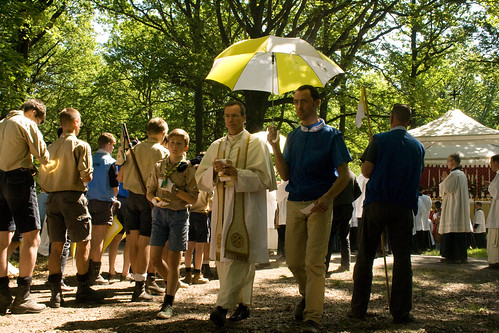
Boy scouts queing up to assist with the distribution of communion at the Chatres Pilgrimage 2010.

It really does not take a long chain of reasoning to see the application of the teaching about the all-male priesthood to girl servers. It is not possible to ordain women because it is not appropriate to their nature: saying Mass it is not part of their role in the Church. If it is totally impossible for women to say Mass, it is not appropriate for women and girls to assist the priest in the role of server. The server plays the part of a cleric: the laity serve when a cleric is not available. It is a quasi-clerical role, and it is not right that women play a clerical role.

Theology is not mathematics: theological argument does not advance by deductive syllogisms. What we have here is a case of something being, as the Scholastics constantly said, 'inconveniens': inconvient, inappropriate, unfitting. It is simply unfitting for girls to serve, because it runs contrary to the female role. In the same way it would have been unfitting for Our Lord to have been born of a woman not a virgin, for Our Lady's body to have been left in the tomb, and so on. To say that it runs against the symbolic and indeed ontological grain of the economy of salvation and the roles assigned to the sexes by the Creator is enough. It should not be done.
2010 08 08_6844
Servers about to process out at Mass at the St Catherine's Trust Summer School 2010.
But don't take my word for it; listen to this brilliant talk by Fr Brian Harrison (MP3), which he gave in the wake of the decision to allow female servers in 1992. His practical points at the end have been overtaken by events, but his theological analysis is acute. As he points out, it is perfectly clear that there is a connection between the desire to have altar girls and the desire to have women priests, nor are the most serious proponents of altar girls blind to this connection. If girls can have the quasi-clerical role of altar servers, this serves to undermine the teaching of the Church that women cannot be ordained.

Bl John Paul II's teaching on the different roles of men and women in the economy of salvation is equally true when Mass is said according to the Ordinary Form or the Extraordinary Form. The significance of this issue for the EF specifically is that the EF is the 'Traditional Mass': the Mass said, as Summorum Pontificum describes it, according to the Church's 'former liturgical traditions'. This is the Mass in which we adhere to the traditions which were current for the whole Church until a very short time ago. These are good traditions, and it is good for the Church that they be preserved. If they are lost in some contexts, it is especially good that they be preserved in others. The very document allowing girls to serve described male altar service as a 'noble tradition', and it is precisely for the preservation of traditions such as these that the 1962 Missal has been presevered - and preserved in its integrity.

Monday, May 30, 2011

Altar Girls Part 2: vocations

As I noted, Church documents allowing altar girls do so with evident reluctance, citing two reasons: the 'noble tradition' of the Church on the subject and the importance of male altar service for priestly vocations. Here I deal with the latter issue first, as being the less fundamental. It is nevertheless clearly a matter of considerable concern to successive Prefects of the Congregation for Divine Worship, even when the substantive issue, of the permission for altar girls, has already been conceded. Why are they so worried?
2010 05 15_6003
LMS Server training in Blackfriars, Oxford.
Serving at the altar is an extraordinarily intimate participation in the Holy Sacrifice. If you haven't done it as a child or an adult, you'll have to trust me on this. I served (the Novus Ordo) intermittently as a child, and I've learnt to serve the EF as an adult. In a certain way it makes you a fellow-worker with the priest. You can see and hear more of what is going on, the mechanics of the ceremonies, if you like, and this serves also to emphasis still more the things you still can't see or hear. You get to handle more of the sacred things used on the altar, and this serves to emphasise still more the sacred things you still must not touch. Unless you are completely dead to any sense of the sacred, it is borne in on you how privileged your position is: the position of being a servant of the ceremonies and of the priest. This serves to emphasise still more the privilege of the priesthood: not the privilege of freedom, of any kind of tyranny or creativity, but the privilege of servitude, of serving in the most intimate ways the greatest Lord of them all. In short, service at the altar makes one understand and appreciate the priestly vocation.
2011 04 10_8840
Altar servers at the St Catherine's Trust Family Retreat.

This is so in the context of the Traditional Mass, vastly more than it is with the Novus Ordo. In the EF the server has much more to do, and more to say, and his role is much more important, and much more sharply distinguished from that of the congregation. Nevertheless, it is true in the Novus Ordo as well. It is fitting, natural and inevitable that the service of the altar is a seed-bed of priestly vocations.

Those in favour of altar girls may accept this point and say that we can have altar servers of both sexes. Well, at best this cuts the number of boys serving, but in reality the results are more drastic than that. When girls start serving, boys become reluctant to do it. You can see this in many, many parishes around the world, where if care is not taken altar service can become an exclusively female occupation.

This is for reasons of male psychology. A great deal has been written about this, so I will direct the reader to other sources and give a very brief summary of what seems to make sense to me. The fundamental issue is that masculinity is made, or achieved, not born. The distinct role of women in society is obviously founded on their reproductive role. Their role in having children is essential, it is long-term, and it is dangerous. For those three reasons they deserve (and need) support and respect. The male role in reproduction is quite different: it is momentary and safe. If men are to be tied in to a useful role in society which entitles them to respect - if they are not simply to muck about - there has got to be something else. They have to be persuaded to take on a male role which, where social and instinctive promptings are working in harmony in a structured way, can commit them to relationships and get them to take on their share of dangerous tasks (for which, after all, they are physically well suited). It is the voluntary taking on of dangerous things which is most obviously masculine trait, and something we see little boys doing to prove their masculinity, to be accepted by their peer group as masculine.
2011 04 09_8890
This is the basis of practically every play-ground gibe directed at boys you have ever heard. Boys have an in-bred horror of the sissy, the cowardly, and the feminine (as something associated with themselves, that is). They are obliged by enormously powerful instincts and peer pressure to shun these things to establish their masculine credentials. This is perfectly normal and healthy, and while feminists may not like it, it is something we have to live with. It follows that boys are particularly unwilling to do things which make them look foolish or effeminate.

Religion can easily be characterised as sissy. If we are not to lose men completely from our congregations, and from the hope of salvation, it is imperative that this perception be combated. Real religion is not sissy, in fact: it is serious, difficult, and dangerous. It is fit for real men to be involved in, and something boys can be proud of associating with. The boy scouts who do the Chartres Pilgrimage can be proud of what they do because of the physical difficulty. The boys who serve Mass can be proud of that too, because be joining the serving team they are joining an exclusively male group, where they are taught an important, difficult and male role by men. At least, that is true where serving is done by males.

This perception of serving is rapidly destroyed by female involvement. Boys of a normal psychological make-up immediately start to feel uneasy about it, and we see a spiral of feminisation. Now this is not a theological issue: it arises out of the contingencies of psychology and social convention. This kind of argument invites the response: 'It should not be so!' Well, too bad, it is so. We have to live in the real world; we have to reach people where they are.

Here is Michael Voris on the subject of masculinity and Catholicism, and female altar servers. This makes the general point I've been making, and extends it is certain ways.


At much greater length, and more profoundly, I recommend a talk given by Dr Leon Podles, author of 'The Church Impotent' on the problem of the feminisation of the Church and the effect this has on male involvement. You can download the MP3 here. Among other things, he points out that the more liberal a Christian church is, the fewer men in the congregation; the Traditional Mass, by contrast, attracts a healthy 50% men. Podles makes an obvious point: men will sometimes die rather than appear unmasculine: indeed, it happens all the time. Do you really think you can make the Church touchy-feely and feminine and still attract them?

Podles' book can be viewed online here; this treats the issue historically and theologically; I'm not sure I agree with all of it by any means, but it certainly gives the issue a much wider context.

Feminists will hate this argument because they hate gender-specific social roles. This is related to a bigger issue, however: the theological issue, and the small matter of admitting women to priestly ordination. I'll deal with that next.

Saturday, May 28, 2011

Altar Girls: why not

The recent Instruction 'Universae Ecclesiae' on the interpretation of the Motu Proprio 'Summorum Pontificum' has made it clear that various liturgical permissions which were introduced for the transitional missals and the Novus Ordo since 1962 do not apply to the celebration of the usus antiquior, the Traditional Mass, where they conflict with the 1962 rubrics. There is a certain amount to be said about what this includes and excludes but it does include the rule in force in 1962 forbidding females serving at the Altar. If there are no men or boys to serve, a woman can make the responses and ring the bell from the communion rail: no women or girls should go into the Sanctuary of the church during the Holy Sacrifice of the Mass, when celebrated according to the 1962 Missal. The legal position is one thing: another is the point of this rule.

As is well known, female alter servers were permitted in 1992, after a long campaign of disobedience towards the Church's norms. It was permitted with considerable reluctance, and clearly the motivation was to avoid the scandal of open warfare on the subject: Pope John Paul II was far from convinced that it was actually a good idea. A 1994 ruling from the Congregation for Divine Worship hedges the matter about with caveats and reservations, which are still in force. Having conceded the possibility of altar girls, it goes on:

2) The Holy See respects the decision adopted by certain Bishops for specific local reasons on the basis of the provisions of Canon 230 #2. At the same time, however, the Holy See wishes to recall that it will always be very appropriate to follow the noble tradition of having boys serve at the altar. As is well known, this has led to a reassuring development of priestly vocations. Thus the obligation to support such groups of altar boys will always continue.

3) If in some diocese, on the basis of Canon 230 #2, the Bishop permits that, for particular reasons, women may also serve at the altar, this decision must be clearly explained to the faithful, in the light of the above-mentioned norm. It shall also be made clear that the norm is already being widely applied, by the fact that women frequently serve as lectors in the Liturgy and can also be called upon to distribute Holy Communion as Extraordinary Ministers of the Eucharist and to carry out other functions, according to the provisions of the same Canon 230 #3.

4) It must also be clearly understood that the liturgical services mentioned above are carried out by lay people ex temporanea deputatione, according to the judgment of the Bishop, without lay people, be they men or women, having any right to exercise them.

The rule against altar girls is not some forgotten rubric of the Middle Ages: it was embedded in the General Instruction of the Roman Missal when the new Missal was published in 1970, and in the new Code of Canon Law of 1983 (though certain ambiguities arising from the notion of lay people substituting for instituted acolytes led eventually to the 1992 ruling). The restrictive nature of the 1994 document was reiterated by the Congregation for Divine Worship in 2001. Indeed, as well as reiterating that it was the bishop's right alone to determine whether to permit altar girls, regardless of what neighbouring bishops had decided, the importance of male altar service for the promotion of vocations, and the fact that no right to serve is established, it emphasised that priests could never be forced to use them:

In accord with the above cited instructions of the Holy See such an authorization may not, in any way, exclude men or, in particular, boys from service at the altar, nor require that priests of the diocese would make use of female altar servers, since "it will always be very appropriate to follow the noble tradition of having boys serve at the altar".

In other words, if any bishop, or any priest, determined not to use altar girls, this would be in conformity not only with the tradition of the Church but would have the support of the Church's highest authorities, who regard such a decision as a priori 'very appropriate'.

These are legislative texts of course and not theological ones so the reasons counting against altar girls are referred to in a summary way: namely, the 'noble tradition' of the Church, and the promotion of vocations. Both are correct and of great importance, but one may still ask: why does the Church have this tradition, and why is this important for vocations? I intend to address this is two separate posts.

Monday, May 09, 2011

Altar girls at the Traditional Mass - again

There's a flurry on the blogosphere about female alter servers being used at the Traditional Mass. It is surprising that this should happen now. Until Cardinal Burke's statement on the matter - of which more below - the legal situation may have appeared unclear, but even if a priest has the right to do a thing it does not mean that it is right for him to do it. The pastoral consequences would obviously be negative - it would be upsetting to to a great many people in the congregation, it would cause division and bitterness - and the concession of female altar servers was only made to allow bishops to permit the deviation from the 'noble tradition' of male service of the altar for 'particular reasons': presumably, cases of pastoral urgency (I quote from the 1992 ruling of the Congregation of Divine Worship which issued the permission for female altar servers in the context of the 1970 Missal).

How can there be a special pastoral reason for doing something which is pastorally damaging?

The situation has been clarified, however, and we now know that female altar servers are NOT PERMITTED at the Traditional Mass. Changes made for the 1970 Missal don't automatically apply to the 1962 Missal, and in this case the concession has not created a right belonging to anyone: no one can demand to serve at Mass. Cardinal Burke, Prefect of the Apostolic Signatura, has written

"As such, out of respect for the integrity of the liturgical discipline within the Roman Missal of 1962, these more modern modifications are not observed in the extraordinary form."

Without wishing to speculate about any priest's motivation, there is a danger in this case, as in other cases, of the Holy Sacrifice of the Mass being made to serve an ideological or political purpose at odds with the traditions and teaching of the Church: to further the ideology of feminism, for example.

The law of the Church and the authority of bishops, and of the Holy Father himself, is designed to preserve and foster the traditions of the Church, not to undermine and destroy them. As the Pope Benedict has said

"It is not the Pope's role to put forward his own ideas, but merely to re-present and serve the Tradition of the Church." (See Fr Ray Blake)