Sunday, November 25, 2012

The Fruits of Pre-Conciliar Catechesis

Daphne McLeod, the Chairman of Pro Ecclesia et Pontifice, has been carrying on a lively correspondence in the Catholic Herald, defending her view that the problems of the Church since the Council have been overwhelmingly due to the failure of the 'new catechetics' which followed it. Specifically, in England all Religious Education teachers had to be retrained by an institution called 'Corpus Christi College' which was a hotbed of heresy, and was finally closed down by Cardinal Heenan. By then, Mrs McLeod tells us, its work had sadly already been done.

Tellingly, she explains that the English translation of the Council's document on education, Gravissimum Educationis, did not appear until 1971, when Corpus Christi College was already closed. The claim that 'the Council' had demanded a revolution in the content and method of religious education was revealed to be completely false, but too late.

'By their fruits you shall know them', Mrs McLeod says: because it has led to lapsation, the new catechetical method is shown to be problematic. However, she does not really address the point made by the previous letter, by a certain Martin Elsworth, that if catechesis was so wonderful before the Council, how was it that things collapsed so rapidly after the Council? Why, we might ask, did adults with this old catechesis fall for every absurd theological fad after the Council, or even give up the practice of the Faith? Why were Catholic RE teachers - of all people, surely the vanguard of the 'well-instructed laity' praised by Cardinal Spellman - so easy to brainwash with a lot of nonsense? Why did no-one think to ask any of the Latinists, so plentyful in the 1960s, what Gravissimum Educationis actually said? Why, in short, was the generation educated between the 1930s and the 1950s led to their destruction, like sheep to the slaughter, with so little resistance? A generalisation to which, of course, Daphne McLeod is such an honourable exception.

It is of course quite possible to check for oneself what pre-Conciliar Catholics were taught: many of the most influential texts have been reprinted, and they are indeed far superior in orthodoxy to much of the stuff written since then. I have before me a copy of the Baltimore Catechism Number 4: this is the teacher's manual, with the fullest treatment of each topic. What does it say about Infallibility? Naturally it tells us that it only extends to ex cathedra statements by the Pope on matters of faith and morals, and that on other matters, or in other statements, the Pope can err. But then it adds:

"Nevertheless, whatever the Pope teaches on any subject you can be pretty sure he is right."

Is there a distinction between matters of discipline and policy in which we should follow even wrong-headed commands for the sake of unity and to avoid scandal, and 'unjust commands' which it would be a sin to follow?

Is there a discussion of cases of the Popes treating the saints badly, and how they responded?

Is there a distinction between policies and prudential judgements, in which one Pope may contradict another, or indeed himself, and matters of Church teaching, in which we should adopt a hermeneutic of continuity: i.e., we should understand what Popes and Councils have said as harmonising if at all possible?

Is there a distinction between basic matters of faith, which as St Robert Bellarmine said should be just obvious to the Faithful, and about which they should never tolerate false teaching from anyone, and more complex matters on which the ordinary laity might best be encouraged to follow the teaching of Pope and Bishops even when they are unsure its orthodoxy?

Is there any discussion of the different levels of authority, or the credence due to past Councils and the Ordinary Magisterium, which should take priority over what is reported as being an off-the-cuff remark by the present Pope, since after all such reports are constantly subject to distortion, tendentious reporting, and misunderstanding?

No, no, no, no, and again no. The teaching of the Baltimore Catechism is one-sided and deficient, and it failed. I should be interested to know if any other catechetical handbooks of the era do better than Baltimore Catechism on this topic, but I don't get the impression that they did. What is more, the ultramontanism of the Baltimore Catechism is still the dominant ideology of many neo-conservatives, even as they reject so many other Catholic assumptions of the day, including the trenchant defence of the Temporal Power of the Papacy which can be found in the catechism's very next pages.

See also my blog post on Daphne McLeod's claim that Trads aren't interested in catechesis;
and a series of posts on the notion of obedience.

Friday, November 23, 2012

Oxford Pro-life Witness

Saturday, 24th November

3pm- 4pm

Please come and pray for all unborn babies, their families and those involved in the crime of abortion.

We meet at the Church of St Anthony of Padua, Headley Way, Oxford.

Witness is at the entrance of the JOHN RADCLIFFE Hospital , Headley Way.

Refreshments available afterwards in the Church hall.

Information, call, Amanda Lewin 01869 600838


Tuesday, November 20, 2012

Sons of the Holy Redeemer: two ordination to the Diaconate

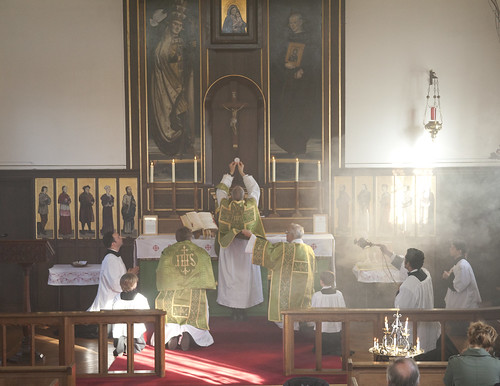
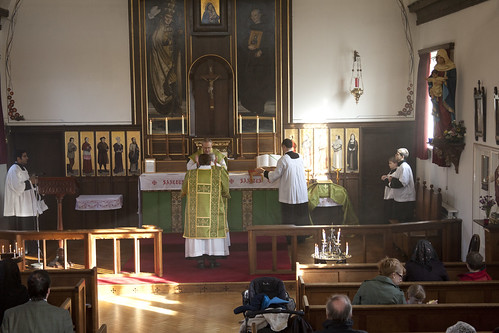
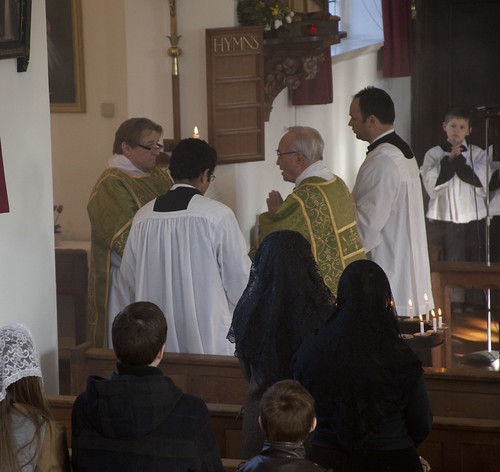
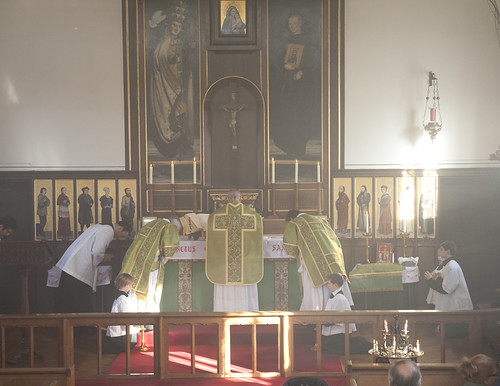
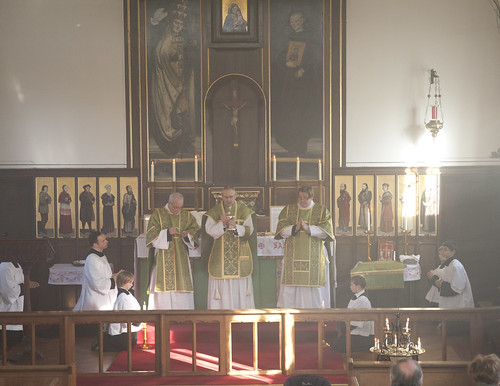
Here they are acting as deacon and subdeacon to Fr Michael Mary F.SS.R, their superior, in the church where they were ordained, the FSSP seminary chapel at Denton Nebraska.
The Sons of the Holy Redeemer who were reconciled to the Holy See and then had to wait an unconscionable period of time for the decree of canonical erection, are now an order of diocesan right in the Diocese of Aberdeen. Various ordinations are now taking place at an accelerated pace: see their blog. Keep in touch with them through the Friends of Papa Stronsay. Subscribe to their quarterly newspaper 'The Catholic'.

Te Deum laudamus!

Monday, November 19, 2012

Heaven in ordinary, man well drest

IMG_1673 IMG_1639
Although George Herbert was committed to the Protestant religion, of which he was an ordained minister, his poem on prayer is still superb, and it seems applicable to the ancient Catholic liturgy. Obviously 'exalted Manna' is a reference to the Eucharist, and it seems reasonable to think of 'heaven in ordinary, man well drest' as an echo of the 'Sunday best' clothes we (clergy and laity alike) put on to participate in that liturgy which is eternal, indeed everyday and 'ordinary', in heaven. IMG_1647
You can't go wrong with the 'metaphysical' poets, of course, because every phrase a dozen meanings. Herbert was one of my own set texts at A Level, and he's stayed with me ever since. IMG_1679
Prayer the Churches banquet, Angels age,
Gods breath in man returning to his birth,
The soul in paraphrase, heart in pilgramage,
The Christian plummet sounding heav'n and earth;

Engine against th'Almightie, sinners towre,
Reversed thunder, Christ-side-piercing spear,
The six-daies world-transposing in an houre,
A kinde of tune, which all things heare and fear;

Softnesse, and peace, and joy, and love, and blisse,
Exalted Manna, gladnesse of the best,
Heaven in ordinarie, man well drest,
The milkie way, the bird of Paradise,

Church-bels beyond the starres heard, the souls bloud,
The land of spices; something understood.
 IMG_1682
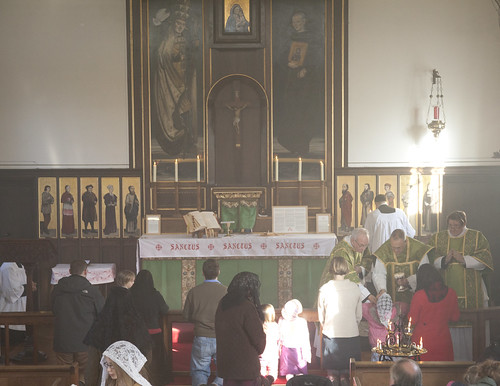
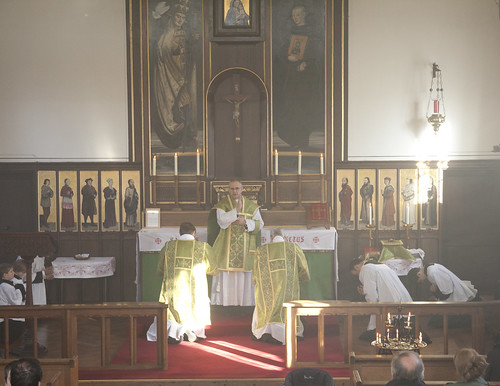
Just another Solemn Mass at SS Gregory and Augustine's, Oxford, just another green Sunday After Pentecost. Just a plain old Chant Mass sung by the Schola Abelis, with the Offertory verses, Communion verses, and Mass IV. De profundis clamavi ad te, Domine! Out of the depths I cried to Thee, O Lord! But he has heard the voice of His Church: the church bells are heard beyond the stars, in heaven itself.
 IMG_1693 IMG_1699

Sunday, November 18, 2012

LMS Annual Requiem

IMG_0865
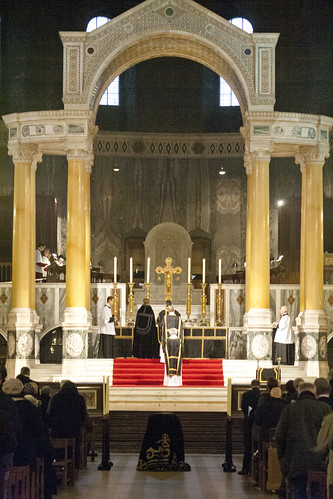
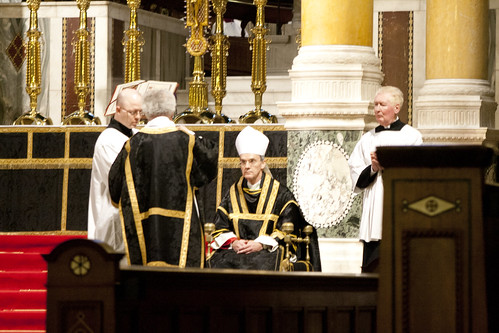
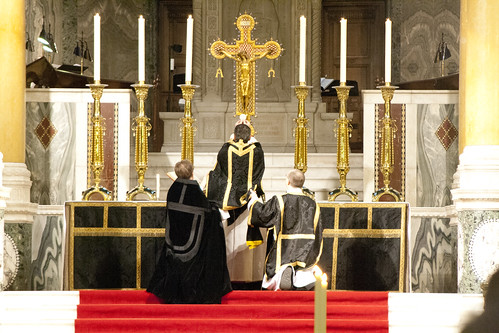
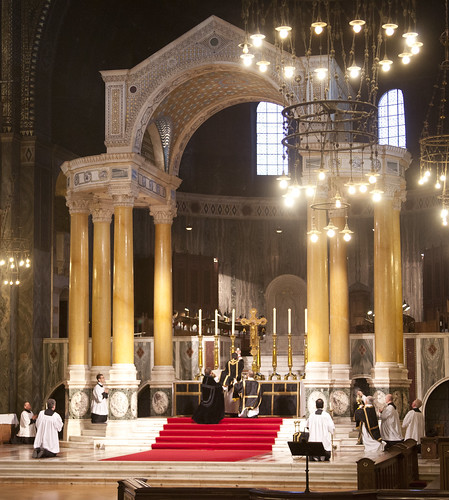
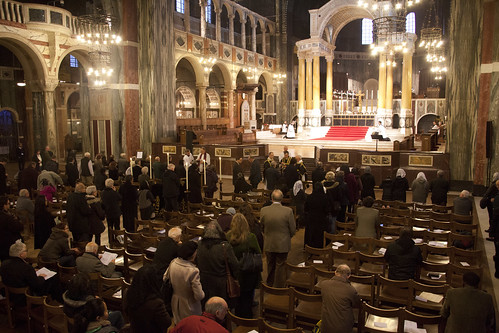
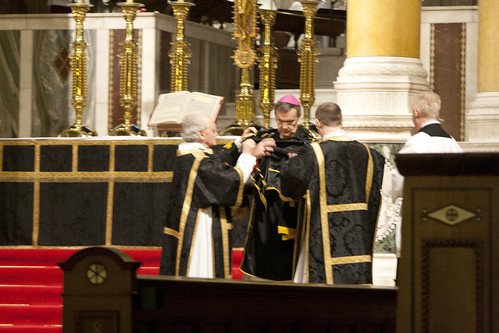
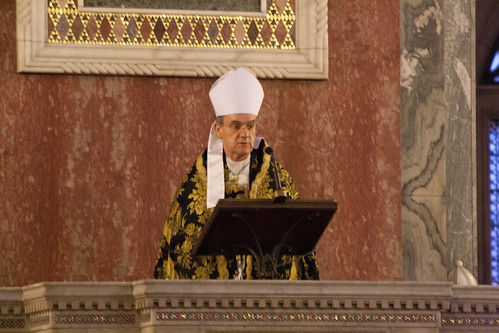
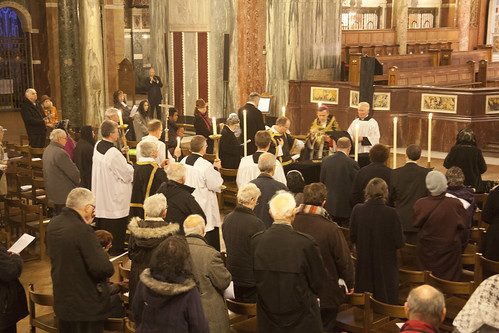
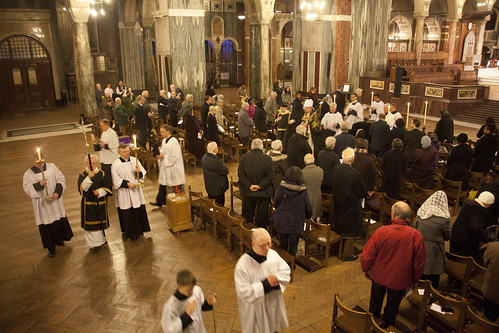
A splendid Mass - Pontificial High Mass with absolutions at the catafalque, celebrated by Bishop John Arnold and accompanied by the Westminster Cathedral Choir.
 IMG_0840 IMG_0872 IMG_1541
I have acquired the ability to take photographs from two places at once, No, seriously, I took both of the last two myself - not with the same camera, of course. One of them I operated by remote control. IMG_1559 IMG_0918
Bishop Arnold was (like all bishops celebrating Mass in the Old Rite) wearing a tunicle and a dalmatic under his chasuble, something which shows how the bishop's office incorporates the subdiaconate and the diaconate. He took these off in the sanctuary, and put on a cope, at the end of Mass, in order, first, to preach, and then to bless the catafalque. IMG_0928 IMG_1596
Sharp eyed readers will see that Fr Armand de Malleray was Assistant Priest, Fr Patrick Haward deacon, and Fr Matthew Goddard FSSP subdeacon. Fr Simon Leworthy can be seen helping to distribute communion. IMG_1615 More photos.

Friday, November 16, 2012

Mass at Milton Manor

IMG_0810
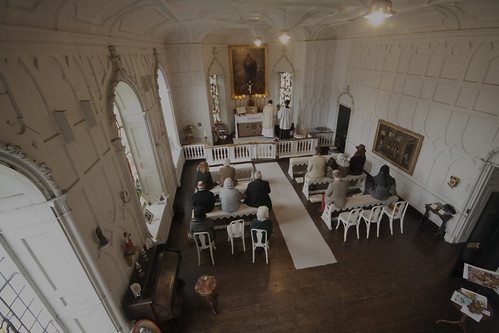
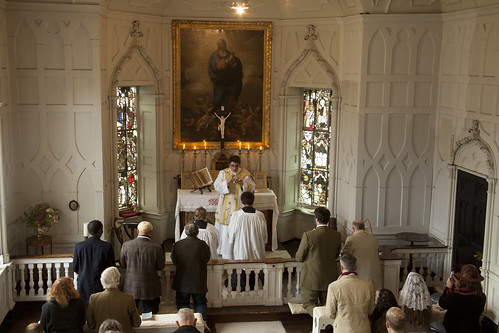
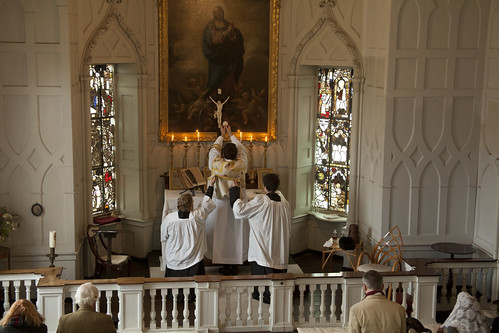
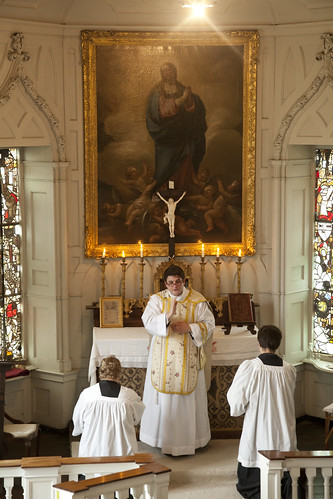
Last Saturday we had Mass in the beautiful private chapel of Milton Manor House, in Milton, between Didcot and Abingdon.
 IMG_1468
It was celebrated by Fr Daniel Lloyd of the Ordinariate, and accompanied by the Schola Abelis. IMG_1465 IMG_1477
Tomorrow is the LMS Annual Requiem in Westminster Cathedral, 2.30pm: see you there!

Thursday, November 15, 2012

Holy Days and Civil Rights

Today I'm publishing the latest Position Paper, number 13 in the series, this one is about Holy Days of Obligation. Go over there to read it.

Here I'm publishing separately Appendix C, to draw it more to people's attention, since I think it warrants it. Probably most people reading this will agree that for Holy Days to be moved to Sunday, as three of them were by the English and Welsh Bishops in 2006, was a mistake: they are important feasts, and celebrating them on their proper days is an essential part of taking them seriously. The situation since then, with most of the remaining ones moving to Sundays when they fall on Saturday or Monday, is that there are now so few Holy Days of Obligation on weekdays that the very concept of the Holy Day is in danger of being lost from the consciousness of the average Catholic.

But here is a quite different argument. If you are Catholic employee, if you are at school, or if you are enjoying Her Majesty's hospitality in one of her prisons, by moving the celebrations to Sunday, or removing the obligation to attend Mass, the bishops are making it much harder for you to make the case to your colleagues and superiors that you be allowed to attend Mass, a few times a year, during the week. The bishops may say: we mustn't be too hard on Catholics, they have busy lives, let's not require they go to Mass on too many days. By doing this they are not making life easier: they are making it harder for Catholics to get to church when they might want to.

I have run this argument past lawyers specialising in this field, and I am very grateful for their help. If there are any mistakes here, they are mine. But the basic idea - with variations for those wishing to appeal to the US First Amendment and those wishing to appeal to Article 9 of the European Convention on Human Rights - is sound.
IMG_8649
A celebration of the Feast of Epiphany on 6th January, SS Gregory & Augustine's, Oxford
Appendix C: Holy Days and Rights Legislation


The right of religious freedom enshrined in international law, treaties, and national constitutions, typically creates a non-absolute right of religious believers to follow the teachings of their religion, most obviously in relation to worship. Since for practical purposes this right has often to be balanced against the convenience of others, it is natural for courts and others to give greater weight to the religious observances which are most important to the believer, and to look to official religious bodies for guidance as which observances are really important. We will illustrate the point briefly with regard to two important jurisdictions: the United States of America, and England and Wales, subject as it is to the European Convention on Human Rights and the European Court of Human Rights.

In the Constitution of the United States of America, the First Amendment is as follows:
Congress shall make no law respecting an establishment of religion, or prohibiting the free exercise thereof; or abridging the freedom of speech, or of the press; or the right of the people peaceably to assemble, and to petition the Government for a redress of grievances.
Since 1947 this obligation has been extended to the States, as well as the Federal Government.[1] A relevant precedent was set in 1963, that a Seventh Day Adventist should not be deprived of unemployment benefit on account of refusing to work on Sundays.[2] Under a Federal statute,[3] the Federal Government must justify actions which ‘unduly burden acts of religion’ by a ‘compelling interest’, even if the action in question does not target religious practice.

In the European Convention on Human Rights, Article 9 reads as follows:
1. Everyone has the right to freedom of thought, conscience and religion; this right includes freedom to change his religion or belief and freedom, either alone or in community with others and in public or private, to manifest his religion or belief, in worship, teaching, practice and observance.
2. Freedom to manifest one’s religion or beliefs shall be subject only to such limitations as are prescribed by law and are necessary in a democratic society in the interests of  public safety, for the protection of public order, health or morals, or for the protection of the rights and freedoms of others.
This applies not only to government bodies but private persons, such as employers. In applying this article, courts distinguish obligatory and non-obligatory ‘manifestations’ of a religion.

Thus, the English Courts have ruled that Sikhs have the right to wear the ‘Kara’, a bracelet,[4] and female Muslims a Hijab,[5] at school. In the latter case the Courts ruled explicitly that the Hijab can be considered as a ‘requirement’ of the Muslim faith. By contrast, a Christian who wished to wear a cross with her uniform lost her case against her employer.[6] The Courts based their decision, in part, on the fact that ‘there is no mandatory requirement of the Christian Faith that a Christian should wear a Crucifix.’[7]  Again, in finding against a Marriage Registrar who refused to register same sex Civil Partnerships, the Court of Appeal based its decision in part on their finding that ‘her view of marriage, ...was not a core part of her religion.’[8] Though the factual basis of these findings can be questioned, the fact remains that Courts do take into account whether any particular practice of religion is a ‘requirement’ of the religion or is merely a personal religious practice.

For both the United States and England and Wales, and other jurisdictions with similar legal principles, it follows both from these legal considerations, and also from the more general culture which they foster, that attempts by the Church to make life easier for Catholics by minimising their obligations, or by making them more flexible, can have the paradoxical result that Catholics will find it harder to observe the practices in question. Furthermore, since the strongest obligations have the most chance of making a difference to the practices of large employers, schools, universities, and prisons, the less demanding the Church becomes, the less impact she can expect to have on public culture.  For bishops’ conferences to decide that a Holy Day of Obligation is no longer a day of obligation has secular legal implications for the Civil rights of Catholics, as well as arguably reducing the spiritual benefits of Holy Days, and their important role in stimulating and defending a distinctive and strong Catholic Culture. 


[1] The precedent was set by the case Everson v. Board of Education in 1947.
[2] Sherbert v. Verner, 1962
[3] The Religious Freedom Restoration Act, 1993
[4] The dispute between a Sikh schoolgirl, Sarika Singh, and Aberdare Girls’ School in South Wales: Watkins-Singh, R (on the application of) v Aberdare Girls’ High School & An or [2008] EWHC 1865(Admin) (29 July 2008)
[5] Begum v Denbigh High School  [2006] UKHL 15
[6]  Nadia Eweida, who was sacked by British Airways for wearing a cross on her uniform in 2006, lost her   Employment Tribunal and  subsequent Appeal case, where she alleged Religious Discrimination and breach of Human Rights: Eweida v British Airways Plc [2010] EWCA Civ 80 (12 February 2010).
[7] Chaplin v Devon & Exeter NHS Trust, ET Case No: 1702886/2009, and Eweida v British Airways [2010] EWCA Civ 80
[8] Ladele v London Borough of Islington [2009] EWCA Civ 1357