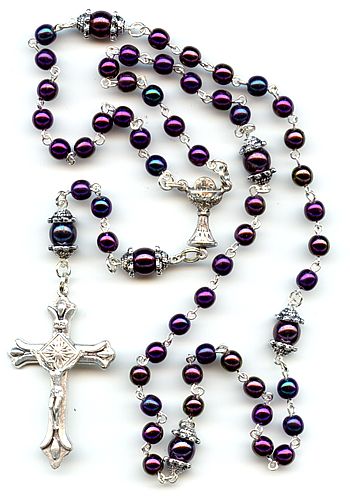
I share with you two concerns. One is the Pelagian current that there is in the Church at this moment. There are some restorationist groups. I know some, it fell upon me to receive them in Buenos Aires. And one feels as if one goes back 60 years! Before the Council... One feels in 1940... An anecdote, just to illustrate this, it is not to laugh at it, I took it with respect, but it concerns me; when I was elected, I received a letter from one of these groups, and they said: "Your Holiness, we offer you this spiritual treasure: 3,525 rosaries." Why don't they say, 'we pray for you, we ask...', but this thing of counting... And these groups return to practices and to disciplines that I lived through - not you, because you are not old - to disciplines, to things that in that moment took place, but not now, they do not exist today...
I can't help being reminded of an old joke. A man asked a Fransiscan and a Jesuit: 'How many novenas must I say to get a Mercedes?'
The Fransiscan replied: 'What's a Mercedes?'
The Jesuit replied: 'What's a novena?'
Boom boom!
The counting of prayers for a spiritual bouquet reminded Pope Francis of a strand in pre-Conciliar spirituality which could appear to emphasise quantity, the measuring and counting of good works. The old Manual of Indulgences encouraged this because you often got your indulgence from a certain number of prayers, or said on a certain number of days, and measured the indulgences themselves in terms of days or years (not, be it noted, off purgatory, but as equivalent to days of public penance). So if this is a problem it came from the top - it wasn't just a popular distortion.
 I'm not sure if it really was a problem, perhaps it was. It might look a little as though, in a Pelagain fashion, one could earn merit by piling up works without grace, though that is clearly not the official explanation of how it works. Pope Paul VI's new 'Enchiridion' of indulgences changed all that and now it is so vague what you need to do or what you get in return that it is rather difficult to use. So perhaps we've swapped one problem for another.
But I think that Pope Francis' example of this attitude is not so well chosen, because a spiritual bouquet is clearly not about earning credit with God for oneself, it is about imploring grace for another. The point of counting the rosaries is that it shows that it derives from a group of people engaged in a corporate effort. It is hard to see how that could be expressed otherwise.
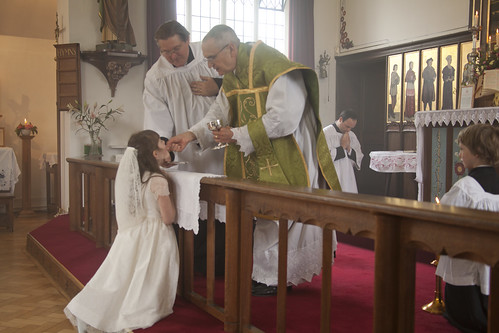
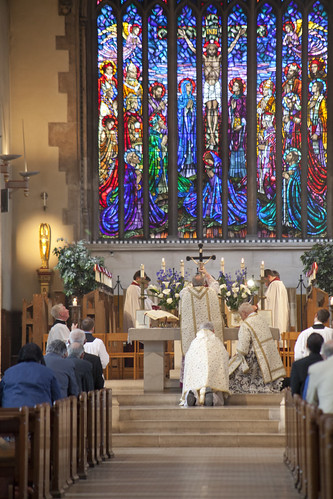
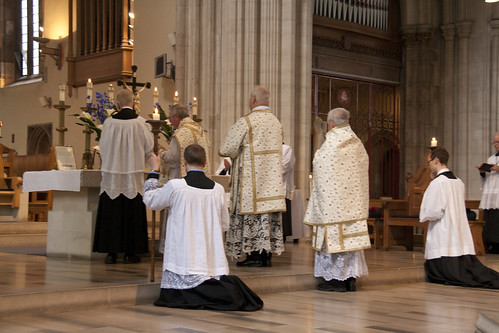
The real question, nevertheless, is whether there is a Pelagian element in the more traditional spirituality found among traddy groups, and here I think we can defend ourselves. Because the direction of traditional spirituality, by contrast with certain trends in the post-Concilar Church, is demonstrably anti-Pelagian.
One way this shows itself is in the prayers of the Mass. The Collects of the ancient Roman liturgy, and to a great extent the readings and other Propers and the Ordinary, are very concerned with grace, human sin and inadequacy; they are quite Augustinian. In preparing the new Missal, Bugnini and his collaborators wanted to remove the 'negative' theme of sin, and this meant that grace had to go as well. If you look at a survey of the changes to the Collects, such as Fr Cekada's 'The Problems with the Prayers of the New Mass', you can see that the term 'grace' has been almost eliminated from the Collects. The 'old ICEL' translated took this tendency even further.
Who's the Pelagian here?
The other way of illustrating this is through a famous criticism of the Vatican II document Gaudium et spes, that it falls into ‘downright Pelagian terminology' when discussing freedom. Here is the offending passage (17):
...authentic freedom is an exceptional sign of the divine image within man. For God has willed that man remain "under the control of his own decisions," so that he can seek his Creator spontaneously, and come freely to utter and blissful perfection through loyalty to Him. Hence man's dignity demands that he act according to a knowing and free choice that is personally motivated and prompted from within, not under blind internal impulse nor by mere external pressure. Man achieves such dignity when, emancipating himself from all captivity to passion, he pursues his goal in a spontaneous choice of what is good, and procures for himself through effective and skilful action, apt helps to that end. Since man's freedom has been damaged by sin, only by the aid of God's grace can he bring such a relationship with God into full flower. Before the judgement seat of God each man must render an account of his own life, whether he has done good or evil.
This isn't false, but one can see what the critics mean. It is unbalanced, and the bit at the end about our freedom being damaged by sin looks a little like an afterthought. The Augustinian and Thomist view - the classical view - places much greater emphasis on the damage done by Original Sin, and subsequently by vicious habits, which give us a tendency to sin. Again, with Original Sin makes it impossible for us to be pleasing to God: only grace can remove that. Again, all our good intentions are gifts of God's grace. And so on.
There is a danger here, of this Gaudium et spes passage allowing something unbalanced to develop, an attitude of human self-confidence which could be described, speaking loosely, as Pelagian. That is something which is very carefully guarded against in traditional Catholic spirituality - for all the rosary-counting which may be going on.
 |
| Surprise! |
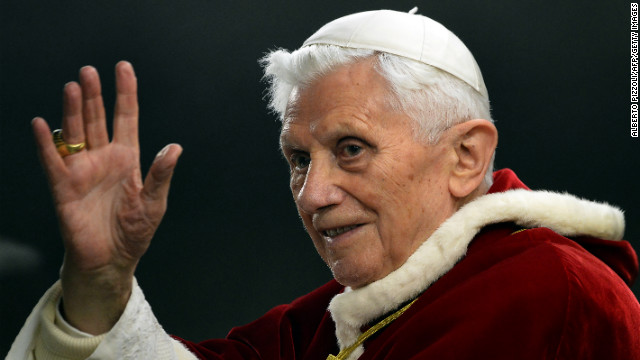
Who was the theologian who made that criticism of Gaudium et spes? Step forward Joseph Ratzinger, later elected Pope Benedict XVI.