Thursday, August 25, 2016

Successful walking pilgrimage in Scotland

St Andrews

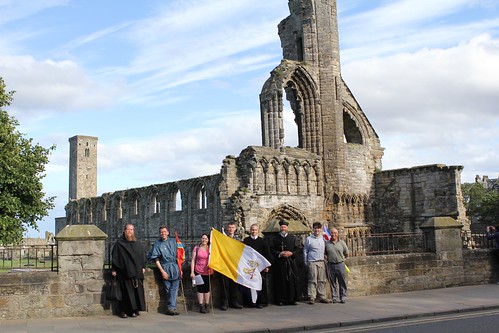
Press release from the organisers of the Scottish 'Two Shrines' Pilgrimage. More photos.


Scotland’s inaugural Two Shrines Pilgrimage took place this month from 6-8 August.  The walk, which began at the National Shrine of St Andrew in St Mary’s Cathedral, Edinburgh, and concluded at the site of the pre-Reformation shrine to Scotland’s patron in St Andrew’s Cathedral, St Andrews, was undertaken for the particular intention of the conversion of Scotland.  Inspired by the Chartres Pilgrimage, the event incorporated daily Mass in the Extraordinary Form, accompanied by traditional devotions. 

Wednesday, August 24, 2016

Why they hate us


This has already done the rounds in the media, but I'd not seen one particular aspect pointed up. The slick propaganda magazine of the Islamic State (ISIS), Dabiq, has a chilling article entitled 'Why we hate you and why we fight you'. You can see this hideous publication here; the article starts on p30. They hate us, they say, for three reasons: for our Christianity, for our liberal secularism, and for Western foreign policy. They emphasise the point that the last issue is not the primary one.

To illustrate the West's secular liberalism they display a photograph of a pro-gay marriage demonstration. To illustrate the West's wrong-headed religious tradition they have a photo of... the Traditional Catholic Mass. The Altar Cards allow no room for doubt.

Tuesday, August 23, 2016

Video interview with Fr Anthony Mary F.SS.R

Fr Anthony Mary is one of the older generation of priests of the Sons of the Most Holy Redeemer, the traditional 'Transalpine Redemptorists' based on Papa Stronsay in the Orkneys. They also have an apostolate in Christ Church, New Zealand, where Fr Anthony is currently based.


Support the work of the LMS by becoming an 'Anniversary Supporter'.

Monday, August 22, 2016

Fr Armand de Malleray FSSP on Fr Rolheiser

Michaelangelo's 'common misconception'
Not for the first time, Fr Armand de Malleray has written to correct a school-boy error on the part of Fr Ronald Rolheiser in the Catholic Herald. For my money, Fr Rolheiser's articles are the next-worst source of theological error in the dead-wood Catholic media in the UK after those of Mgr Basil Loftus. How a priest of good will could have failed to grasp the fundamental reality of the doctrine of hell as a point of no return is mystifying, but that is what he has done. He even presumes to correct the teaching of our Lord in the Gospels, writing as follows.

And yet, the Gospels can give us that impression. We have, for example, the famous parable of the rich man who ignores the poor man at his doorstep, dies, and ends up in hell, while the poor man, Lazarus, whom he had ignored, is now in heaven, comforted in the bosom of Abraham. From his torment in hell, the rich man asks Abraham to send Lazarus to him with some water, but Abraham replies that there is an unbridgeable gap between heaven and hell and no one can cross from one side to the other. That text, along with Jesus’ warnings about that the doors of the wedding banquet will at a point be irrevocably closed, has led to the common misconception that there is a point of no return, that once in hell, it is too late to repent.
Yes, it has led to that impression: because that is the teaching of both Testaments of Scripture, the Fathers and Doctors, and of the whole Church.

Thursday, August 18, 2016

Walsingham Pilgrimage preparations

I've just ordered 80 copies of the LMS Pilgrims' Booklet for the LMS Walsingham Pilgrimage.

If you're not coming, you are missing out! But we'll put up some reports on social media as we go along.

Support the work of the LMS by becoming an 'Anniversary Supporter'.

Tuesday, August 16, 2016

New Mass of Ages available

The autumn 2016 edition is now available in which we publish part of the talk given to the AGM by Archbishop Thomas Gullickson, Apostolic Nuncio to Switzerland and Lichtenstein. Speaking on the subject ‘The persecution of the Church’, Archbishop Gullickson said:

“The refusal to admit suffering from persecution as a part of the Christian life is not so much a question of our struggle with the problem of evil (why must the innocent suffer?) as it is of properly attributing the ongoing suffering of the just to Satan’s wrath and to the presence in our midst of not few people unwilling to renounce the father of evil and his works and pomps. Why are there martyrs today? Why are Christians persecuted today? Because the ‘Beast’ is on the loose. The Church, the Body of Christ is lacerated yet today by those who serve the Father of Lies and the Prince of Darkness, by those who prefer darkness to light. To this mix, as it has to do with denial in the hearts and minds of fellow Christians, just add a heaping spoonful of ambiguity and will to obfuscate, then stir in stupidity and faithlessness, and you have a better idea as to why our insistent prayer should be that the Lord come quickly.”

Also in the new edition:

Tuesday, August 09, 2016

Feminisation in the 1960s: the policy aspect, and the way out

IMG_0337
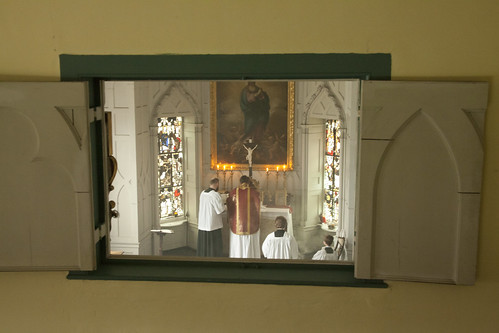
Mass in the private chapel of the historic Catholic house, Milton Manor.
I've been writing about Callum Brown's thesis that discourse about religion became feminised around 1800. What he means is that, by contrast with the two centuries before that date, from 1800 onwards not only were the dominant exemplars of piety women (in obituaries, for example); not only were men regarded as in need of conversion in a way women were not (the vices of men were addressed at length, those of women little or not at all); but the very idea of religiosity was closely bound up with the idea of femininity. To be feminine, women needed to be religious. To be religious, even men had to become somewhat feminised.

One little straw in the wind was the way angels are represented. Before 1800 they look masculine; afterwards, they look feminine. Female angels, of course, are with us still.

Brown's thesis about the 1960s is that, after a 'final blast of feminisation', religiosity in the 1950s was uniquely vulnerable to a reassessment of what it meant to be a woman, in the 1960s. This duly took place in the context of Feminism. Without the support of women, religious practice collapsed, across all Christian denomenations, in the 1960s and 1970s.