Showing posts with label Pope Francis: Mystical not ascetic. Show all posts

Friday, October 11, 2013

Mystical not ascetic: a response to Pope Francis, Part 5

IMG_9613

This post (really) concludes my series about Pope Francis' long interview with the Jesuit journals.

Part 1: what his disctinction 'Mystical' vs. 'Asectic' means
Part 2: why traditional Catholics can better accomodate this perspective than 'Neo-Conservatives'
Part 3: why liberal Catholics shouldn't feel too comfortable with it
Part 4: what is going on with the reference to the life and family issues.

You can also find them all with the label 'Pope Francis: Mystical not ascetic'

I have tried in all these to find a way for Traditional Catholics to understand Pope Francis and to make use of his perspective to make a case for the things they want to defend. In this post I examine the one, short, reference to the 'Vetus Ordo' (as Pope Francis calls it). It comes at the end of a paragraph about the Second Vatican Council.

Asked about the Council, the interviewer is taken by surprise at how little Pope Francis wants to say about it. It is just this.
IMG_9634

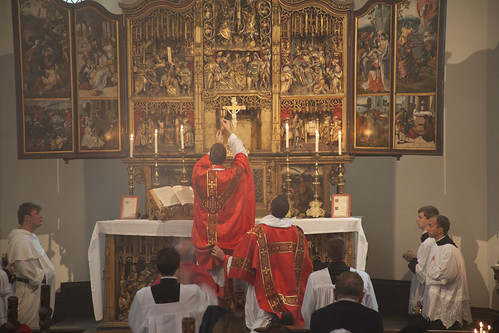
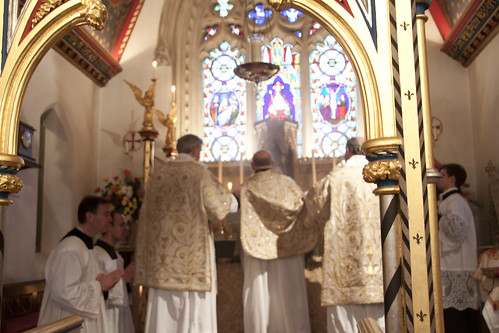
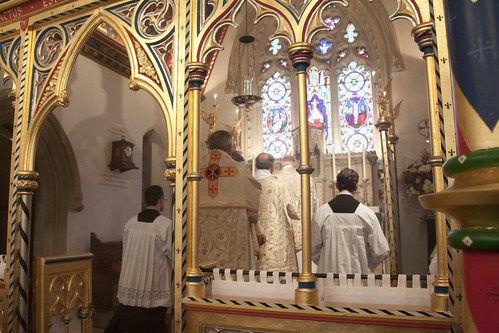
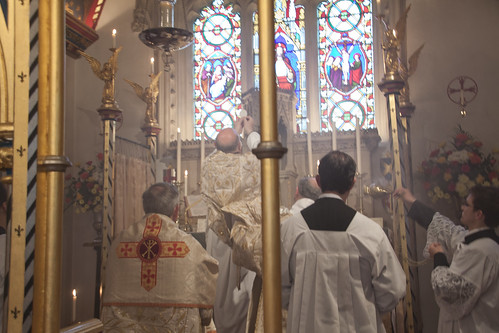
“Vatican II was a re-reading of the Gospel in light of contemporary culture,” says the pope. “Vatican II produced a renewal movement that simply comes from the same Gospel. Its fruits are enormous. Just recall the liturgy. The work of liturgical reform has been a service to the people as a re-reading of the Gospel from a concrete historical situation. Yes, there are hermeneutics of continuity and discontinuity, but one thing is clear: the dynamic of reading the Gospel, actualizing its message for today—which was typical of Vatican II—is absolutely irreversible. Then there are particular issues, like the liturgy according to the Vetus Ordo. I think the decision of Pope Benedict [his decision of July 7, 2007, to allow a wider use of the Tridentine Mass] was prudent and motivated by the desire to help people who have this sensitivity. What is worrying, though, is the risk of the ideologization of the Vetus Ordo, its exploitation.”

I have already noted how, on another occasion, Pope Francis has made clear that he regards the traditional liturgies of East and West as God-centred, and that this is a good thing, which 'we have lost a little' in the West with the reform. That doesn't mean he thinks what is gained does not compensate for what is lost, from this paragraph it is clear he thinks it does. But he does not take the view, which many progressive liturgists have taken over the years, that the traditional liturgy is either theologically problematic or pastorally a dead-end. Which is good, obviously, since those views are absurd.

What he is expressing here is another familiar concern, expressed in Bugnini's book 'The Reform of the Liturgy'. Bugnini writes about the early Traditional movement, and how there were calls for permission for the Old Mass both from rather fanatical groups and perfectly orthodox ones (pp295-7). He appears to conclude that permission was withheld because of the former: a nice example of kicking the cat to punish the dog. Indeed, in practice it forced the orthodox traddies to choose between hearing the Traditional Mass in the context of the more extreme groups or not hearing it at all.
IMG_9641


Anyway, this self-defeating policy is over, thank heavens, and Pope Francis approves of this change, but he is still worried about 'the risk of ideoligization' of the Vetus Ordo. Let's think about what that means.

There are, of course, groups totally at odds with the Church which celebrate the Traditional Mass, or some approximation of it; if anyone is ideologizing the Mass presumably they are, so they can be our paradigm. Old Catholic groups didn't adopt the 1970 Missal and have done their own thing since 1870, Jansenists since even earlier, though these groups have in many cases made their own changes. Feeneyits also went into schism before the Council (many in fact have been reconciled since). Then there are Sede Vacantists, the main body of whom split away from the SSPX in the 1980s, and the even loopier 'conclavists' who elect their own Popes. These are all a pretty rum lot and mainstream Traditional Catholics wouldn't touch them with a bargepole. I'm not even going to bother explaining who they are or what they think; anyone can satisfy a morbid interest with the help of Google, but they are numerically insignificant, and really shouldn't become the focus of an obsession. They are, however, a really clear case of people using the Traditional Mass who have lost the plot doctrinally. My question is: in what sense can we say there is an 'ideologization' or 'exploitation' of the Mass going on here?

In two senses, perhaps. First, apart from the Old Catholics / Jansenists (who can be very liberal) they like to claim that theirs is the only valid Mass. In this way they make an ideological issue out of the Mass. Secondly, they exploit it, in the situations in which they alone offer the Traditional Mass in an area, by attracting people who are (at least at first) simply interested in experiencing the Church's authentic liturgical traditions. They make the Mass a bait for drawing people in to quite distinct theological issues, where their views are heterodox.

Oh Nobadaddy! As William Blake wrote,
Why darkness & obscurity
In all thy words & laws
That none dare eat the fruit but from
The wily serpents jaws?

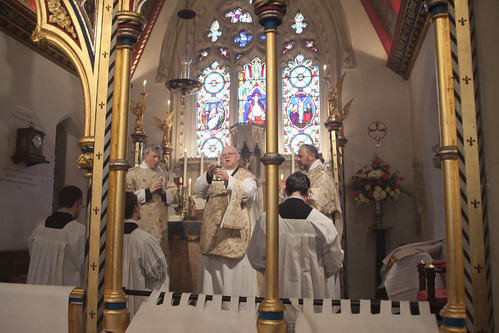
Clearly, the way to  combat both aspects is to make the Vetus Ordo more and more widely available in the Church, with the permission of the hierarchy. This undercuts the argument that the authentic Catholic theology implicit in the EF is denied by a heretical hierarchy, and it undercuts efforts to attract Catholics to schismatic celebrations by offering something which can't be found in the Church. In short, the danger of 'ideologization'/ 'exploitation' is a danger in not having enough Traditional Masses celebrated, NOT a danger which arises from having too many celebrated.
IMG_9648

There is, however, another kind of ideologization/ exploitation of the Mass in the Church today, that of liturgical abuses in the Novus Ordo. In most, if not all, cases, common abuses have a theological rationale which is at odds with the theology of the Church. For example, cramming the aisles with Extraordinary Ministers of Holy Communion has a theological motivation (in the minds of the ideological initiators of these things), namely an attempt to downplay the role of the priest; this is also achieved by many other abuses, such as that of having lay people receive communion in the sanctuary, or having the priest go into the nave all the time. Many abuses, similarly, downplay the Real Presence: I'm sure we can all think of examples. It seems to me that these are even better examples of 'ideologization' / 'exploitation' of the liturgy than those noted above, since they can be used to impose false theological ideas on the Faithful through the very ceremonies of the Mass, and not just over a cup of tea afterwards. It is not surprising that such abuses have been condemned so strongly by Bl Pope John Paul II and Pope Benedict.

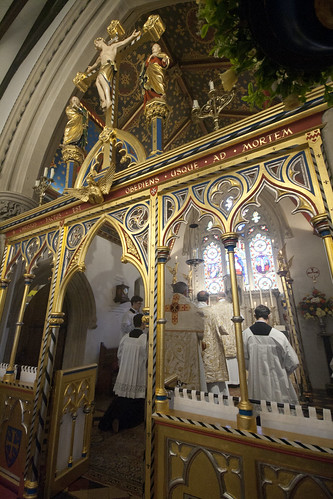
If we are concerned, as we certainly should be, about the liturgy being utilised to convey an ideology at odds with the Faith, then we have to look very seriously at these abuses and, if we can, do something about them. As far as the Traditional Mass is concerned, the answer is again to have more and more of it, since its ceremonies tend to made clear precisely those things which the abusers want to obscure, and to teach precisely what the abusers want to deny, notably about the special role of the priest and the Real Presence, but also about the reality of sin, grace, transcendence, the role of art and beauty, and so on.
IMG_9610

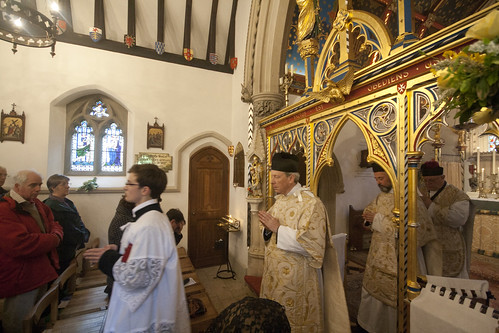
In short, the widespread celebration of the Traditional Mass is an effective defence against the ideologization of both the Old and the New liturgy. Such ideologization can only flourish where the Vetus Ordo is little celebrated in a diocese and where it is regarded, consequently, as something peculiar and either wrong-headed or at least to be steadfastly ignored. For in fact, as the FIUV Position Papers have shown on many topics, it has much to teach the Catholics of today.

On a final point, I'd like to say that I rather like the Holy Father's revival of the term 'Vetus Ordo', if only because I believe in a terminological free market against those who fanatically insist on the term 'Extraordinary Form', and have even suggested that to use any other terms is disloyal to the Holy See. If we can say 'Vetus Ordo', obviously we can also say 'Novus Ordo', which contrary to popular belief has never been a term of abuse, but just what Pope Paul promulgated (the 'New Order of Mass', Novus Ordo Missae). Let's stop arguing about words, and address the realities to which they refer.
IMG_9612

Thursday, October 10, 2013

Mystical not ascetic: a response to Pope Francis, Part 4

IMG_9452
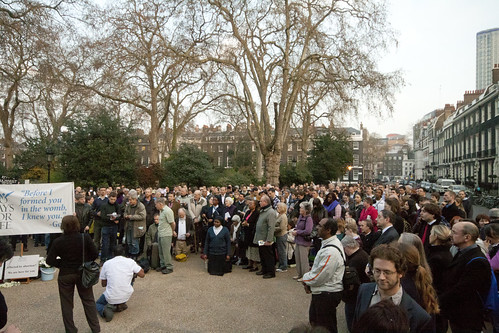
Praying outside the abortion clinic in Bedford Square, London, with 40 Days for Life.


Update: to ease navigation here is the complete series of posts:
Part 1: what his disctinction 'Mystical' vs. 'Asectic' means

Part 2: why traditional Catholics can better accomodate this perspective than 'Neo-Conservatives'
Part 3: why liberal Catholics shouldn't feel too comfortable with it
Part 4: what is going on with the reference to the life and family issues.
Part 5: what to make of the worry that the Vetus Ordo suffer 'ideologization'.

I said in the last post that there was something about which I wised to disagree with the Holy Father. This is about what quickly became a well-known passage in the interview with the Jesuit journals:

“We cannot insist only on issues related to abortion, gay marriage and the use of contraceptive methods. This is not possible. I have not spoken much about these things, and I was reprimanded for that. But when we speak about these issues, we have to talk about them in a context. The teaching of the church, for that matter, is clear and I am a son of the church, but it is not necessary to talk about these issues all the time."

"The dogmatic and moral teachings of the church are not all equivalent. The church’s pastoral ministry cannot be obsessed with the transmission of a disjointed multitude of doctrines to be imposed insistently. Proclamation in a missionary style focuses on the essentials, on the necessary things: this is also what fascinates and attracts more, what makes the heart burn, as it did for the disciples at Emmaus. We have to find a new balance; otherwise even the moral edifice of the church is likely to fall like a house of cards, losing the freshness and fragrance of the Gospel. The proposal of the Gospel must be more simple, profound, radiant. It is from this proposition that the moral consequences then flow."


As before, I want to take this seriously, to understand it, and recognise what is true here, before voicing my concerns.


First off, if someone were to say to me: what's Catholicism all about, then? What the point of it all? I would certainly not begin my reply by talking about abortion and contraception. I would talk about the existence of God, the Incarnation, the Redemption: 'the essentials, on the necessary things: this is also what fascinates and attracts more, what makes the heart burn, as it did for the disciples at Emmaus.' Absolutely. Perhaps the phrase ' dogmatic and moral teachings of the church are not all equivalent' is open to misunderstanding, but let's be fair to the Holy Father, he explains what he means. He means that there are fundamental ones from which others flow, the latter are not less true or easier to repudiate. In the missionary mode we would start with the fundamental ones. They offer the best way in.


IMG_9456
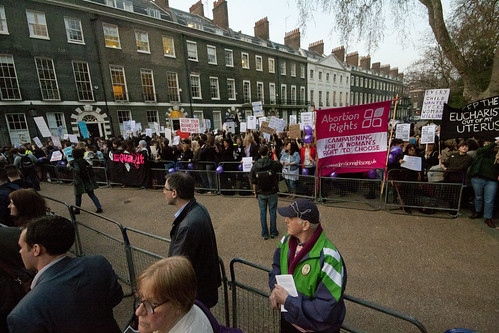
The counter-demonstration (and Joanna Bogle)
On the radio, and I have been in this position myself, the interviewer is not likely to allow this mode free operation. You get asked (as I was on one occasion) 'well what about condoms then?' This is a dirty trick to set the audience against you, to raise everyone's defences, and you have to use the means at your disposal to deal with it. Pope Francis mentions using a technique used by Our Lord: answering one question with another.

A person once asked me, in a provocative manner, if I approved of homosexuality. I replied with another question: ‘Tell me: when God looks at a gay person, does he endorse the existence of this person with love, or reject and condemn this person?’ "


That can work. It assumes of course that everyone knows what the Church teaches, and that we - the speaker, the voice on the radio or whatever - agrees with that teaching. That may be a fair assumption (if, say, you are Cardinal Archbishop of Buenos Aires).


the Holy Father's speech to a group of gynaecologists recently is not a repudiation of this strategy (as William Oddie seems to think) but an example of it. The occasion allowed him to put the teaching of the Church on abortion into the right context, and he expressed that teaching with power and beauty. The point isn't that he doesn't believe it - that's a liberal misreading. The question is only about how far he'd go in 'insisting' on it, as we might say, 'out of season'. He is clearly criticising a certain approach taken by some Catholics, presumably including some Catholic bishops, who he thinks insist on it too much, and not only when they can place it in a proper context.


Bishop Alan Hopes leading the Rosary in Bedford Square
Here is my disquiet. It is not just a matter of how to deal with aggressive interviewers. We also need to deal with what is coming up in Parliament, in debates in the media, even classroom discussions. When we hear that the Government wants to kill even more babies, and old people too, to destroy marriage, and heaven knows what else, we cannot remain silent, and to a lesser extent this is true whenever the subject comes up for discussion. We can't say 'making a fuss isn't going to reach people's hearts,' and leave it at that. It is a matter of justice: too bad for our evangelisation if some people are going to be put off the Church by her opposition to abortion, or for that matter to genocide. Come to think of it, Pope Francis doesn't seem too bothered about putting criminal plutocrats off the Church by defending the poor. Not to speak out can be a form of consent to evil.

But I also think that, paradoxically given what I said above about the way to evangelise, defending the unborn and marriage isn't always such a bad strategy for the Church in terms of winning souls either. Here in England, whatever the deficiencies of our bishops on these issues, it has been very clear that the Roman Catholic Church is the only serious organisation with determined and reasoned opposition to the agenda of of the culture of death. We have reaped a rich harvest of conversions from this over the years, particularly of serious-minded Anglicans, of both the High Church and Evangelical varieties. Perhaps most famously Malcolm Muggeridge (long an agnostic, then a non-Catholic Christian) converted because of these issues. Many now in the Ordinariate developed a deep respect for the Church for speaking out on these issues; without such a respect the issue of female ordination might have pushed them towards Constantinople instead of Rome. Strong ties have been forged with the Orthodox themselves, with Jews, and even with Muslims, because of our shared concerns. It has also had a very salutary effect internally, giving many Catholics a visible and emotionally charged cause which puts their faith into contact with political realities. It takes the Church out of herself and onto the streets.


The final result.
So this is what I would say to a follower of Pope Francis on this issue. You want Catholics conformed to Christ, who don't worry about keeping things neat and tidy, who aren't concerned above all with bureaucratic structures and procedures, but recognise Christ in those crushed by the injustices of modern life: let me show you the pro-life movement. You want Catholics who are mystical, who are spirit-driven, the modern followers of Amos, Isaiah and Jeremiah: take a look at the pro-lifers. I'll tell you what they do, they take away the shame the Church deserves for failing to defend life and the family, for preferring committee meetings with Government ministers to causing any offence to our rulers. The Spirit in them is not confined to a little box called 'religion', it permeates their lives and directs their actions. They can make a 'mess', yes, but thank God for them.

Pope Francis' remarks on the life issues make perfect sense at one level: the level of thinking how to get something useful across to unbelievers, and the best strategies to adopt when cornered in an aggressive interview. But at another level it is inconsistent with his general outlook. God has placed us in a situation where our cleverly thought-through human strategies are constantly frustrated, where we are forced to admit we oppose contraception, sex change operations, homosexual sex, same-sex marriage, explicit sex education, all those things we'd rather leave to lesson 94 in our catechetical programme.

I'm not saying that the most bone-headed approach to preaching the Gospel is more responsive to the Spirit than the more media-savvy ones. God gave us intellects to use. We should be as cunning as serpents as well as innocent as doves. What I am saying is that if you are out there, on the streets, in the student bars, on the radio, among unbelievers, you are going to be backed into a corner from time to time.


St Henry Walpole's name on the wall of his cell in the
Tower of London, which he carved before his martyrdom in 1595
We are cornered because to deny would be to apostatize and to stay silent would be to consent to injustice. When that happens we just have to trust the Holy Spirit to bring good out of our witness. He will indeed do so, if we follow the demands of the Spirit. It may be that our words will reach the hearts of the most unexpected people. That after hearing those horrid Catholics being tarred and feathered for the thousandth time for their bigotry, someone might say: how is it that they are so faithful to a lost cause? Where does this zeal come from? And maybe a seed of Faith will be planted, as it was when the young Henry Walpole was splashed with blood at the execution of St Edmund Campion

What I have attempted to show in this post is that Pope Francis' own thinking and rhetorical provides the resources to an effective response to what appears to be his critique of the pro-life movement. Tomorrow I'm going to do something similar in relation to the one remark which appears to be directed squarely at those attached to the Traditional Mass: the worry about the 'ideologisation' of 'Vetus Ordo'.

Wednesday, October 09, 2013

Mystical not ascetic: a response to Pope Francis, Part 3

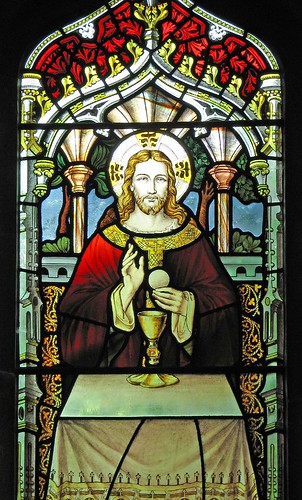
Christ saying Mass
Photo by Fr Lawrence Lew

Update: to ease navigation here is the complete series of posts:
Part 1: what his disctinction 'Mystical' vs. 'Asectic' means

Part 2: why traditional Catholics can better accomodate this perspective than 'Neo-Conservatives'
Part 3: why liberal Catholics shouldn't feel too comfortable with it
Part 4: what is going on with the reference to the life and family issues.
Part 5: what to make of the worry that the Vetus Ordo suffer 'ideologization'.

In my last post I argued that the veiws of Catholics attached to the Traditional Liturgy are in many ways closer to Pope Francis' preferences than those of many 'Conservative' Catholic writers. Pope Francis doesn't like centralisation in the Church: nor do we, but they do. Pope Francis condemns legalism: so do we, but they don't. Pope Francis wants a Church open to the Spirit, not concerned above all with rule-keeping and discipline: so do we, but again, Neo-Con writers too often give the impression that they do not.

This actually fits in with a certain well-worn Neo-Con argument which says that Liberals and Traditionalists are the same in their disrespect for proper authority and discipline. The people who used to make that argument are really hoist by their own petard now, and I hope they are enjoying the experience. But things are a lot more complicated than that; as I argued here, Traditionalists like the Latin Mass Society and the Traditional Orders have always gone to extraordinary lengths to keep the rules, and do so even when putting forward an argument that the rule in question wasn't really a rule at all. In the case of the obligation to ask permission for the celebration of the Traditional Mass, this argument of ours was vindicated in spectacular fashion by Pope Benedict, who wrote in Summorum Pontificum in 2007 that we'd never needed permission after all.

Another problem with applying that old Neo-Con argument here, is that it implies Pope Francis is a liberal. Again, things are more complicated than that, and this is what this post is about. What Pope Francis wants, remember, is a Church conformed to Christ. Liberals like to use that kind of phrase when they want to deny a teaching of the Church or commit some liturgical abuse, but Pope Francis actually means it. As I quoted him before, in Brazil he said

"We may become a charitable NGO, but not the Church, the Bride of the Lord."

In another sermon, he told newly ordained priests:

"Therefore, carry out the ministry of Christ the Priest with constant joy and genuine love, attending not to your own concerns but to those of Jesus Christ. You are pastors, not functionaries. Be mediators, not intermediaries."

What does this mean?

The key thing to keep in mind is the notion of conforming oneself to Christ: the concerns of Christ, not those of an organisation, however enlightened; the Church as the Bride of Christ, not an NGO. Pope Francis is talking about the Church having a spiritual identity and a spiritual mission. That doesn't mean we shouldn't be concerned about the poor - far from it. But it does mean we shouldn't conform ourselves to the World, even in order (as we might imagine) to serve the poor more effectively.

IMG_4470
Making the streets of an English country town resound to the sound of prayer: Walsingham 2013

This is a critique of the secularisation of the Church. It is a critique of the classic liberal argument that we must stop being Catholic in any meaningful sense in order to advance justice in the world. The liberal nuns, to take an extreme example, have 'moved beyond Christ' while working for social justice.

And here's something else. Pope Francis wants us to be open to the world, not closed in on ourselves, looking inwards to an organisation which is concerned only with its own workings. This is a critique of a bureaucratic tendency in the Church which is today at its apogee, and it is liberal Catholics who are in charge of this bureaucracy  Liberals love committees: this is true across all areas of life. They flourish on comfy chairs with little plates of biscuits and matters arising from the minutes of the last meeting. This the antithesis of a bishop or parish priest taking real responsibility for his diocese or parish, being a father to it; it is the antithesis of the encounter between a pastor and Christ found in the poor and in those wounded by sin. 'Oh no, I'm not going to answer your question, that's for the liturgy committee!' 

The attitude of defending the Church as an institution, rather than doing what is called for by the Church's supernatural reality, is at issue in the paedophile crisis. When bishops and superiors cover up, deny the truth, move problem priests around, fight unjust legal battles and refuse to pay compensation, they are defending the Church conceived of purely as a human organisation, a bureaucracy. Such actions have been done by prelates of a range of views, but it happened at a time when liberals had a massive domination of the levers of power.

It would be a tragedy indeed if Pope Francis' desire for decentralisation led only to the morbid growth of Bishops' Conference bureaucracies, where these attitudes could continue to flourish.

In sum, Pope Francis is opposing the invasion of the Church by secular attitudes and secular goals. The point was expressed with great lucidity by Dietrich von Hildebrand, one of the founders of the Traditional movement:

It is easy to feel oneself alive and free if one forgets about the unum necessarium, the one thing necessary, and directs all one’s powers toward secular endeavors. It is easy to feel oneself bursting with energy if, for example, the clearance of slums concerns one more than transformation in Christ. What the progressives call “leaving the Catholic ghetto” is in reality giving up the Catholic and keeping the ghetto. They would replace the universal Church with the ghetto of secularism, with imprisonment in a stifling immanentism, with isolation in a world that sits in umbra mortis, in the shadow of death. To achieve a unity of religion and life by adapting religion to the saeculum does not result in a union of religion with our daily life, but reduces religion to the pursuit of purely mundane goals.
...
The fallacy in the progressivist approach is obvious. If we assert that religion should permeate our lives, the implication is that we should break through to the realization of the primary vocation, the very meaning of our lives, which is our re-creation in Christ. We should then no longer be exclusively absorbed by the immanent logic of our professional lives or by everyday preoccupations, but should see them and all things in the light of Christ. Indeed, the echo of our self-donation to Christ should resound through all the scenes of our lives.

It is the very opposite of uniting true religion with everyday life to believe that all that is demanded from a Christian is to fulfill the duties prescribed by the logic of his secular life. This would mean the absorption of religion by secular activities, so that we would be satisfied that in fulfilling the requirements of these we were doing everything that God could ask of us. In reality this is to avoid the confrontation with Christ. Those who act in this way are Christians in name only. The decisive question for the vivification of religion today is whether through the light of Christ our everyday lives will become deeply changed and adapted to Him, or whether the Christian religion is to be adapted to the immanent logic of mundane concerns.

Thinking about von Hildebrand's characterisation of the alternatives, which is Pope Francis putting forward: the progressive theory that only secular concerns are real, that (for example) in a Catholic school exam results are the only thing to think about, or, instead, the idea that even what we do in secular contexts should be suffused with the Christian spirit and give witness to the Faith? The latter approach fills liberals with horror, but it is clearly what Pope Francis is talking about.

Dietrich von Hildebrand's analysis, in his great book Trojan Horse in the City of God (1967), is so useful in this context that I've had ten pages retyped in order to make it available to a wider public. You can download the text of the chapter 'Vivification of Religion' here.

In these three posts I have not been arguing that Pope Francis is really a Trad in a false flag operation, and that tomorrow he is going to celebrate the Old Mass and do all sorts of other things we'd like. No, he is coming from a very different place. Nor is my point that his words can be twisted around to suit a traddy agenda. I'm not concerned with taking stray phrases out of context, but of the underlying argument.

Rather, my point is that if you look at the underlying argument, what he is saying is not so easily categorisable in terms of liberalism or conservatism; he recognises problems with both, even while (as it would seem) associating Traditional Catholics with problems as well. The object of my discussion has been to suggest a way in which Traditional Catholics can respond to his analysis of the problems in the Church, an analysis which represents a genuine insight, to show that we can be part of the solution, and not only part of the problem. I don't suppose we will make ourselves heard by the Holy Father directly, we don't have a loud enough voice for that, but we will have plenty of opportunity to engage with people officially directed to apply his policies, and to people impressed with his general orientation. It is to them, therefore, that we need to explain that Traditional Catholics are not hyper-conservatives with all the baggage of Ultramontanism and legalism, and that we recognise the need to conform ourselves, and the world, to Christ, and not the Church, and ourselves, to the World.

I have one last thing to add, in a final post in this series. In the spirit of freedom of discussion there is something Pope Francis said with which I wish to disagree.

Tuesday, October 08, 2013

Mystical not ascetic: a response to Pope Francis, Part 2


Update: to ease navigation here is the complete series of posts:

Part 1: what his disctinction 'Mystical' vs. 'Asectic' means

Part 2: why traditional Catholics can better accomodate this perspective than 'Neo-Conservatives'
Part 3: why liberal Catholics shouldn't feel too comfortable with it
Part 4: what is going on with the reference to the life and family issues.
Part 5: what to make of the worry that the Vetus Ordo suffer 'ideologization'.


In my last post I tried to explain, as I understand it, the central distinction Pope Francis employs. As he puts it in the long interview, on the one hand you have the 'mystical', which is about conforming oneself to Christ, being God-centred and open to the Spirit, and on the other hand you have the 'ascetic', which manifests itself in an an inward-looking concern with the Church as an organisation. This can be either a 'disciplinarian', 'legalist' attitude, or a naturalist attitude, that of a functionary in an 'compassionate NGO'.

My question in this post is whether Catholics attached to the Traditional Mass, who are formed by the traditional spirituality of the Church and influenced by the traditional side of the debate on a range of issues, whether they need to worry that they are especially vulnerable to a critique inspired by Pope Francis' distinction: whether they can be characterised as asecetic rather than mystical, in the special senses in which he uses the words.

The first thing to note is that Pope Francis, like almost all the bishops and influential clerics and high-ranking lay employees in the Church today, has almost certainly never had the opportunity to see Traditional Catholics at close quarters. You can't spend long working for Church institutions without having to collaborate with Catholics at a variety of points along the 'liberal-conservative' spectrum. But in the unlikely situation that traditionally-minded Catholics find themselves in important roles, they will be in deep cover. Again, very few non-trads have read a serious book by a traditionally-minded Catholic: by Michael Davies, for example, Dietrich von Hildebrand, Amerio Romano, or Christopher Ferrara. Very few under fifty are remotely familiar with the traditional works of liturgy and spirituality, or (under sixty) the Traditional liturgy itself, which form the background to the movement, and the old-timers will have no way of knowing how these things manifest themselves in post-Conciliar conditions. In other words, we should not be surprised at a very low level of understanding of the concerns, attitudes, or practical strategies of Catholics attached to the Traditional Mass. It is up to us to address the misconceptions which inevitably arise.

One very easy misconception is that Traditionalism fits onto the same linear scale as 'liberal' and '(neo-)conservative', but at the extreme end: that is, they are just conservatives on speed. Something which cannot be emphasised too much is that when Neo-Conservative Catholics become Traditional Catholics - and most trads were conservatives once - they give up two positions which are crucial to the standard 'conservative Catholic' offering: Legal Positivism and Ultramontanism.

Neo-Conservatives might deny that they really hold these positions, but a strong tendency in these directions is absolutely necessary to the Neo-Con project. They accept whatever has just been enacted by the Church as the most authoritative statement on any subject, regardless of the weight of earlier laws, or considerations such as Natural Justice and custom. And they place enormous emphasis on the person of the Pope, seeking at all costs to endorse and live by even their non-magisterial statements and philosophical preferences. Pope Paul was a follower of Maritain? Let's all follow Maritain! Bl John Paul II was a Phenomenologist by training? Let's all be Phenomenologists! Pope Benedict likes St Augustine and Scotus? You get the idea.

As I have remarked before, the absurdity inherent in this approach should be apparent, since neither Legal Positivism nor Ultramontanism are teachings of the Church. It is going to be particularly painful for conservatives under the present pontificate, however, since Pope Francis is even more clearly opposed to these tendencies than his immediate predecessors. He is very opposed to 'legalism', of which Legal Positivism is a variety, and is very opposed to the centralisation of the Church, a tendency of which Ultramontanism is the most extreme endorsement. Legal Positivism, of course, is demolished by Thomas Aquinas' observation that human laws only bind in conscience if they promote the Common Good; centralisation is demolished by the insistence on Subsidiarity in the Church's Social Teaching, the principle that decisions should be made at the lowest level possible, which is at the heart of a traditional conception of all societies, including the Church.

Perhaps the Neo-Conservatives' great respect for the Office of the Papacy will lead them to reassess these attitudes, and become traditionalists: that would be nice. On the blog of my favourite Neo-Con, the trad-bashing Fr Longenecker, is a neat expression of the dilemma. (This was attributed to Fr L himself by the usually reliable Hilary White, but it is in fact a commenter: thanks to the commenter in my own box for pointing this out). This man (or woman) is in pain.

I find this interview very hard. I have accepted that this is the Holy Father's personal view, and that it is not infallible, but this interview is challenging my prior notion of what devotion to the Papacy meant because previously I would not have selected what the Popes said but assiduously read things like this. I can't get past the cognitive dissonance.  

Did you get that? While in theory he accepts the distinctions between fallible and infallible, and between magisterial and private, in practice, up to now, he has tried to accept whatever any Pope has said without 'selection'. He doesn't mention this, but this only applies to living Popes, otherwise he would have gone mad long ago.

In these respects Traditional Catholics are far ahead of Neo-Conservatives on a Fransiscan analysis. The centralisation of the Church is certainly not something we have committed ourselves to. All Catholics have the right to appeal to Rome against unjust decisions at a local level: that is a fact about the hierarchical nature of the Church. But Traditionalists recognise that the centralisation of power in the Church has been a very mixed blessing. A practical example in the realm of the liturgy is that it is Traditionalists, and not Neo-Conservatives, who agree with the Second Vatican Council about the preservation and fostering of local liturgical rites and usages. Neo-Cons tend to see liturgical pluralism as nothing but a source of problems. Everyone, they tend to think, should be marching in step.

Another aspect of Neo-Conservatism which is closely linked to this is the emphasis on discipline. There is a tendency for them to say, on the one hand, that obedience should be exercised without any discernment of whether what we are being asked to do is just - what Aquinas called 'indiscreet obedience' - and on the other, that all problems can be solved by the exercise of discipline. How many times have Neo-Cons told us that if only priests could be taken outside and shot for liturgical abuses and doctrinal indiscretions, all our problems would go away? As if the collapse of Catholic spirituality was really a minor detail in the overall scheme of things, and all that mattered was outward conformity to the Rules.

When faced with a person who has absorbed Pope Francis' analysis, therefore, one thing Traditional Catholics need to do is to distance themselves from Neo-Conservatives. We are not the ones who regard obedience as the only virtue, who think that the firm smack of discipline is the cure for all ills, that would like to see the Pope as the Bishop, Parish Priest, and Spiritual Director of every Catholic in the world, and who can't see a rule without wanting to apply it to everyone in a mechanical way, with the Electric Chair for anyone who baulks at it. No: we are the ones who have been resisting those tendencies. Insofar as these tendencies were present in the Church before the Council, this goes a long way to explain the problems we have had since the Council. We don't endorse everything from the 'old days': on the contrary, as Pope Francis expresses it,

Tradition and memory of the past must help us to have the courage to open up new areas to God.

Now, before people say that I am taking this argument too far, and the Pope Francis could never see the Traditional liturgy as anything other than rigid and rubrical, remember what he has actually said about traditional liturgy in East and West. Speaking to a Russian interviewer, he remarked:

They have conserved that pristine liturgy, no? So beautiful. We have lost a bit the sense of adoration, they conserve it, they praise God, they adore God, they sing, time does not count. The center is God and that is a richness that I would like to emphasize on this occasion as you ask me this question.

IMG_4279
God-centred pristine liturgy has not been completely lost in the West.

The traditional liturgy is God-centred: it is mystical, not ascetic  If there is a problem with Western traditionalistism, it is somewhere else, and this is why we need to clarify what we are really about.

In the next post I will compare Traditional Catholics and Liberals, from a Fransiscan perspective.

Monday, October 07, 2013

Mystical not ascetic: a Traditionalist response to Pope Francis, Part 1


Update: to ease navigation here is the complete series of posts:
Part 1: what his disctinction 'Mystical' vs. 'Asectic' means

Part 2: why traditional Catholics can better accomodate this perspective than 'Neo-Conservatives'
Part 3: why liberal Catholics shouldn't feel too comfortable with it
Part 4: what is going on with the reference to the life and family issues.
Part 5: what to make of the worry that the Vetus Ordo suffer 'ideologization'.


Pope Francis' long interview with Fr Antonio Spadaro SJ for the Jesuit journals presents a challenge for Catholics attached to the Traditional Mass. It is a challenge which I think we can meet.

My concern, in this first post of a series, is to get inside the Holy Father's thinking, really to understand what he is trying to convey, which is not always on the surface of the words. It seems to me that his thinking in the interview turns on a distinction he expresses when he makes the puzzling remark:

“Ignatius is a mystic, not an ascetic.”

He had, however, already indicated what this distinction means.


"A Jesuit is a person who is not centered in himself. The Society itself also looks to a center outside itself; its center is Christ and his church. So if the Society centers itself in Christ and the church, it has two fundamental points of reference for its balance and for being able to live on the margins, on the frontier. If it looks too much in upon itself, it puts itself at the center as a very solid, very well ‘armed’ structure, but then it runs the risk of feeling safe and self-sufficient. The Society must always have before itself the Deus semper maior, the always-greater God, and the pursuit of the ever greater glory of God, the church as true bride of Christ our Lord, Christ the king who conquers us and to whom we offer our whole person and all our hard work, even if we are clay pots, inadequate. This tension takes us out of ourselves continuously.”
"... The mystical dimension of discernment never defines its edges and does not complete the thought. The Jesuit must be a person whose thought is incomplete, in the sense of open-ended thinking. There have been periods in the Society in which Jesuits have lived in an environment of closed and rigid thought, more instructive-ascetic than mystical: this distortion of Jesuit life gave birth to the Epitome Instituti.”
St Ignatius of Loyola
To put it perhaps too crudely, what Pope Francis has in mind is simply this. The mystic is a person open to the influence of the spirit, and that means he is conforming himself to Christ and is always ready to serve others. The ascetic tendency is legalistic, it is an attempt to keep things neat and tidy; it is closed in on itself.
I have never heard of a mystic who was not, in the ordinary sense of the word, ascetic. But Pope Francis is using both words in his own sense for his own purposes.
When Pope Francis looks at different movements in the Church he asks himself which side of this distinction is applicable to them. Vatican II, obviously, was an attempt to shift the Church more completely into the mystical mode. On the other hand:
If the Christian is a restorationist, a legalist, if he wants everything clear and safe, then he will find nothing. Tradition and memory of the past must help us to have the courage to open up new areas to God. Those who today always look for disciplinarian solutions, those who long for an exaggerated doctrinal ‘security,’ those who stubbornly try to recover a past that no longer exists­—they have a static and inward-directed view of things. In this way, faith becomes an ideology among other ideologies.”
It is not immediately clear who Pope Francis has in mind by the terms 'restorationist' and 'legalist'; it is best to try to understand the phenomenon he is talking about and worry about who, if anyone, represents this phenomenon later. There is such a thing as an inward-looking attitude. When talking about the Jesuits above, and elsewhere, Pope Francis has emphasised another, related, manifestation of this. In Brazil he warned:
"We may become a charitable NGO, but not the Church, the Bride of the Lord."

In another sermon, he told newly ordained priests:

"Today I ask you in the name of Christ and the Church, never tire of being merciful. You will comfort the sick and the elderly with holy oil: do not hesitate to show tenderness towards the elderly. When you celebrate the sacred rites, when you offer prayers of praise and thanks to God throughout the hours of the day, not only for the people of God but for the world—remember then that you are taken from among men and appointed on their behalf for those things that pertain to God. Therefore, carry out the ministry of Christ the Priest with constant joy and genuine love, attending not to your own concerns but to those of Jesus Christ. You are pastors, not functionaries. Be mediators, not intermediaries."

The 'ascetic' side of the distinction, therefore, includes not only people stuck in the past, it includes people who approach the task of being a priest or bishop as just a job, people who look at the Church as just a human organisation, which must be defended, and whose rules are all-important. Because they look at things in a natural way, a merely human way, they are not open to the Spirit. They too want to keep things neat and tidy, in order to maintain bureaucratic efficiency.

IMG_0340
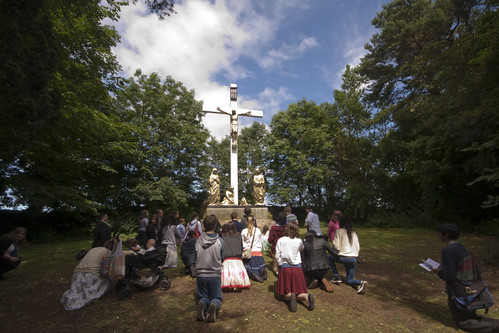
Being Christ-centred: the 13th Station at the SCT Summer School
The challenge here for all of us is to ask ourselves: is the strategy I am pursuing within the Church mystical or, in Pope Francis' idiolect, ascetic? Traditional Catholics are subject to these temptations like everyone else. But it seems to me that the general tenor of the Traditional approach can be vindicated as genuinely mystical. What we need to do, to clarify what we are about to those who take on Pope Francis' way of thinking, is to demonstrate this.