Showing posts with label Tom McIntyre. Show all posts

Thursday, March 31, 2011

Reply to Tom McIntyre

It can be a difficult question whether to lend credibility and publicity to opponents by responding to their attacks, especially opponents so notoriously dull, wrong-headed, and maddeningly persistent that they have become a laughing stock by their own efforts. Such a one is Tom McIntyre, who appears what seems like every week in the Letters page of the Catholic Herald. (See comments on him here and here.) I used the search facility on the CH's electronic archive to make sure of this and since July 2007, that is, over the course of less than 44 months, he has had 47 letters published. How many he has actually written is anyone's guess, since his letters display no special expertise, he has no position such as might lend them authority, and he does not speak for any particular group.

The archive goes back to 2003 and his output shot up when Summorum Pontificum was published. It has been his special project to obscure what is clear in the document, and since misunderstandings about it persist in other quarters it seems right to take the opportunity to correct some of them.

So here is the last paragraph of his latest effort, and my reply, published by the Catholic Herald last weekend.

From Tom McIntyre, with my emphasis and comments.

The Old Rite's individualist allure has intensified with postmodern vogues for the antique, the "retro" and the exotic in religion. [Met any 'post-modern' trads? Me neither. Among insults, this is a new one.] How wise, then, of the Pope to make it clear that, in parishes, Summorum Pontificum's concession [actually, it gives Catholics a right, not a concession] of the 1962 Missal as an extraordinary use applies when a body (coetus) of adherents to the previous liturgical tradition is well-established. [Actually, it applies in every parish.] As Mr Medlin says, the Motu Proprio is carefully drafted: otherwise the vagueness of coetus - "crowd" or "assemblage" - might seem a problem. [McIntyre is a retired Latin teacher. But this is weak stuff.] But the document has already clarified that. It concerns those places where the faithful have been, and still are, emotionally attached to and culturally steeoed in the previous form in very large numbers (haud pauci). [So strictly over-70s only? See below.] Indeed, the Pope later told reporters in France that the beneficiaries of Summorum Pontificum would be "a small group, given that it presupposes a formation in Latin." [He says the same thing in the Letter to Bishops, but he's talking about priests, not the laity. 'Formation in Latin' wasn't a requirment on laity in the old days, and there's no reason why it should be now.]

Yours faithfully,

Tom McIntyre.


-----------------

As usual McIntyre presents what American military strategists call a 'target rich' field but to avoid filling the entire Letters page I have to be selective as to what I respond to. The stuff about post-modernism is too wacky to bother with but a casual reader might just think McIntyre has found a restrictive reading of the Motu Proprio worth a second glance. But he hasn't.

-----------------

Sir,
Tom McIntyre (Letters, March 18) repeats his tired claim that 'in parishes, Summorum Pontificum ... applies only where a body (coetus) of adherents to the previous liturgical tradition is well established', and not newly established or small in numbers. Last time (Letters, Sept 3, 2010) he attempted to argue this point by a tendentious translation of a word which does not even appear in the official Latin text [the old 'continenter'-'stabiliter' confusion, recommended for insomniacs]. This time he takes a phrase from the preamble, ‘haud paci’ (‘not a few’) and applies it to the word ‘coetus’ (the ‘group’ seeking the Extraordinary Form) seven paragraphs later. 2011 03 26_8580
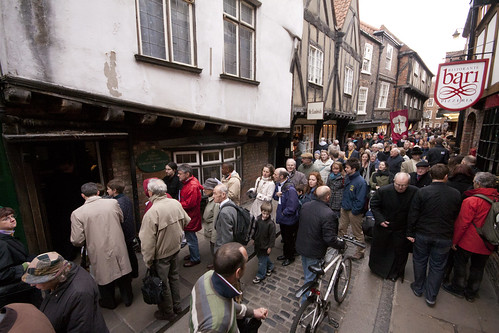
(A non-stable group, in fact a moving one, at the York Pilgrimage last Saturday.)

To be clear, the document says that it was the 'not a few' requesting the Traditional Mass who encouraged John Paul II to issue an indult back in 1984 (penultimate paragraph of the preamble). Later, Article 5 talks of a 'group of faithful' who are given the right to ask for the Traditional Mass. The two paragraphs are talking about completely different things. Were further refutation of Mr McIntyre needed, the Motu Proprio tells us that requests for the Traditional Mass can come not only from 'well established' groups, but transient groups attending pilgrimages and weddings (Art. 5), and young people discovering this form of the Mass for the first time (see the Letter to Bishops accompanying the Motu Proprio).


Since Summorum Pontificum was published in July 2007 Mr McIntyre has had no fewer than 47 letters published in the Catholic Herald letters page, of which 20 concern that document and related issues. The reasonable tone of these letters belies an obsessive attempt to occlude the pastoral concern of the Holy Father and the treasures represented by the Church's liturgical traditions with his own peculiar prejudices.
Surely by now even the most occasional reader of The Catholic Herald is sufficiently familiar with Mr McIntyre's views. Can't we finally say, enough is enough?

Joseph Shaw Chairman,
The Latin Mass Society


Sunday, September 12, 2010

More letters in the Catholic Herald

On Friday I was at a reception given by the Catholic Herald in honour of the Papal Visit, and saw two people who had letters next to mine in the letters page. Well it's a small world!

Last week I had a letter quoting extensively from official documents to back up the point for which I have been criticised: that liturgical abuses have been a major cause of lapsation, and that the Extraordinary Form of the Roman Rite - the 'Traditional Mass' - is part of the solution to the problem which we face. My point was that it is not just me saying this - it is the Holy Father, who notes the pain caused by abuses, and goes on to express the hope that the Traditional Mass will influence the way that the New Mass is said. Why? Because the abuses are typically an attack on the sacrality of the Mass, and the Traditional Mass is particularly noted (by the Holy Father) for its sacrality. This is all in the letter accompanying the motu proprio - if you don't like it, don't complain to me, complain to Pope Benedict!

The aspects of this analysis less spelt out in the letter are made abundantly clear in Redemptoris Sacramentum, an Instruction from the Congregation for Divine Worship 'in collaboration with' the Congregation for the Doctrine of the Faith, at that time under Cardinal Ratzinger. One of the useful things about this document, published in 2004, is its honesty in admitting the enormity of the problem: in 'some places' (and we all know a few) abuses have become 'almost habitual' (section 4). That is extraordinarily strong language for such documents, and gives the lie to the claims that the problem went away in the 1980s.

It pays to be familiar with these documents. A correspondent in last week's Catholic Herald came a serious cropper by quoting a version of the motu proprio ('MP') Summorum Pontificum which was redacted by the Holy See before getting into the Acta Apostolicae Sedis ('Acts of the Apostolic See'), which is the official record of Papal documents. What is in the Acta is definitive; until the Acta is published we are dealing with an unofficial text. This particular change caused much comment - see Fr Zuhlsdorf for example (and here). But this clearly passed a certain Tom McIntyre by, and he is merrily quoting the un-revised version nearly three years after the confusion has been cleared up.

But not by coincidence, for the original Latin refers to a group (coetus) asking for the Traditional Mass which had existed 'continenter'. It was clear enough to the fair-minded reader that this was meant to contrast with the temporary groups which exist when a wedding, funeral or pilgrimage takes place: people who don't normally worship together gather and then disperse. A temporary group like that has the right to ask for the Traditional Mass under the MP section 3; an on-going group, existing continuously, also has the right to ask for the Mass under the MP section 5. And of course priests could say it off their own bat.

Nevertheless, some commentators claimed, on the basis of the original version, that the Traditional Mass could only be said if requested by a group existing 'continenter', and these commentators then set to work to make this phrase as restrictive as possible. It must be an enormous group. All its members must come from a single parish. And it must not only have existed 'continuously' but have been attached to the Traditional Mass 'continuously', ever since before the Missal of Paul VI was published, in fact.

This is taking wishful thinking to hallucinatory lengths. The text simply does not support any of these restrictions, and naturally the MP would be pointless if it were so restrictive. This debate all took place in the weeks after the MP was first published, but sometimes misunderstandings get lodged in people's minds. In reply to Tom McIntyre's letter I wrote as follows:

Sir,

Tom McIntyre (Letters, 3rd Sept) paraphrases the Holy Father's motu proprio Summorum Pontificum as giving 'those uninterruptedly (continenter) attached to it their right to participate in it.' He must be puzzled, then, that the Holy Father also observes that 'young persons' have found the Traditional Mass 'particularly suited to them', since according to Mr McIntyre such persons, born after the Council, are unlikely to have been 'uninterruptedly' attached to the Mass in that form.

The notion that only those who knew the Mass before 1970 have a 'right' to ask for it today is an old canard; it hardly coheres with the authorisation of new religious orders whose mission is to offer the Traditional Mass and Sacraments to new generations of Catholics.

Clearly wishing to head off such misunderstandings, the Holy See revised the text of the motu proprio when the definitive text was finally published, and, if he goes to the Vatican website, Mr McIntyre will find that the word 'continenter' no longer appears in the document. Instead it refers to those who 'stably adhere' to the Mass in the older form: 'coetus fidelium traditioni liturgicæ antecedenti adhærentium stabiliter exsistit'. Such a group has a right to ask for it, and the pastor should receive such a request willingly ('libenter') (Article 5 Section 1). Age is irrelevant.

But this is just one provision of the motu proprio. In Section 3 we learn that, in addition, it should be allowed for 'special celebrations', such as weddings, funerals, and pilgrimages: these are cases where there is no 'stable group'. Furthermore, in Article 2, any priest is permitted to say the Traditional Mass, without any lay request for it; in Article 3 any order or religious community may adopt it. Article 4 makes the point that these non-requested Masses can be attended by any member of the faithful who wishes to go. Capping all of these provisions, Article 1 says the Traditional Mass has never been abrogated: special permissions with conditions attached are no longer at issue.

The era of specially permitted Traditional Masses in the chapels of old peoples' homes have long gone. The old liturgical books are increasingly used for weddings and baptisms. For many years now the Archdiocese of Westminster has provided a bishop to confer the Sacrament of Confirmation in the Traditional form, in a service organised by the Latin Mass Society. The Holy Father refers to this liturgy as 'sacred and great', not only in the past but 'for us too'. It is a patrimony which should not be denied to future generations.

Yours faithfully,

Joseph Shaw

Alongside my letter were several others on related subjected. As well as letters lamenting the problems caused by liturgical abuses, Daphne MacLeod suggested that it was catechesis, not the liturgy, which caused lapsation in the 1970s and later. I certainly wouldn't dispute the importance of sound catechesis; this simply wasn't the subject of the correspondence. However Mrs MacLeod uses arguments which I don't find entirely convincing in trying to separate the different causes at work by reference to the experience of Africa and the Soviet Bloc. She has used these before, and I have addressed them on this blog before.

Another letter was from Fr Leo Chamberlain OSB, which interestingly claimed that the youthful doubts of many of his contemporaries in the 1950s were successfully addressed by the exciting new perspectives given by Vatican II. I'm happy to take his word for it; I assume he'll take my word for it that what later generations were offered, in the 1980s and 1990s and beyond, did not successfully address many of our youthful doubts. In fact there's no need to take anyone's word for it - just look at the statistics.

He also returns to a well-worn theme (of his) about my use of the term 'Traditional Mass'. He says we should use the terminology used by the Holy Father; the difficulty of this argument is sufficiently demonstrated by his failure to follow his own advice (he keeps reverting to his own invention, 'the Old Form'), as I pointed out on this blog the last time he treated readers of the Catholic Herald to these views of his.

All I would add is that insisting on using technical vocabulary from legal documents instead of the vernacular - the terms people actually use - makes one look stupid. The Quixotic attempt to get Catholics to call Confession 'the Sacrament of Reconciliation' has produced nothing but momentary confusion over the years; it is never likely to change popular usage. The attempt by Lady Thatcher's government to insist on 'the Community Charge' when everyone was talking about 'the Poll Tax' just made them look out of touch.

I'm all for a linguistic free market. It's the reality behind the words which is important.