Friday, September 03, 2010

Tiley vs. Shaw: round 2

Following my exchange of letters with Bernard Tiley in The Catholic Herald, Mr Tiley wrote again - and again I have responded. My letter is in the current edition.

Mr Tiley's letter from last week merely reiterates what he said before, at greater length. The most salient point in his letter, however, is his repeated insistence that he can't understand what I'm saying. His words are in blue, my comments in red.

What is baffling in Dr Shaw's letter is that my view is a 'remarkable example of the "blame the victim syndrome"'. I don't blame anyone, and I don't understand how a person who chooses to lapse from the faith becomes some sort of victim. ...

Saying that lapsees are not 'serious' and have wrongly placed personal preferences above participation in the Eucharist sounds like blame to me. But the last admission is simply astonishing. Misguided, certainly, sinful, obviously, but surely we can have compassion for the lost sheep, the man who fell among thieves, the prodigal - didn't Our Lord say something about this?

I am equally baffled by Dr Shaw's question, "Is Mr Tiley seriously suggesting that the Church's job is to make it as hard as possible to get to heaven, so only those who really deserve it will make the grade?" The short answer is no. It beggars belief that Dr Shaw can read such nonsense into what I said in my letter. I made no reference to salvation or heaven except to say, when referring to Holy Communion, that in John's Gospel we have Jesus' promise that "when we eat his flesh and drink his blood we will have eternal life." [sic] ...

Well yes, the Blessed Sacrament is the Bread of Wayfarers, which sustains the Christian life through the difficulties presented by the World. Lapsing means missing out on this - and on Confession, and probably Extremen Unction. Salvation becomes harder if you abandon the Sacraments - let us put it no more strongly than that. Making it harder to continue to practice the Faith, by imposing liturgical hurdles on the faithful, ipso facto makes it harder for them to get to heaven.

I do not think it right, for example, to try and "sell" the Tridentine liturgy by denigrating the Novus Ordo. Also, I do not think there is anything to be gained by continuing this dialogue, so I suggest that Dr Shaw and I agree to differ, and I wish him well.

I wish Mr Tiley well too, come to that, but I haven't 'denigrated the Novus Ordo' in this correspondance, and I wouldn't see that as the best - or any - way to 'sell' the Traditional Mass, if I were in the 'Mass selling' business, whatever that might be. It is presumably legitimate to promote particular devotions; this happens a good deal in the Catholic Church, and this is what the Latin Mass Society, like many Catholic organisations, is engaged in.

However I replied as follows - the letter has been published in the current edition.

Sir,

Mr Tiley (Letters, 27th August) reiterates his criticism of my observation that poor liturgy has been a factor in the lapsation of many people growing up after the Second Vatican Council. Since he remains ‘baffled’, I will attempt to clarify the situation.

For people of this generation – my own – there is seldom any question of ‘liturgical preferences’. We experienced a fairly narrow range of variations on the Mass of Paul VI, larded with liturgical abuses. The ones who lapse are not liturgical experts; they are victims – a word Mr Tiley professes not to understand – of a liturgy (and catechesis) which fails to present to them the fullness of the Faith.

To summarise: ‘In some places the perpetration of liturgical abuses has become almost habitual’. Abuses ‘contribute to the obscuring of the Catholic faith and doctrine concerning this wonderful sacrament’. ‘[T]hey also hinder the faithful from “re-living in a certain way the experience of the two disciples of Emmaus: “and their eyes were opened, and they recognised him””’. (Redemptoris Sacramentum (2004) 4-6.) [The internal quotation is from John-Paul II's encylcical Ecclesia de Eucharistica.]

In this context the Traditional Mass has an important role. The Holy Father refers to ‘the sacrality which attracts many people to the former usage’ (Letter Accompanying Summorum Pontificum), and professes the hope that this will influence the way the Mass of Paul VI is said. So the Traditional Mass is particularly good at manifesting the divine realities obscured by the liturgical abuses condemned in Redemptoris Sacramentum; this is why the Holy Father tells us in the same document that ‘it has clearly been demonstrated that young persons too have discovered this liturgical form, felt its attraction and found in it a form of encounter with the Mystery of the Most Holy Eucharist, particularly suited to them.’

Yours faithfully,

Joseph Shaw
Chairman, The Latin Mass Society

There are three other letters on the same subject in the same edition. Mr Aiden Kirkpatrick makes the point that even people defined by Mr Tiley as lacking 'seriousness' for lapsing as a result of the liturgical revolution deserve our help: 'The weak must be saved as well as the theologically strong'. Mr Anthony Dowling lambasts liturgical abuses which have the result that the Lord 'has been eclipsed by the personality of the priest', and identifies this as a cause of lapsation. Mr Tom McIntyre suggests that liturgical abuses are possible in the Traditional Mass - obviously true, though no one seems to be arguing that these caused lapsations. He then goes on to misquote Summorum Pontificum in order to claim that only geriatrics have the right to ask for the Traditional Mass. We shall see if the Letters Editor has had enough of this correspondance...

Tuesday, August 31, 2010

Keeping up with technology

I have recently bought a new camera. This takes such enormous photos that I had to upgrade my photo processing software. It won't be long before I have to get a whole new PC, but in the meantime I am slowly getting my head around what I can do now, which I couldn't do before.

One of my prize possessions in a wide angle lens, which takes in vast panoramas at a short distance. The trouble is, it distorts the image: straight lines become curved, parallel lines converge. Like this photo of Bishop Schneider saying the Pontifical Mass at the Downside Priest Training Conference:
2010 08 12_7316

But I now have the technology to correct this effect:
2010 08 12_7316'

I have more options to correct the colours as well. But I still have a great deal to learn!

Monday, August 30, 2010

New LMS Photo Gallery

We are nearing the completion of a new website, and one thing which can now be revealed is our new, up-to-date photo gallery, which uses Flickr.

You can see the photo gallery here; and the 'photostream' here.

The way it works is that LMS local Representatives and others admitted to the 'LMS Group' can upload their photos onto the 'photostream'; a special LMS Flickr account is then used to create a 'gallery' for each event or set of photos. Viewers can add comments and extra information to the galleries as they wish.

The galleries go back in time to about 2007, with a few important things from before then. We already have more than 80 galleries; we hope to keep this up to date and add photos from a range of places and photographers as time goes on.

Anyone who would like to join the LMS Group should contact me: joseph.shaw@philosophy.ox.ac.uk

Friday, August 27, 2010

Ely to Walsingham: Liturgy

2010 08 20_7541
Fr Redman blessing our pilgrims' scrips - aka daysacs.

The liturgy along the way was excellent. Though I say it myself - as one of the two singers - the singing was highly competent, not just 'well we got through it somehow', and we had a decent number of servers; for two of the Masses we were joined by an excellent local MC. Although our Masses in Downham Market and Oxburgh were not widely advertised, we were joined there and at Walsingham by a good number of locals, including (at Oxburgh) the local LMS Rep, Lech Hansel (who not long ago redecorated the LMS Office for us).

After the blessing in the Catholic Church of St Ethelreda, where we were sprinkled with holy water stretched out full length on the floor, we walked round the corner to Ely Cathedral. We had considered using this for the blessing, but in the end decided against it. Although the medieval craftsmanship in the Cathedral is breathtaking, the place has the atmosphere of a museum, and (presumably in an attempt to bring it 'up to date') is disfigured by some hidious modern art. The statue in the Lady Chapel / Chapter House is quite notorious (it was compared by the News of the World to Charlie Dimmock; one of our group suggested it was a shrieking witch). We contented ourselves with a prayer for the healing of schism and a look round.
2010 08 20_7547
We had the Angelus at noon, and Mass in the Catholic church of St Dominic at Downham Market in the evening. This is where the notorious Fr Oswald Baker refused to say the Novus Ordo from 1970 to 1975, when the Diocese took back control of the church; incredibly, he continued to live at the Presbytery, saying Mass elsewhere, until 1989, forcing his replacement to live down the road.

The church started life as a stable; since Fr Baker's time it has been extended, sideways.
2010 08 20_7559
The altar was originally on the left wall, where you can just see some votive candles.

2010 08 20_7562
The present Parish Priest, who is just about to leave, Fr Edmund Eggleston, has done great things to the sanctuary, which was little more than a wooden table in front a brick wall before. The limestone is all due to him, including a good permanent altar, which allowed the church to be formally consecrated for the first time. (Wooden altars are always classed officially as 'temporary'; a church with one can be blessed, but not consecrated.)

2010 08 20_7569
The Mass was of St Bernard; the fine vestments belong to Fr Eggleston.

The patronal statue of St Dominic, on the right, reminds us of the Dominican Sisters who initiated regular Catholic worship in Downham, in a chapel carved out of a large house next to this site.

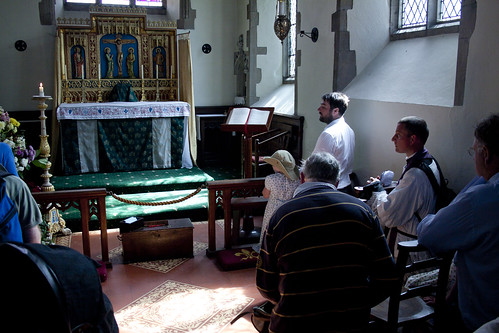
The following day we had a qute a contrast: Oxburgh Hall, and its private chapel, dedicated to the Immaculate Conception and St Margaret. Although built after the Catholic Relief Act (in 1836), the reredos is Medieval, and the chapel represents a continuation of the worship in more hidden places in the Hall itself during the times of persecution. Oxburgh is a very fine house, and boasts a priest hole.
2010 08 21_7500
Since this photo wasn't taken by me, you can see our liturgical schola: even on the move, we were able to have a vested schola and a serving team of MC, thurifer, and two acolytes.

Standing up on the left, above, with a dark jacket and grey hair, is Henry Bedingfeld, descendant of the Sir Henry Bedingfeld who was the custodian of Princess Elizabeth during the reign of Mary Tudor. She is said to have remarked afterwards 'if we have anie prisoner whom we would have hardlie and strictly kept, we send him to you.' He refused to sign the Act of Uniformity, and the house became a centre for Catholic worship. Washing was hung out to dry on the hedges to signal that Mass was to be said. A later Sir Henry fought for the King in the Civil War and was imprisoned in the Tower of London for two years after his capture. A priest-hole can be seen in the house.
2010 08 21_7503
These white vestments, for the Feast of St Jane Frances Chantal, the friend of St Francis de Salles, belong to the Bedingfeld family.

We walked first to Walsingham village, passing in sight of the Slipper Chapel on the converging road road. When we saw it, we knelt down and said a prayer of thanksgiving.
2010 08 22_7437
Arriving in the village, we had lunch outside the recently built Catholic church, and had a final blessing before making the Holy Mile to the Shrine.
2010 08 22_7455
The large church next to the Slipper Chapel (which is very small) is extraordinarily difficult to photograph. The lights seem to be far more yellow than usual artificial lighting, and the enormous windows means that the celebrant is back-lit. The windows can be opened to allow Mass to be said the other way round - with the congregation outside, on benches.
2010 08 22_7479
As it is a recognised Shrine, we were able to have a Votive Mass of Our Lady; hence the white vestments (which nevertheless look yellow in photographs if you aren't careful). The vestments belonged to Paul Waddington, the LMS Treasurer who was part of our support team.

At Mass we were joined by Fr Thomas Crean OP; he can just be seen, on the left, in choir.

The more you fiddle with the colour settings, the more flat the resulting picture; it looks quite decent in black and white. This was just last Sunday, not some bygone era!
IMG_0620

We were extremely fortunate in our chaplain, Fr Redman, who walked every foot of the way with us, Sang Mass each day, led the Rosary and the Angelus, gave us meditations on the way and heard confessions. He really was the ideal chaplain; I hope it won't take him too long to recover!
2010 08 21_7531
See the full set of photographs, or a slideshow.

Thursday, August 26, 2010

Ely to Walsingham: overview

See also a post on the liturgy, and a running commentary.

2010 08 22_7457
Now my feet are slowly recovering, and I've had a chance to process my photos, it is possible to take stock of this pilgrimage, which was the first of its kind; I'll do a separate post on the liturgy along the way. We were extremeley fortunate from the very beginning of the planning, to have several important precedents to follow: several of the walkers, including me, had been on the Chartres Pilgrimage; one of our support team, Jeff Pillar, had an intimate knowledge of the great Walsingham Pilgrimages of the Guild of Our Lady of Ransom, and more recently those of the Dominican Sisters of Ely. Our chief organiser, Paul Smeaton, had been on the traditional 'Christus Rex' Pilgrimage from Ballerat to Bendigo in Australia. From all of these pilgrimages we learnt important lessons, both practical and in relation to the spirit of the thing. For example, we adopted some of the practices of the Australian pilgrimage, adapting their pilgrim's handbook and using the impressive pilgrims' blessing at the beginning, and we sang the Rosary in Latin as it is done at Chartres.
2010 08 22_7428
Our route and stopping places were based on the Dominican Sisters' pilgrimage. We are very grateful to the people who have been welcoming them for welcoming us also, especially the Convent of the Sacred Heart in Swaffam, in whose school gym most of the pilgrims slept, and the Bedingfeld family, who allowed us to have Sung Mass in their lovely private chapel. We were given a great welcome by the Parish Priests in both Ely and Downham Market, who let us sleep on their floors and use their churchs. We are also grateful to the Shrine of Walsingham itself, for finding us a slot for Mass at reletively short notice. One of the lessons of the pilgrimage, in fact, is how welcoming and helpful so many people on the route are to pilgrims, of whom of course there is a steady stream.
2010 08 20_7546
Catholic symbols in Ely Cathedral: the keys and sword of the Papacy, and the Five Wounds, which served as the banner of the Pilgrimage of Grace, the great protest against the Dissolution of the Monasteries, and was carved on the wall of the Salt Tower in the Tower of London by Catholics awaiting maryrdom.

How did it work? Contrary to what we had imagined, we managed to avoid using tents: there was enough space in the presbyteries and the school already mentioned for everyone. This made things a lot simpler, and cut down the gear which needed to be transported. As on the Chartres Pilgrimage, we had support vehicles taking the heavy baggage and providing us with water at regular intervals. These consisted of an 8-seater car, a Landrover, and a minbus. The nuns at Swaffam allowed us to use their large minibus on the Sunday as well.
2010 08 20_7553
Two of our support vehicles.

The route was meticulously planned; two chaps actually walked the great majority of it a couple of weeks earlier, to check the details and work out realistic walking times. The one section on footpaths which they weren't able to walk in advance was the one place where - perhaps inevitably! - we got slightly lost. This merely meant a lot of earnest looking at maps and a slight detour.
IMG_0596
The stops were planned, so we could be met by the support vehicles, but we didn't walk exclusively on roads. On the first day, we were almost entirely walking on the high banks of the Great Ouse and the Little Ouse, and we made a lot of use of footpaths on the second day as well, walking through some lovely woods after our stop at Oxburgh Hall.
2010 08 21_7524
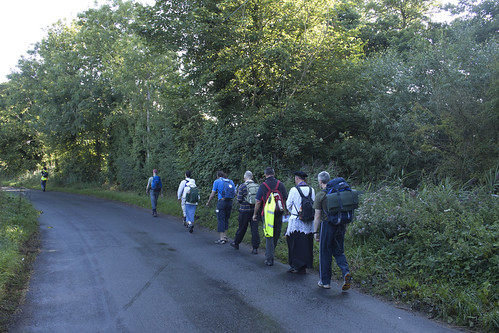
When on roads without footpaths our small group - between 10 and 12, as we were joined by extra people - had a lookout with high-visibility clothing at the front and back, with walky-talkies, to warn us about approaching cars. In fact the traffic was very light on these roads.
2010 08 22_7430
At the Mass for Chartres pilgrims in Westminster Cathedral, Fr Martin Edwards, the principal chaplain, joked that if English people were organising it would involve a lot of detours to agreeable pubs. Many of our stopping places were, in fact, pubs, but they were invariably closed when we got there: they use old-fashioned opening hours in East Anglia. There was one place, the Great Danes, near Swaffam, where the landlord found us resting on his outside benches and very cheerfully offered to serve us; this was very nice, but an exception!
2010 08 21_7532
As for the walk itself, it was certainly hard work. We had glorious weather, despite the despondant weather forcasts - all the rain fell at night. We made much better progress than we had anticipated on the first day, and kept up the pace well throughout. We did, of course, get the usual blisters and aches and pains. I have yet to find the ideal walking shoes; although my blisters were not as bad as at Chartres they certainly didn't let me forget about my feet! We walked 20 miles on each of the first two days, which was about 7 hours walking; starting at 7.30 from Ely, we got into Downham just before 5pm, and had Mass in the evening, followed by fish and chips. On the second day we left again at 7.30, and after an extended stay at Oxburgh, including Mass, and getting slightly lost, we got into Swaffam at about 8.30.
2010 08 21_7515
The private garden, within the moat, at Oxburgh, where the Bedingfelds invited us to have our lunch.
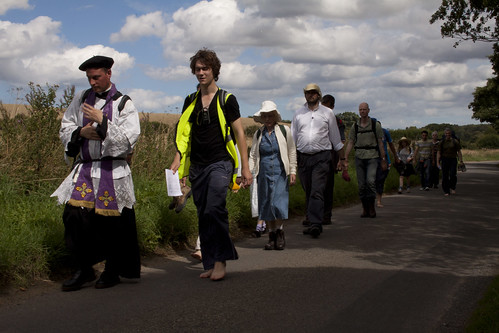
It was annoying not to be able to cover all the distance to Walsingham on foot, but with Mass at 2.30pm on Sunday it was obviously impossible to cover another 20 miles that day. We did half the distance, about 10 miles, being dropped off by minibus just south of the village of Helhoughton, south of Fakenham. We then walked to the village of Walsingham, and walked back the 'Holy Mile' to the Catholic Shrine. Despite the fatigue and blisters, many of the pilgrims took their shoes and socks off for the Holy Mile, in accordance with ancient tradition: this tradition, of course, is the origin of the 'Slipper Chapel', the place for pilgrims' shoes, at the southern end of the Holy Mile, which is the only part of the ancient shrine complex which has survived intact, and is in Catholic hands as the heart of the Catholic Shrine.
2010 08 22_7463
Pilgrims on the Holy Mile, led by our Chaplain Fr Alexander Redman.

The pilgrimage was a wonderful event. No one dropped out from injury or fatigue. As well as the prayers and the many hymns and songs we chatted at intervals and were able to have periods of quiet reflection. The group didn't come from any one place or group of friends, and included people of a wide range of ages and backgrounds, yet it was jolly and cohesive. This was a walking pilgrimage with a serious edge: fifty miles in three days is no joke. But it not as demanding as the Chartres Pilgrimage, and not the kind of thing where only the fittest can make it all the way to the end.
2010 08 22_7475
The Slipper Chapel
A pilgrimage like this, with serious physical effort and the inevitability of some degree of suffering, is a worthy offering to Our Lady of Walsinham for even the great intention which we had as a group, the Conversion of England, and our individual intentions. I hope to join this pilgrimage for many years ahead, and see it grow. We have made a good start.
See here for a slideshow of the photographs.

Tuesday, August 24, 2010

Does the TLM make things too easy?

Following my exchange with The Tablet there appeared a letter from a certain Bernard Tiley in the Catholic Herald. It is unusual for a letter in one publication to quote and reply to a letter in another, but that is what Mr Tiley did. The CH's letters page can't be copied and pasted, but here are some key passages:

In a recent statement Joseph Shaw, chairman of the Latin Mass Society, said, when referring to the celebration of Mass post-Vatican II, that "arbitrary deformations of the liturgy" (a phrase used by the Pope in his letter accompanying Summorum Pontificum) "have driven most (italics mine) of his contemporaries away from the practice of the faith; he was born in 1971.
2010 08 12_7341
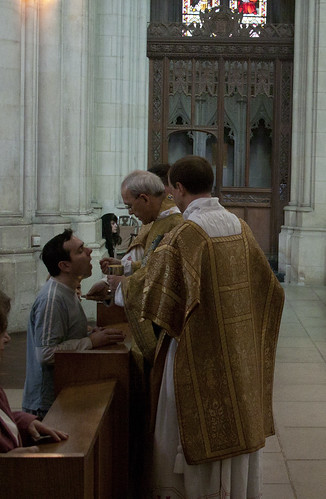
[Bishop Athanasius Schneider distributing Communion at a Pontifical Mass at the LMS Downside Training Conference]
...I much prefer the Ordinary Form of the Mass for a number of reasons; principally the vernacular and the logical way in which the Scripture readings in Mass relate to each other. However, if I were only able to attend the usus antiquior I would do so. To state the obvious, the Sacrifice of the Mass and the partaking of Jesus's body and blood is the same irrespective of the Liturgy with which it is celebrated.
2010 08 22_7463
[Pilgrims on the Holy Mile to the Catholic Shrine at Walsingham, having walked 50 miles from Ely on the LMS Pilgrimage.]
If people cease to practice the faith because of their liturgical preferences and I, like Stuart Reid, find this incredible, then the situation is truly alarming. It indicates an urgent need for effective catechesis in regard to the Mass. To cease to practice the faith on account of liturgical preference is to give the form of the Liturgy a higher priority than actually participating in the Eucharist.

It is hard to know where to start with a letter like this; it contains so many curiosities - including the eccentric capitalisations - and confusions. To start with I didn't say that anyone lapsed because of liturgical preferences - my contemporaries can hardly be said to have had much in the way of preferences, since they were not liturgically informed, and it would have been rare indeed for a person growing up in the 1980s to have experienced the Traditional Mass, let alone to have a serious opinion about it.
2010 08 05_7196
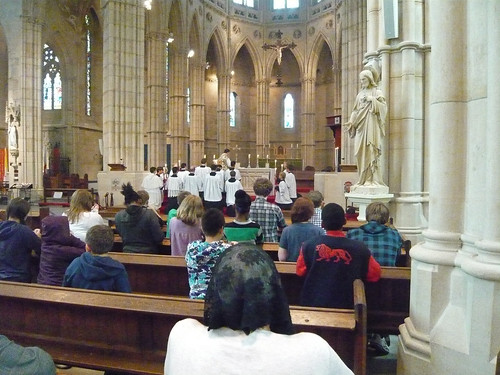
[The St Catherine's Trust Summer School, Missa Cantata at Arundel Cathedral.]
As for there being an 'urgent need for catechesis', I couldn't agree more: the people complaining about the liturgy for the last 40 years have also been complaining about the disastrous state of catechesis, which is indeed another reason for the high levels of lapsation. But Mr Tiley refers to this problem almost as if it were the fault of the children that they were not catechised, like a parent castigating his child for being spoilt. Well, whose fault was that?

However, I responded to a different aspect of his letter, in a letter published in the current edition:

Bernard Tiley (Letters, August 13th), quotes my reiteration of the Holy Father’s point (from the letter accompanying his motu proprio Summorum Pontificum): ‘I have seen how arbitrary deformations of the liturgy caused deep pain to individuals totally rooted in the faith of the Church.’
2010 08 06_6947
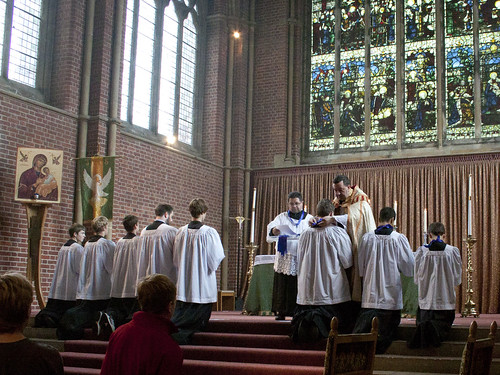
[Servers being enrolled in the LMS-sponsored Society of St Tarcisius, a guild of traditional altar servers, at the SCT Summer School.]
In a remarkable example of the ‘blame the victim’ syndrome Mr Tiley (who also finds the situation ‘incredible’) accuses these individuals of ‘giving the form of the liturgy a higher priority than actually participating in the Eucharist’. Certainly, wilfully to cease practicing the faith for any reason is a sin, but this sin is on the conscience not only of the ones who lapse from the faith but also of those who give occasion for lapsation. To watch two generations of Catholics lapse, at least in part because the fullness of the faith is no longer presented in a compelling way, or at all, in typical parish liturgies, and to react by washing one’s hands of them as insufficiently catechised, seems to me a pretty callous exercise.

Is Mr Tiley seriously suggesting that the Church’s job is to make it as hard as possible to get to heaven, so only those who really deserve it will make the grade? Would it not be better to take account of human frailty, and celebrate the liturgy in forms which give the most spiritual nourishment to participants? With this in mind, it is surely time, as the Holy Father indicates, to encourage more frequent celebration of the Traditional Mass, and to cease the liturgical abuses which disfigure so many celebrations of the Mass of Paul VI.
2010 08 08_6839
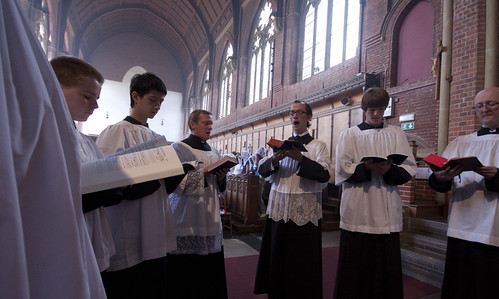
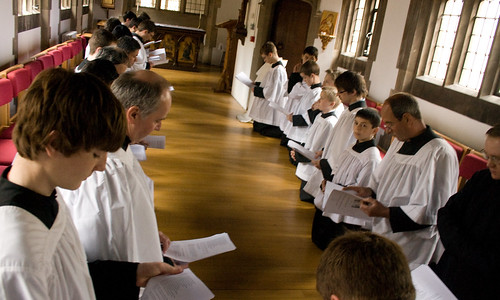
[Pupils and teachers singing Gregorian Chant at the SCT Summer School.]
I can't help wondering what is going through the mind of a man like this Mr Tiley: what is the Church about? He speaks of the reality of the Blessed Sacrament, but it is almost as though he wanted to keep it for himself, or at least for a small elite. The wider population is not good enough, and probably never will be.

But what is even more remarkable is that he, and others like him, have starting arguing in favour of the Novus Ordo Mass in spite of its pastoral deficiencies. He seems to be conceding the point that the Traditional Mass may be better at forestalling lapsation, but trying to persuade us that this is irrelevant. Well, it is certainly not the first object of the liturgy, which is the worship of God. But the whole point and justification of the post-Consiliar reform of the liturgy was pastoral - even the theological issues behind some of the changes were influenced by pastoral considerations. Having the Mass in the vernacular, being able to see the actions of the priest more clearly, etc. etc. were supposed to make it more attractive and more didactically effective. Playing down the metaphysical realities, grace, sin, death, miracles and the saints, was supposed to make the Faith easier to swallow.
2010 05 15_5998
[Inaugral meeting of the Society of St Tarcisius at Blackfriars, Oxford.]
But it turns out the that Novus Ordo has been a failure, from a pastoral point of view. Rather than saying: 'Well, we tested that hypothesis to destruction, let's try something else' the supporters of the post-Conciliar liturgy seem to be saying that we should ignore the pastoral consequences.

This is a common problem with discussions about the Church's pastoral practices since the Council. Things which have been tried as policies on the basis of prudential judgements have been elevated to the level of doctrines which have to be upheld by Catholics as articles of faith. The way this has been done with Ecumenism was brilliantly treated not long ago by Dr Thomas Pink, in an article which aroused much comment at the time it came out, and which is still well worth reading.
003
[A Traditional Sung Mass in the presence of the Relics of St Therese, the Oxford Oratory.]
For forty years we have been told that the Novus Ordo must be accepted because it is going to make the Faith vivid and attractive. Now people are coming to accept that the Traditional Mass can make the Faith more vivid and attractive: the boot is on the other foot.

Confirmations this November!

Last year I was able to attend the LMS' Confirmation service in London; I can see this year I won't be able to make it, but it is a wonderful occasion, with between 30 and 40 mostly young people receiving the sacrament from a bishop of the Westminster Archdiocese. I include below some of the pictures I took last year; see the slideshow.
2009 11 07_4719_edited-1
Bishop George Stack, auxiliary bishop in Westminster, will administer Confirmations in the Extraordinary Form of the Roman Rite (Traditional Latin Rite) at St James’ Church, Spanish Place, London W1 on Saturday 20 November 2010 in a ceremony organised by the Latin Mass Society. This will be the seventh year the LMS has organised ceremonies.
2009 11 07_4760_edited-1
As usual, permission for the Old Rite Confirmations has been given by Archbishop Vincent Nichols of Westminster.
2009 11 07_4766_edited-1
The candidates’ day will begin with a catechetical meeting in the Lady Chapel with Bishop Stack at 11.00 am. The Confirmation ceremony will begin at 11.30 am and will be followed by Pontifical Benediction of the Blessed Sacrament.

The choir and organist of Spanish Place will provide the music, and, as ever, a large congregation is expected.
2009 11 07_4771_edited-1
After the ceremonies, a reception for the bishop and newly-confirmed will be held in the crypt during which Bishop Stack will cut the celebratory cake.
2009 11 07_4793_edited-1
Anyone requiring Confirmation in the Extraordinary Form for their children – or themselves; we often have several adult candidates – should contact the LMS office urgently for registration forms and full details. (T) 020 7404 7284; (F) 020 7831 5585; (E mail) info@latin-mass-society.org