From the Catholic Herald:
On Saturday Pope Francis will lead thousands in St Peter’s Square in a prayer vigil for peace.
During his Angelus address on Sunday, Pope Francis said: “We will gather in prayer and in a spirit of penance, invoking God’s great gift of peace upon the beloved nation of Syria and upon each situation of conflict and violence around the world. Humanity needs to see these gestures of peace and to hear words of hope and peace.”
The vigil will include a recital of the rosary, eucharistic adoration, Scripture readings, a papal blessing and remarks by Pope Francis, said the Vatican spokesman, Jesuit Father Federico Lombardi. During the event, which will last from 7 p.m.-11 p.m, priests will be available to hear confessions.
For all Catholics, the Pope has proclaimed Saturday a “day of fasting and prayer for peace in Syria, the Middle East and throughout the world.” On fast days, adult Catholics in good health are expected to eat only one full meal.
Labels
- Bishops
- Chant
- Children
- Clerical abuse
- Conservative critics of the EF
- Correctio Filialis
- FIUV Position Papers
- Fashion
- Freemasonry
- Historical and Liturgical Issues
- Islam
- Liberal critics of the EF
- Marriage & Divorce
- Masculinity
- New Age
- Patriarchy
- Pilgrimages
- Pope Francis
- Pro-Life
- Reform of the Reform
- Young people
Friday, September 06, 2013
Thursday, September 05, 2013
Cong for Clergy urges priests to celebrate Mass daily

This interesting document is in danger of not being noticed because it has so far been published only in Italian and German. It is short, however, and (with a bit of help from Google) the main points are clear enough. Priests are urged to celebrate Mass every day, even in the absence of the Faithful. The arguments in favour of this traditional practice are, at bottom, the spiritual life of the priest, and the good of the Holy Souls in Purgatory.
This position strikes at the heart of the liberal conception of the Mass as a 'shared meal' in which the congregation's role is as important as that of the celebrating priest. On such a conception Missa sine populo - Low Mass literally without any congregation, perhaps not even with a server - doesn't make any sense.
The document also sheds some light on the meaning of the buzz-word of today: Pelagianism.
'To omit this daily celebration - except in the case of impossibility - means [as priests] depriving ourselves of the main food needed for our sanctity and the apostolic ministry of the Church, and to the risk of indulging a kind of spiritual Pelagianism , trusting in the power of man more than the gift of God.'
(Google, with corrections.)
Here it is, in Italian. How about someone doing a proper translation?

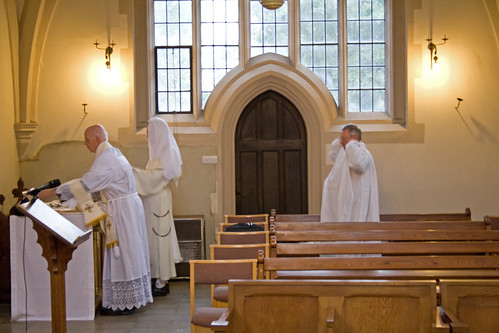
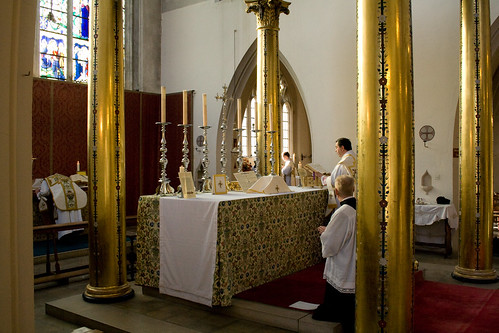
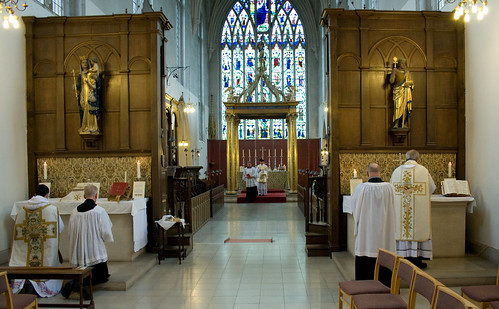
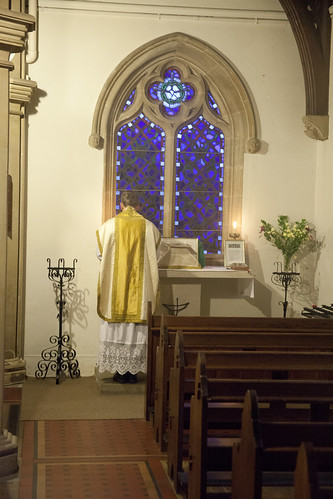
Photos: private Masses at the Latin Mass Society Priest Training Conference at London Colney in 2009. No Pelagians here!
Tuesday, September 03, 2013
Baltimore Catechism on Kindle!
This is fun: the Baltimore Catechism Number 3 is now available for the Kindle book-reader.
Number 3 is the most comprehensive of the series, excluding the teachers' version, which is called Number 4. So this is the one suitable for preparation for Confirmation.
New Kindle Catechism
We are pleased to announce our new Kindle version of the classic Baltimore Catechism just in time for the return of students to the classroom this fall. Now anyone can have the truths of the Catholic Faith available to him on his own electronic device wherever he goes. This comprehensive eBook edition of the Baltimore Catechism contains the constant, authentic doctrine and moral teaching of the Catholic Faith. More than 500 clear and concise questions and answers are included.
Fr. Connell's catechism is superior to any other catechism, including any other Baltimore catechism. Answers are well developed with thorough explanations and Sacred Scripture is used extensively to amplify the answers. In addition, each chapter concludes with study helps, exercises, and a summary essay for teachers and students.
This eBook edition by The Seraphim Company of Fr. Connell's 1949 Baltimore Catechism No. 3 was originally published by Benziger Brothers. In addition to the original content, this eBook edition includes an excellent section of essential Catholic prayers at the beginning and twenty-two beautiful engravings with explanations. It is not only excellent for adults and children, but is also perfect for religious programs and anyone desiring information about the Church.
To watch a brief video about the catechism itself and for a link to the book version as well, CLICK HERE.
Besides saving time and the costs of shipping and handling, the Kindle version brings several advantages to the use of the catechism:
- Convenience – access the Faith anywhere or anytime using your electronic device like a smartphone.
- Usability – highlight, annotate, bookmark/tab, cross-reference, search etc. within the book very quickly, easily and at great depth.
- Readability – increase point sizes, use backlit screen, enhance contrast for easier reading by anyone of any age.
Walsingham Pilgrimage Part 2

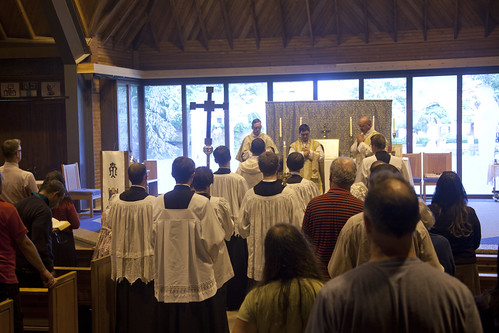
Continuing from my earlier post about the Pilgrimage, since we had four priests we had Solemn Mass each day, which was a treat; private Low Masses followed and/or preceded to give all the priests a chance to say Mass.

One of the high points of the pilgrimage is always Oxburgh Hall, and Mass in the private chapel of the house, which is quite substantial: you see here the transition from secret chapel in the attics to public mission church, which became the basis of the parochial system in the 20th Century.

Mass at the Catholic Shrine was very well attended - more than 200 people were there, not only the walking pilgrims but others who had travelled in the LMS coach from London, or in their own cars, or who happened to be around the shrine. There always seem to be lots of Keralan Catholics about the place, and it is the weekend of the Youth 2000 pilgrimage.
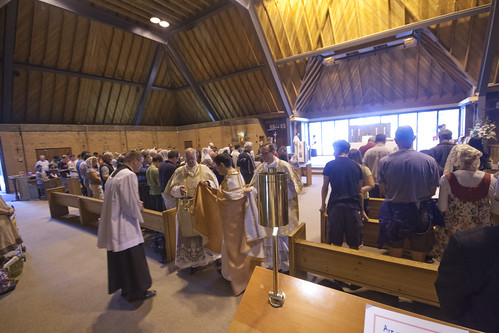
We can't fit that kind of number into the historic Slipper Chapel, where the shrine image is, so we use the 'barn', the Reconciliation Chapel. This, it must be said, is a strange structure, with even stranger, rather municipal, orange lighting. But the sanctuary doesn't impede the ceremonies of Solemn Mass, which is something.

Before Mass we had the Asperges; because the priest, Fr Michael Rowe from Australia, is away from the sunlight of the window shining from behind, I could get a decent photo.

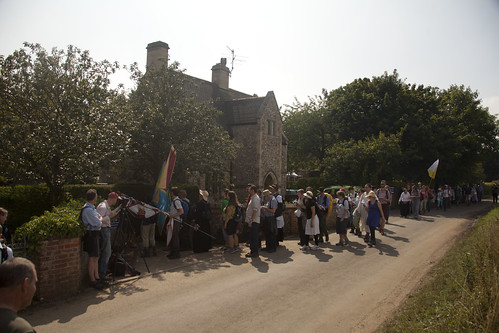
After Mass is the procession to the ancient shrine, down the 'Holy Mile' leading from the Slipper Chapel (where medieval pilgrims left their shoes) to the site of the Holy House, and the Priory which was built next to it.

There we had our final devotions and blessing from Fr Bede Rowe.

But there is a sort of postscript to the pilgrimage's devotions which I'll blog about tomorrow.
Monday, September 02, 2013
Young Catholic Adults retreat in September
Book now for the Young Catholic Adults weekend event at Cold Ash Retreat Centre (a couple of miles from Douai Abbey, which was booked up this year).* It will be include the following speakers:- Fr Gregory Person OP, Fr Matthew Goddard FSSP Fr Armand de Malleray FSSP, Fr. Gabriel Wilson O.S.B.
* There will be a Marian Procession, Rosaries, Sung/High Masses, Confession and socials.
* Gregorian Chant Workshops will also be running, this year led by the Schola Gregoriana of Cambridge.
Prices start at £35 per night.
Go here to book.
Sunday, September 01, 2013
Loftus attacks God
The Walsingham Pilgrimage has again put me behind with Loftus' outpourings, this one is from 25th August (Catholic Times). He is still talking about what Pope Francis said on the aeroplane. What the Holy Father said, Mgr tells us, is
in direct contradiction to fundamentalist legislism which enshrines values immutably, as though in tablets of stone.
So, who did that, writing laws on tablets of stone? Er, God. Loftus is calling God a practitioner of 'fundamentalist legalism'.
Loftus seems to get cold feet about this and later in the article says that some things can't change - 'they go to Faith'. I wonder if he means Faith as opposed to Morals. In any case, what he really lambasts in this article is the notion of the Christian society. Referring to Rahner, he writes:
Pure and unadulterated Christianity is not meant to be protected by taboos, or by some sacral aura, from all opposition or criticism. Christianity is no less complete without Christendom than it was with it.
But if Christianity today is not to become a fundamentalist sect, then the smaller it is, the more open it must be to the world about it. Only in this way can we preserve the 'Catholicism' or universality. And this can call for some quite dramatic changes.
While Loftus fantasises about the changes an ever-shrinking Church must make to enable it to blend in with an ever-hardening Christianophobia around it, the rest of us can reflect on the fact that the obligation to convert society to reflect the truth about morality is not only firmly fixed in the Ordinary Magisterium over many centuries, but is famously reiterated in Vatican II. While talk of 'religious liberty' might seem to point in the direction of a state and society which was neutral on controversial moral questions, and away from what Loftus quaintly calls 'taboos', Dignitatis Humanae, the Council's 'Declaration on Religious Liberty', goes to the trouble of explicitly excluding any such conclusion. Thus, DG 7:
Furthermore, society has the right to defend itself against possible abuses committed on the pretext of freedom of religion. It is the special duty of government to provide this protection. However, government is not to act in an arbitrary fashion or in an unfair spirit of partisanship. Its action is to be controlled by juridical norms which are in conformity with the objective moral order. These norms arise out of the need for the effective safeguard of the rights of all citizens and for the peaceful settlement of conflicts of rights, also out of the need for an adequate care of genuine public peace, which comes about when men live together in good order and in true justice, and finally out of the need for a proper guardianship of public morality.
When wondering what the 'guardianship of public morality' means we must keep in mind that when this document was promulgated, in 1965, divorce, abortion, homosexual acts and contraception were prohibited or strictly limited in a great many jurisdictions, not just in South America and Africa but in Europe and North America. We could argue about what DG means for the public manifestation of the Christian revelation (look at the prefatory note and the earlier magisterium on that), but that's public morality for you. You can't escape Natural Law by talking about changes in social conditions any more than about religious liberty. If Rahner disagrees, so much the worse for him.
in direct contradiction to fundamentalist legislism which enshrines values immutably, as though in tablets of stone.So, who did that, writing laws on tablets of stone? Er, God. Loftus is calling God a practitioner of 'fundamentalist legalism'.
Loftus seems to get cold feet about this and later in the article says that some things can't change - 'they go to Faith'. I wonder if he means Faith as opposed to Morals. In any case, what he really lambasts in this article is the notion of the Christian society. Referring to Rahner, he writes:
Pure and unadulterated Christianity is not meant to be protected by taboos, or by some sacral aura, from all opposition or criticism. Christianity is no less complete without Christendom than it was with it.
But if Christianity today is not to become a fundamentalist sect, then the smaller it is, the more open it must be to the world about it. Only in this way can we preserve the 'Catholicism' or universality. And this can call for some quite dramatic changes.
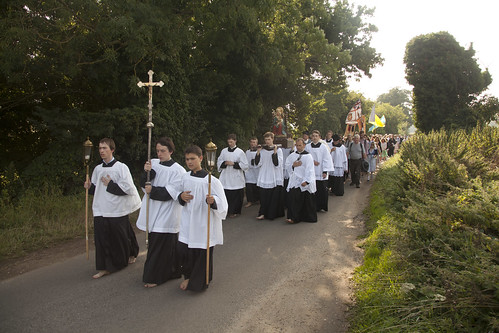
![]() |
| The public manifestation of the Catholic Faith: in Walsingham |
Furthermore, society has the right to defend itself against possible abuses committed on the pretext of freedom of religion. It is the special duty of government to provide this protection. However, government is not to act in an arbitrary fashion or in an unfair spirit of partisanship. Its action is to be controlled by juridical norms which are in conformity with the objective moral order. These norms arise out of the need for the effective safeguard of the rights of all citizens and for the peaceful settlement of conflicts of rights, also out of the need for an adequate care of genuine public peace, which comes about when men live together in good order and in true justice, and finally out of the need for a proper guardianship of public morality.
When wondering what the 'guardianship of public morality' means we must keep in mind that when this document was promulgated, in 1965, divorce, abortion, homosexual acts and contraception were prohibited or strictly limited in a great many jurisdictions, not just in South America and Africa but in Europe and North America. We could argue about what DG means for the public manifestation of the Christian revelation (look at the prefatory note and the earlier magisterium on that), but that's public morality for you. You can't escape Natural Law by talking about changes in social conditions any more than about religious liberty. If Rahner disagrees, so much the worse for him.
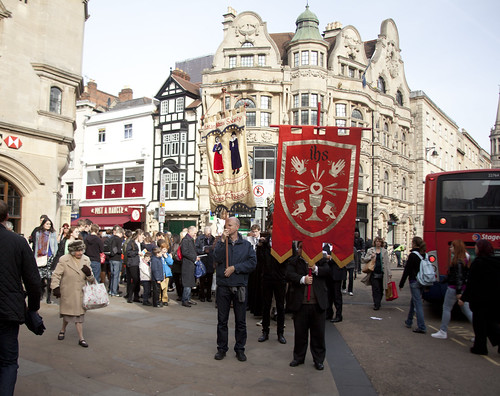
![]() |
| And in Oxford: the LMS Oxford Pilgrimage, in October last year. |
Saturday, August 31, 2013
Longenecker vs. Voris
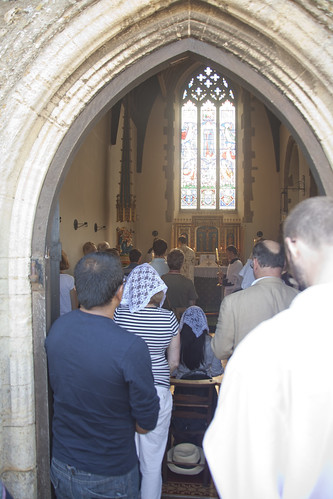
![]() |
| Looking in from the outside, at Walsingham |
Voris is railing against 'professional Catholics' being paid six-figure salaries (in dollars, of course). Fr Longenecker says he'd like to see a few more professionals in Catholic apologetics. Touche - I also think Voris is a bit of an amateur. (Full disclosure: I am not a professional theologian, and nor am I paid by the Latin Mass Society. I get expenses, mostly for travel, when I get round to claiming them.) But I think Fr L has missed Voris' point, which Voris doesn't articulate but I think takes for granted. These salaries are connected in Voris' mind with the big salaries of liberal diocesan administrators, as part of a military-industrial complex - well, ideological-liturgical complex - of the Catholic Establishment, which has done nothing over the last two generations but preside over a disastrous decline. Leaving it to amateurs like Voris to say the things which need saying.
No doubt the guys at Catholic Answers see themselves as a beleaguered remnant battling against the odds for the truth. (Funnily enough, Catholic liberals have the same self-image.) But from Voris' perspective, they are part of the Establishment of mutual back-scratching, and the salaries demonstrate this. The fact is that there is, in the USA at least, a Conservative Catholic establishment, with endowed institutions, a career-structure, access to the hierarchy and so on. And, Voris says, while acknowledging the good they do, they are also part of the problem. Because they refuse to see the real causes of the problems in the Church.
The problem Voris identifies with certain 'conservatives' is that, in order to have a seat at the big table as part of the Catholic Establishment, they profess themselves content with, or even enthusiastic about, the wrenching discontinuities of liturgy and theology which are present in the Church today. This then manifests itself with a contempt towards Traditionalists.
There is an established definition of a Catholic Traditionalist: they are people who wish to live in continuity with their predecessors in the Faith. This means that, while not rejecting organic development or new initiatives, they prefer the Traditional Mass, they gravitate towards traditional spirituality, they regard innovations of institutional form or theology as having to make their case: they must carry the burden of proof. This is, of course, what all Catholics should be like, this is the attitude called for by Popes down the ages, it is even explicitly demanded, in liturgical matters, by the Second Vatican Council.
Sacrosanctum Concilium 22:
Finally, there must be no innovations unless the good of the Church genuinely and certainly requires them; and care must be taken that any new forms adopted should in some way grow organically from forms already existing.
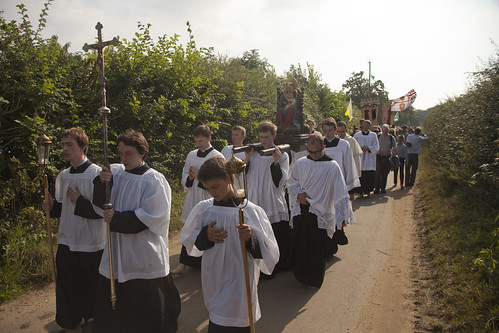
![]() |
| Not fruitcakes on the march, just Catholics on pilgrimage, doing what we've always done. |
But this Catholic attitude is a rebuke to some 'conservatives' - maybe they have a guilty conscience. So we have incessant attacks on 'radtrads', as Fr Longenecker delightfully calls them. He doesn't bother telling us who exactly he has in mind, he neither names names nor specifies theological positions, but when challenged he says that he likes good Traditionalists and is only attacking the bad ones. This is a lazy old trick: who is which? What kinds of 'traditionalist' attitude counts, according to Longenecker, as sede vacantist or anti-semitic?
You can't spend long in the Catholic world attached to the Traditional Mass without being called a sede vacantist or an anti-semite. I have been called both, at least by implication, over the years. I have no way of telling whether my own views don't put me into Fr Longenecker's sights: whether, that is, he is only criticising people who are genuinly sede vacantist and genuinely anti-semitic, or whether he is using these terms as hiss-words to apply to a much larger group. Of course, there is a lunatic fringe, there are people attached to the Old Mass who have genuinely unpleasant views, and I've been attacked by them as well. I am a bit hazy about exactly what Christian Order stands for these days, but they think I am insufficiently hard-core for them and I am pretty content with that situation. But even if Fr Longenecker does have only the nut-jobs in mind, it is hardly helpful to fixate on them.
I don't spend all my time attacking the people who've been excommunicated for carrying out bogus ordinations of women: the radical liberals. Why not? Because they aren't a serious part of the conversation. Not even the Tablet takes them seriously. Sure, if they got too much influence they could drag the whole progressive Catholic groove into disrepute - to parallel Fr Longenecker's argument about trads - but that isn't going to happen, they know perfectly well what lines they can't cross. Fr Longecker should apply his critical faculties to the positions which are part of the conversation: the views of ordinary Traditionalists, their respected publications, organisations, conferences and so on. There's plenty there to get your teeth into.
Subscribe to:
Posts (Atom)