I'm reposting this from March 2014, inspired by seeing one of the arguments I address below used on social media somewhere. (By someone who apparently hadn't heard of Savoranola, Dante, or Robert Grosseteste.) 2014 seems like a lifetime ago, but although I have criticised Pope Francis since then I stand by the principles I set out back then, which explain the on-going policy of this blog about how to handle difficult issues surrounding Pope Francis.
------------------------------------------------
Michael Voris thinks not. His arguments are interesting but don't work.
First, he says that to criticise the Pope causes scandal, sharply contrasting this with criticism of bishops and Cardinals. (First silly point: there is no sharp contrast. What is true of one is to a large extent true of the other.) That there is a danger of causing scandal is true, but it is also true that, in certain circumstances, not criticising the Pope causes scandal. It is lucky for us today that St Catherine of Siena and Savoranola and Dante and Robert Grossteste criticised the popes of their day, because they prove that not all Catholics are guilty of Papolatry: that it is not necessary to have your conscience surgically removed to become a member of the Mystical Body. They are our defence against some of the most insistent and damaging polemics, developed by Protestants and re-used by Secularists, against the Church. To use a phrase of Pope Francis, when I encounter a clericalist, it makes me feel anti-clerical.
Voris then turns to the counter-argument that saints have criticised Popes. In an astonishing inversion of logic, he says that they could legitimately criticise Popes because they were saints.
First, this misses the point, which was not that only saints are widely regarded as being justified in their criticisms of Popes (see my short list above: plenty of others have been too), but that this widespread judgement can't be too off the mark because even saints criticised popes.
Secondly, it would be strange to suggest that St Catherine and St Paul and the other saints had to ask themselves if they were holy enough to carry out their obligations. That way only egomaniacs will criticise the Pope, and that won't be progress.
The wider point is well made by no less that the Supreme Legislator himself, in Canon Law: even the laity can have the right and indeed the duty to voice their concerns about their pastors. The Pope is not excepted.
Canon 212 sec. 3, the laity has "the right and even at times the duty to manifest to the sacred pastors their opinion on matters which pertain to the good of the Church and to make their opinion known to the rest of the Christian faithful, without prejudice to the integrity of faith and morals, with reverence toward their pastors, and attentive to common advantage and the dignity of persons."
I don't say this because I am about to embark on a lot of blogging criticising the Holy Father. I just think it is important to oppose grossly distorted understandings of Catholic teaching wherever I see them, to the best of my ability, because, to coin a phrase, they cause scandal.
As far as criticising Popes is concerned, I would in practice urge great caution.
First, any criticism which comes across as personal, or as mocking or insulting, is inappropriate to a person holding his high office. That is because the office is holy, even if not all holders of the office are holy. The office is august, it commands our respect. The holder does not become impeccable - incapable of sin - but it does mean that any criticism is a serious matter, and should be undertaken, if at all, in a serious way. This of course is part of what the canon says.
I do, incidentally, think that mockery, ridicule and even invective can sometimes be appropriate: I'd be in trouble if I didn't, since Our Lord used them, and so did many prophets, Fathers of the Church, saints, and apologists down the ages. They are useful to take people worthy of ridicule down a peg or two. The Pope, however, is never ridiculous. When he is wrong, things are too serious for that.
Secondly, as with others in very exalted offices, but very much more so, it is difficult to separate what is personal to the Pope from what is the initiative of advisors and office-holders. He does have the fearful ultimate responsibility - true - but as initiatives and policies develop from day to day it is impossible, at least for those of us without inside information, to know what is the Pope's idea, what is his speechwriter, what comes from (good, bad, or indifferent) briefings given to the Pope, and what are the actions of his Cardinals and other ministers.
For example, I was astonished to read that Pope Paul VI approved the new Lectionary without giving it prolonged attention, and actually said so. He trusted his advisers. If this was an error, it was not the same error as the error (say) of deliberately excluding 1 Corinthians 11:29 (about the sin of receiving Communion unworthily) from the Lectionary, when it had previously been read on Maundy Thursday and Corpus Christi. Being too trusting is not the same fault as not taking seriously the importance of being well prepared for Holy Communion. If people had laid into Pope Paul for the second thing in 1970, they would have been barking up the wrong tree.
Far better, therefore, to voice concerns, if there are legitimate concerns, about policies, about new regulations or liturgical texts or other documents, but without turning it into a personal attack on the Holy Father.
We are sometimes told that being 'over critical' of the Pope or bishops is the besetting sin of traditionalists. As a matter of fact, this is not true. Not only do liberal Catholic publications like The Tablet attack the pope all the time (yes, including Pope Francis), but many Catholic organisations down the years who had no particular connection with the Traditional Mass have, for one reason or another, ended up associated with criticisms of the hierarchy.
The classic example is Aid to the Church in Need, which used to criticise the appeasement of Communism which was the official Vatican policy under Pope Paul VI. More recently, the headline cases have been Pro Ecclesia and SPUC. Now we have Deacon Nick Donnelly being hauled over the coals, for what we can assume is the same thing. I don't say these criticisms were not justified, or that they were not expressed in the best ways: that would be a long discussion. I've just said that criticism isn't ruled out in principle, so the matter is an open one. My point is simply that the Traditional Mass was nothing to do with it.
Critics of traditionalists have become confused by the fact that until Summorum Pontifcum it was such open season on trads and any old stick was good enough to beat them. But once you take away the assumption that support for the Traditional Mass is itself an act of personal disloyalty to the Pope, then you can allow yourself to notice that established traditionalist organisations like the Latin Mass Society and the Una Voce Federation are, and always have been, models of diplomacy and restraint.
They combine this respect for the hierarchy with a complete adherence to the unchanging teaching of the Church, not out of any superficial ultramontanism (whatever the Pope said about his breakfast is the latest infallible doctrine), but because of their attachment to Tradition. This is something I want to develop in future posts.
Labels
- Bishops
- Chant
- Children
- Clerical abuse
- Conservative critics of the EF
- Correctio Filialis
- FIUV Position Papers
- Fashion
- Freemasonry
- Historical and Liturgical Issues
- Islam
- Liberal critics of the EF
- Marriage & Divorce
- Masculinity
- New Age
- Patriarchy
- Pilgrimages
- Pope Francis
- Pro-Life
- Reform of the Reform
- Young people
Showing posts with label Michael Voris. Show all posts
Friday, December 29, 2017
Saturday, April 23, 2016
God bless Michael Voris
I've had my differences with Michael Voris (and here), but never doubted his zeal and sincerity. The idea that the repented sins of his past life should cause one to question either zeal or sincerity is patently ludicrous, from a Catholic standpoint, and like pretty well everyone in the Catholic online community I am very impressed by his response, which can be seen here.Liberals have a very different line, as their attacks on Kim Davis indicated not long ago. For anyone who has forgotten, Kim Davis was the elected County Clerk in Kentucky who refused to issue marriage licenses to same-sex couples. She is a 'born again' Christian, and liberals thought they could undermine her witness to her faith by pointing at her former life - she'd been married four times. On so many levels, So what? What difference does it make to the truth or falsity of what she says? What difference does it make to the sincerity of her faith? What difference does it even make to whether she is assessed as a good person?
Thursday, October 08, 2015
Can the Traditional Mass preserve orthodoxy?
![]() |
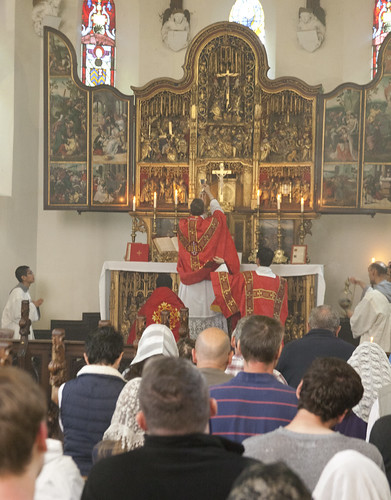
| High Mass in Oxburgh Hall Chapel, for the LMS Pilgrimage to Walsingham for the Conversion of England. |
Michael Dougherty has written (in The Week, largely reproduced on 1 Peter 5) that the current crisis in the Church arises out of a failure to centre the Faith on Christ. The Traditional Mass is Christ-centric, and in the writings of Cardinal Ratzinger we find powerful arguments that the Ordinary Form is much less so. Ratzinger explains the Christocentric meaning and influence of a series of features of the Traditional Mass which have been lost, or usually lost: the silent canon, the priestly prayers, and celebration ad orientem.
The solution to the dogmatic crisis, then, is connected with the solution to the liturgical crisis. Indeed, everyone by now knows the passage from Cardinal Ratzinger:
“I am convinced that the ecclesial crisis in which we find ourselves today depends in great part upon the collapse of the liturgy, which at times is actually being conceived of etsi Deus non daretur:as though in the liturgy it did not matter any more whether God exists and whether He speaks to us and listens to us."
In short, the Traditional Mass can help to restore the Church's lost balance.
The response to this in the com box is largely the same as the response to this idea made recently by Michael Voris in an interview with the Latin Mass Society which you can read here (see p8):
Thursday, September 17, 2015
Michael Voris on the SSPX: not charitable, not true
The announcement by Pope Francis that priests of the Society of Pius X (SSPX) will be given faculties to hear confessions during the 'Year of Mercy' has stimulated Michael Voris to reiterate once again his view that the SSPX are in schism. I've mentioned Voris positively over the years on this blog, and the current issue of the Latin Mass Society's magazine, Mass of Ages, includes an interview with him, but I have to disagree with him about this, which is far from being a merely theoretical issue.
The reality is that the exact legal status of the SSPX has always been somewhat ambiguous, and as does happen in real life, it is an ambiguity which has been deliberately maintained by both sides to facilitate a positive evolution of the relationship. It is not for Michael Voris to insist on what successive Roman officials have refused to insist on.
Not exactly. He said that Archbishop Lefebvre's ordination of four bishops without the consent of the Holy See was 'a schismatic act', and later in the document pointed out the penalty - excommunication - for 'formal adherence to schism'.
The reality is that the exact legal status of the SSPX has always been somewhat ambiguous, and as does happen in real life, it is an ambiguity which has been deliberately maintained by both sides to facilitate a positive evolution of the relationship. It is not for Michael Voris to insist on what successive Roman officials have refused to insist on.
Voris tells us that 'In 1988, Pope St. John Paul called their movement a schism'
Not exactly. He said that Archbishop Lefebvre's ordination of four bishops without the consent of the Holy See was 'a schismatic act', and later in the document pointed out the penalty - excommunication - for 'formal adherence to schism'.
Thursday, August 20, 2015
Autumn Mass of Ages available
I'm being a bit slow with blogging at the moment, but the new edition of Mass of Ages, the first to be edited by Dylan Parry, is now available in your friendly local church (if not, ask your friendly local priest to stock it: it is FREE), and from the LMS Office.Members have their copies delivered to their homes, so join here.
Monday, May 04, 2015
Voris in London: how to witness to the Faith
![]() |
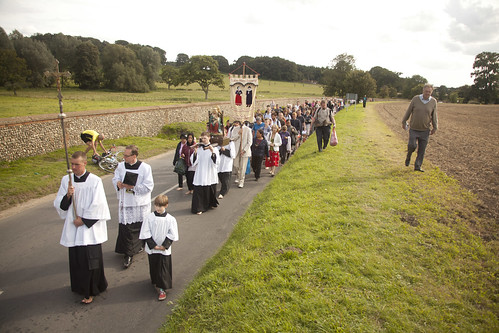
| Witness to the Faith: the Walsingham Pilgrimage, in August. Book now. |
On this persecution, he referred to the case before the Supreme Court in the USA about same-sex marriage. If they find it to be a constitutional right, everything changes: and not for the better.
I think the emphasis on the importance of being in a state of grace, which I've seen from some other orthodox Catholic sources in recent years as well, is extremely good. It can't be stressed too much that if you are in a state of mortal sin you have no sanctifying grace in you; you have lost the friendship of God and the life of God in your soul. Not only will you go to hell if run over by the proverbial bus, but you can't expect to be effective in situations of what we might call spiritual combat. You won't be able to stand up well to temptations; you won't be able to give good advice to friends and colleagues who need it; you won't be a witness to the faith. If you've committed fornication, if you've used contraception, if you've been complicit in an abortion, engaged in vindictive gossip, fiddled your taxes, or cheated your employer or an employee: for heaven's sake get to confession.
There's another aspect of what he said which, in the same spirit of constructive criticism I employed after his last London talk, I want to question. For he said repeatedly that as good Catholics we should challenge people, such as family members and colleagues, about religion. He said it was not enough, for example, to have a statue of Our Lady by your place of work, hoping it might stimulate enquiries or conversations; you must go out and initiate these conversations.
Sunday, April 19, 2015
Michael Voris is coming to London
I've been asked to pass this on. While I certainly don't agree with everything he says, Michael Voris is an important voice for traditionally-minded Catholics, and this event is FREE.It is at the Regent Hall, Oxford Street, in London, at 7pm on Friday 1st May.
Get your free e-ticket here.
Support the work of the LMS by becoming an 'Anniversary Supporter'.
Saturday, August 31, 2013
Longenecker vs. Voris
![]() |
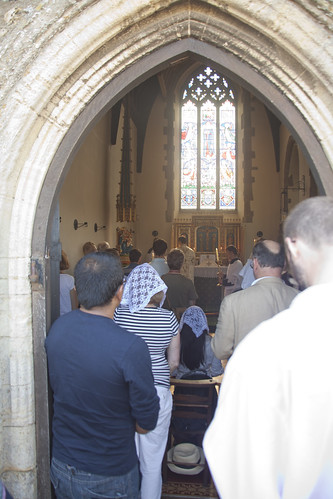
| Looking in from the outside, at Walsingham |
Voris is railing against 'professional Catholics' being paid six-figure salaries (in dollars, of course). Fr Longenecker says he'd like to see a few more professionals in Catholic apologetics. Touche - I also think Voris is a bit of an amateur. (Full disclosure: I am not a professional theologian, and nor am I paid by the Latin Mass Society. I get expenses, mostly for travel, when I get round to claiming them.) But I think Fr L has missed Voris' point, which Voris doesn't articulate but I think takes for granted. These salaries are connected in Voris' mind with the big salaries of liberal diocesan administrators, as part of a military-industrial complex - well, ideological-liturgical complex - of the Catholic Establishment, which has done nothing over the last two generations but preside over a disastrous decline. Leaving it to amateurs like Voris to say the things which need saying.
No doubt the guys at Catholic Answers see themselves as a beleaguered remnant battling against the odds for the truth. (Funnily enough, Catholic liberals have the same self-image.) But from Voris' perspective, they are part of the Establishment of mutual back-scratching, and the salaries demonstrate this. The fact is that there is, in the USA at least, a Conservative Catholic establishment, with endowed institutions, a career-structure, access to the hierarchy and so on. And, Voris says, while acknowledging the good they do, they are also part of the problem. Because they refuse to see the real causes of the problems in the Church.
The problem Voris identifies with certain 'conservatives' is that, in order to have a seat at the big table as part of the Catholic Establishment, they profess themselves content with, or even enthusiastic about, the wrenching discontinuities of liturgy and theology which are present in the Church today. This then manifests itself with a contempt towards Traditionalists.
There is an established definition of a Catholic Traditionalist: they are people who wish to live in continuity with their predecessors in the Faith. This means that, while not rejecting organic development or new initiatives, they prefer the Traditional Mass, they gravitate towards traditional spirituality, they regard innovations of institutional form or theology as having to make their case: they must carry the burden of proof. This is, of course, what all Catholics should be like, this is the attitude called for by Popes down the ages, it is even explicitly demanded, in liturgical matters, by the Second Vatican Council.
Sacrosanctum Concilium 22:
Finally, there must be no innovations unless the good of the Church genuinely and certainly requires them; and care must be taken that any new forms adopted should in some way grow organically from forms already existing.
![]() |
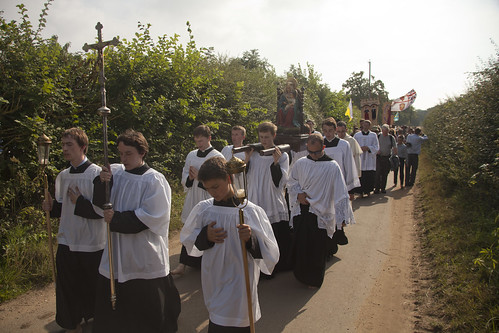
| Not fruitcakes on the march, just Catholics on pilgrimage, doing what we've always done. |
But this Catholic attitude is a rebuke to some 'conservatives' - maybe they have a guilty conscience. So we have incessant attacks on 'radtrads', as Fr Longenecker delightfully calls them. He doesn't bother telling us who exactly he has in mind, he neither names names nor specifies theological positions, but when challenged he says that he likes good Traditionalists and is only attacking the bad ones. This is a lazy old trick: who is which? What kinds of 'traditionalist' attitude counts, according to Longenecker, as sede vacantist or anti-semitic?
You can't spend long in the Catholic world attached to the Traditional Mass without being called a sede vacantist or an anti-semite. I have been called both, at least by implication, over the years. I have no way of telling whether my own views don't put me into Fr Longenecker's sights: whether, that is, he is only criticising people who are genuinly sede vacantist and genuinely anti-semitic, or whether he is using these terms as hiss-words to apply to a much larger group. Of course, there is a lunatic fringe, there are people attached to the Old Mass who have genuinely unpleasant views, and I've been attacked by them as well. I am a bit hazy about exactly what Christian Order stands for these days, but they think I am insufficiently hard-core for them and I am pretty content with that situation. But even if Fr Longenecker does have only the nut-jobs in mind, it is hardly helpful to fixate on them.
I don't spend all my time attacking the people who've been excommunicated for carrying out bogus ordinations of women: the radical liberals. Why not? Because they aren't a serious part of the conversation. Not even the Tablet takes them seriously. Sure, if they got too much influence they could drag the whole progressive Catholic groove into disrepute - to parallel Fr Longenecker's argument about trads - but that isn't going to happen, they know perfectly well what lines they can't cross. Fr Longecker should apply his critical faculties to the positions which are part of the conversation: the views of ordinary Traditionalists, their respected publications, organisations, conferences and so on. There's plenty there to get your teeth into.
Tuesday, April 10, 2012
Michael Voris on the Traditional Latin Mass
I'm not an uncritical fan of Michael Voris (that's just me, I'm like that with most people!); this video of his is fun both because it is about the TLM and because the Juventutem London group gets an honourable mention.
Voris is right: a high proportion of the places where the Faith is active, growing, and engaged with the issues of the day are places where the Traditional Mass is to be found. A much higher proportion, that is, than in the general Catholic population. If the TLM accounts for only one percent or so of Catholic Masses, it certainly accounts for a lot more than one percent of pro-life activists, chant scholas, vocations to the priesthood, and young families.
Thursday, September 08, 2011
On being critical
"If I say to the wicked, 'You shall surely die,' and you give him no warning, nor speak to warn the wicked from his wicked way, in order to save his life, that wicked man shall die in his iniquity; but his blood I will require at your hand." (Ezekial 3:18)
When I posted my reaction to Michael Voris, I said that since I thought he was basically a Good Thing I would show my appreciation by criticising what I took to be the main point of his talk. I wasn't joking: since I am basically well disposed to what he had to say, it is useful to him (in the unlikely event that he reads it) and to others to make a critique of what he said. In fact I thought his message should have been more nuanced and balanced.
Inevitably I was criticised myself in the com-box by some of his many fans - since this blog is pretty obscure I got off lightly, I know others who've criticised Voris have been deluged. These fans say that I shouldn't criticise Voris for the very reason that I think that it is important to criticise him: that is, because despite his limitations he is basically a Good Thing.
Presumably Voris himself agrees with me, since he is famous for being critical, and indeed for criticising not just the lunatic fringe liberals but apparently conservative groups like the Knights of St Columbus. Those fans of his, who infest the com-boxes of bloggers who dare say anything critical of Voris, don't seem to be alive to the irony of attempting to silence criticism of a man whose entire apostolate is based on the justification and indeed necessity of criticing fellow Catholics. If we shouldn't criticise Voris, then a fortiori Voris shouldn't criticise anyone else, especially bishops. If these fans had any sense, they'd welcome criticism of Voris in the spirit of a healthy and charitable debate.
The bigger question is whether a healthy and charitable debate is indeed an ideal, or whether we Catholics should be stifling public criticisms of each other in the interest of presenting a united front, or (where applicable) respect and obedience of legitimate authority, or simply because we think that charitable debate is impossible and we want to avoid acrimony and divisiveness. Let me address these objections in turn.
1. If we criticise fellow Catholics, we give scandal to non-Catholics.
This may indeed happen, but it is a far greater scandal to non-Catholics to see a public sinner or dissident being treated as if nothing were amiss by his fellow Catholics. When theologians who publicly dissent from Catholic teaching, or politicians who vote for abortion, are feted in Catholic institutions and lauded on Catholic blogs this very clearly and directly undermines the witness of the Church to the truth of her teaching. St Paul repeatedly says that the Christian community should ostracise and eject such people (2 Thess. 3:14; 1 Cor. 5:13; 1 Tim. 1:20). A community united by a set of beliefs will simply cease to exist if it tolerates as fully-paid up members those who do not share the beliefs.
Catholic bloggers are not the most important line of defence here - it is for bishops to reprove formally, and ultimately to excommunicate - but they do have obligations. They should not contribute to the idea that people are model Catholics because (like the Kennedy clan, for example) they are so rich or well-connected or otherwise influential that everyone is too frightened to point out that they have departed from the Faith. A vigorous rejection by a wide range of Catholic voices of the views of dissident Catholics is the best possible witness we can give to non-Catholics, given that we can't make the dissidents disappear.
2. Criticism is incompatible with respect and obedience to legitimate authority.
St Paul criticised St Peter; St Catherine of Siena criticised a series of popes. This is certainly something which has to be done with great care, and I'm not recommending it, at least in normal circumstances (normal for today, I mean). It can easily be counter productive, for one thing. But criticising those in authority is certainly not ruled out in principle by obligations of respect and obedience. Our bishops give us very clear teaching on this, by (rightly) criticising the civil authorities. We owe the civil authorities respect and obedience. We can still criticise them, and indeed we often must. However, it is usually enough to criticise ideas rather than individuals, if we want to avoid the impression of disrespect for those in authority. The point should never be a personal attack, but a point of principle.
'Conservative' Catholics and liberal Catholics sometimes seem to share a blindness to the distinction between dogmatic and prudential matters, and also to between authoritative public teaching and off-the-cuff or private statements. On issues of faith and morals, authoritative statements by those in the Church with authority to teach have prima facie force and should be accepted by the faithful, although the faithful can't be expected to accept contradictory statements, as would happen if a priest or bishop contradicted another authoritative statement. And here it should be noted that the docility of the faithful is as much, indeed more, to be measured by their acceptance of the decrees of Lateran IV or the Athanasian Creed as by the latest pastoral letter from their local ordinary. On prudential issues, matters of policy, tradition has a lot to say and priests and bishops have the grace of their offices in governing their flocks, but they are not preserved from error and debate may be an essential part of getting things right. (Also see my series about obedience.)
3. Charitable criticism is impossible so we should have no criticism at all.
It is certainly a problem for bloggers that sweet reason can be overwhelmed by the 'crazies'. The internet, it can seem, belongs to those who are least averse to staying up all night ranting. I actually think that this is a passing phenomenon: increasingly blogs are refusing to accept anonymous comments and swift moderation should mean that rants are online, attached to respectable blogs, for a very short space of time. The most widely read sites are the ones which are reasonably sane and the internet makes it easy to show that really crazy ideas contradict on-line Church documents and the like.
The other thing we all need to get used to is the instant publication of our views. The internet is a hasty forum and people blurt things out in a way they might in a saloon-bar discussion, and it is there for the whole world to see forever. I have said it before, we have to accept that the blogs are more like people sitting round in a pub than a carefully researched monograph; while being careful ourselves we shouldn't get too upset when other people seem to fly off the handle. Certainly we shouldn't forget the advantages of the medium: the instant correctability, the ability to link to photographic or video evidence or textual sources, the linking up with scholars and specialists as well as ordinary Catholics.
Debate about the application of the Church's teaching to new situations, and to prudential matters, has always taken place in the Church, and it is not only inevitable but frequently very important. When St Bernard of Clairvaux said that St Peter the Venerable was wicked from the top of his head to the soles of his feet, or when A.W. Pugin said that the classical style of architecture was unfit for Christian worship, they were getting a bit too excited. But you can't stop them, and you shouldn't want to stop them, engaging in criticism and debate. What we might want to do is make the debate more calm and charitable.
There is an deeper issue here, however, and that is mediocrity. The love of mediocrity leads to a hatred of criticism; I actually think this is a more important motive in the attempt to stifle criticism than concerns about giving scandal and charity. I'll post about this next.
Pictures: Voris, St Catherine, St Bernard.
Labels:
Bishops,
Blogs,
criticism and mediocrity,
Michael Voris
Thursday, August 25, 2011
Michael Voris in the flesh
So now I've seen him. You pick up a lot more from seeing someone without the mediation of an internet video, and editing. Voris is just as energetic as he seems on his website, but not as carefully scripted.
Michael Voris is not a particularly good speaker. I don't say this as a criticism, it is just a fact; we all have different talents. I've given lots of talks and my concern is always to make a coherent, structured case; I don't know if I always succeed, but for all his charisma Michael Voris didn't. His talk meandered; at one point he made an aside and never got back onto the main point, as far as I could tell. Nevertheless he had lots of interesting things to say. He spoke without notes, with urgency, making points of principle and relaying some helpful and amusing anecdotes.
He is clearly not theologically trained. A number of times I thought: 'No, that not quite the right way to make that point': he's no heretic, but gets betrayed into saying things which aren't exactly right, he doesn't always use the right terms or express things in the right way. He said all the other sacraments exist for the sake of the Eucharist: no, that's not quite right. They exist for our salvation. Baptism shouldn't be subordinated to the Eucharist; one could as easily say the Eucharist exists for the sake of Baptist, for the sake of the Christian people brought into existence by Baptism. (And how does Matrimony fit in?) However he was making a point about the importance of the Eucharist; we knew what he was driving at and I'm not going to be reporting him to the CDF.
The fact is that the people who are theologically trained, or most of them, have left it to an enthusiastic auto-didact like Michael Voris to defend the faith, in its fullness, in an appealing way to a mass audience, addressing issues of immediate concern and relevance. Yes this has often happened in the Church before. The theologians, priests and bishops who don't like Voris' style should get off their backsides and do what he is doing, better. Frankly Voris is a hero for taking on this apostolate, all the more because of his limitations; that doesn't mean he shouldn't be criticised, but he should also be appreciated.
The overall impression was good. The audience loved it. And to show my appreciation I'm going to criticise (yes, that's my way of showing appreciation) what I take to be his central point: that we should all focus all of our energy on 'being Catholic', to the exclusion of things like (his examples) stamp collecting or football.
I wish more Catholics spent less time on frivolous matters, but there is an opposite worry too: that of religious mania, obsessiveness. As Catholics we see the value of artistic and cultural things, of friendship, and of simply playing games, in themselves. They aren't the most important things, but neither are they excluded from a well-lived life. It is interesting and can be useful to relate these things to Catholic history or culture where applicable, but we don't need to do that in order to justify them. Michael Davies used to say (I think I read this somewhere, someone who knew him can correct me) that Traditionalists needed sometimes to take some time off. Davies was a rugby fan. It is actually necessary for our mental health that we aren't always wound up in a state of religious enthusiasm--even if we do try to be aware, always, of the presence of God. We shouldn't see the state of spiritual fervour as an ideal to which we only sometimes attain, but as a part of a life of varied mental states, a life which includes playing with our children, reading a trashy novel, going for a walk, having a cup of tea... and maybe even collecting stamps.
As I say, I wish more Catholics put aside their video games or gossip columns to read up on the faith, to attend devotions, to get involved in Catholic activities of all kinds. But there is a different message to be given to the kind of people who were attending Michael Voris' talk last night, the 'generous souls'. As Voris said, Catholics believe in the goodness and the salvation of the body as well as of the soul. Live a complete life; religious observance and Catholic activism may be the most important things in your life, but they shouldn't be the only things. Otherwise, you'll get burnt out and then you'll be no use to anyone. Yup, religious mania can be a danger to the Faith: your own, and other people's.
This is difficult today because everyone under the age of 60, if they care about their faith, is desperately trying to catch up on the religious formation they did not have as children and young adults; and the situation in the Church and the World is just so bad it can feel like living in a war zone. Do you take time off for pleasant excursions when the enemy is fighting their way in to your front room? Well, if you know the war is going to last at least for the rest of your life you have got to.
So! Talking of devotional activities, I'm now off to Walsingham. Look out for my live blogging from the road.
Tuesday, August 23, 2011
Michael Voris in London tomorrow!
I've listened to a few of his video broadcasts and I must say I'm fascinated to see him in the toupée - I mean in the flesh!
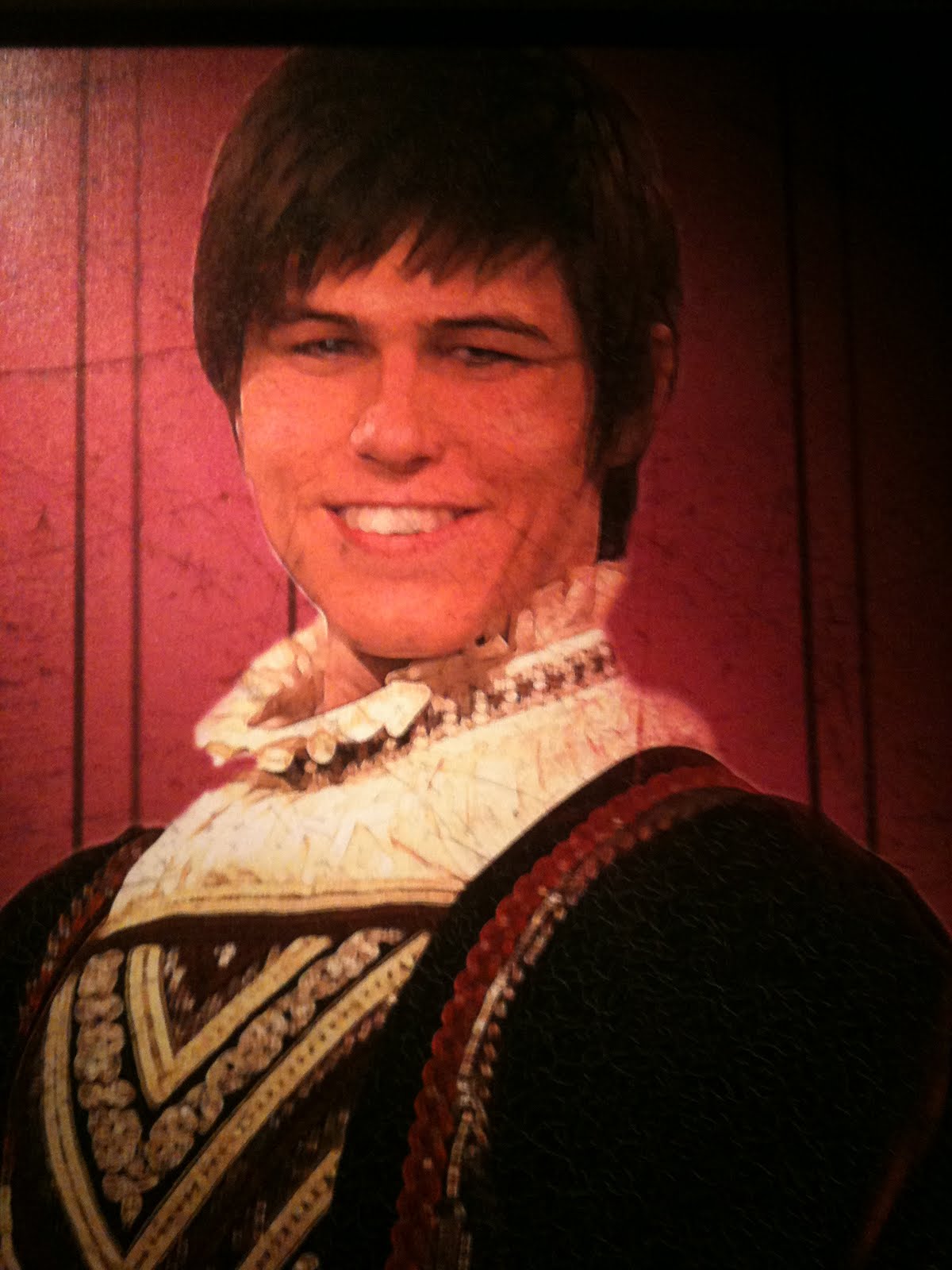
Oddly enough I saw a picture of him on a recent visit to Warwick Castle. They called him Prince Toby for some reason - it was in part of the castle dedicated to entertaining children. He looked a little younger.
He'd like Warwick Castle, in fact, judging from this photo of him.
Well done to Smeaton's Corner for arranging the event - go to him to get a ticket.
Subscribe to:
Posts (Atom)