Showing posts with label Paul Inwood. Show all posts

Monday, October 06, 2014

More uninformed bile from Paul Inwood

IMG_7274
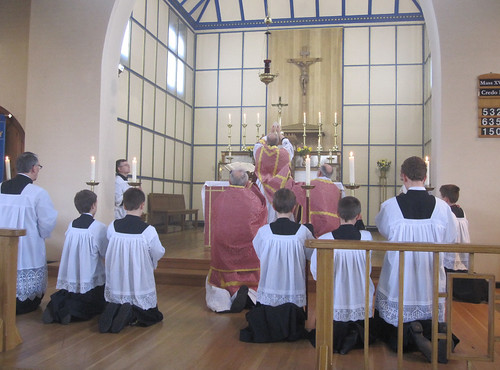
Training in High Mass at the LMS Training Conference at Belmot Abbey this year.
Paul Inwood's comments on the Pray Tell blog are as un-euphonious as his hymns. Here's the latest.

I am completely in agreement with Jack Wayne when he says that priestly training should prepare ordinands to minister to the entirety of their flock, but that is surely not the end of the story.
The proportion of the flock represented by adherents of the EF is a tiny fraction of 1%, and yet we find that some seminaries are devoting a disproportionate amount of time to celebrating in this form, and a hugely-disproportionate amount of time to training ordinands to celebrate in this form.
It may be revealing that a number of seminarians and young priests exposed to the EF in England and Wales in recent times have rejected training in this form of the rite because of the ecclesiology that goes along with it. The “bishop-bashing” that is prevalent in the course of some training sessions, especially those run by bodies such as the Latin Mass Society, is unseemly as well as unhelpful to their cause.
Talking of undermining one's own cause, Inwood would have more credibility in his attacks on the Latin Mass Society if his factual claims bore any relationship with reality.

Friday, September 20, 2013

Paul Inwood up to his old tricks


For only about the hundredth time, Paul Inwood claims that Summorum Pontificum was a concession  only to those previously attached to the traditional liturgy.

As I have pointed out on this blog before, the claim is fatally undermined not only by the complete lack of support in the text, but the reference in the Letter to Bishops which came with it to 'young people' who appreciate it. This implies a process of spreading and discovery of the traditional Mass - 'proseletyzation' - with which Pope Benedict was completely comfortable.

#22 by Paul Inwood on September 20, 2013 - 4:17 am
I think Francis is right to be worried by the ideologization and exploitation of the Vetus Ordo.
This was never Benedict’s intention — he wanted to make room for those (he described them as a very small group) who still hankered after a particular way of worshipping. In other words the original intent was a pastoral one.
SP allowed those who had previously continued with an older form — existing members of a group — to become “normative” rather than continuing to be subject to indult. It did not give them permission to proselytize, to attempt to draw in new members (that only came later on with Ecclesia Dei), and I think Benedict quite naïvely believed that proselytization would not happen. Allowing them to worship in their own way would be enough. The bishops of France and of England and Wales, who had first-hand experience of the sort of people Benedict was reaching out to, urged him not to promulgate SP because they knew he was wrong about that and foresaw that proselytization and ideologization would follow, as indeed they immediately did.
Francis recognizes Benedict’s pastoral desire for inclusion of the EF folk, and describes it as prudent. From that point of view it was rather like lancing a boil. In the fullness of time, it would die down and heal and disappear. But in expressing concern that the EF is now the subject of ideologization and exploitation he also acknowledges that the boil has instead become a running sore. And the problem he faces is that it is going to be very difficult, perhaps impossible, to turn it back into a boil.


But what's this reference to 'Ecclesia Dei'? This encyclical was promulgated by Bl. Pope John Paul II in 1988 - not 'later' than SP in 2007. It does, of course, give the green light to 'proseletyzation' because it proposes religious orders committed to the ancient liturgy, and therefore a permanent presence of the EF in Catholic life promoted by them.

Or does Mr Inwood mean Universae Ecclesiae, the Instruction issued in 2011? What does that say about proseletiyzation?

The fact is, we need no permission to promote a liturgy in full conformity with the laws of the Church, which Pope Benedict described as a 'treasure' which should be made available to future generations.

Tuesday, May 28, 2013

Inwood vs. Ostrowski on chant propers in the OF

I came across by chance this critique, by Jeff Ostrowski, of one of Paul Inwood's attacks on the idea that we should sing the chants given in the Graduale Romanum for the Ordinary Form. It's an interesting post but it gets terribly complicated and technical. I'm not going into the complications, but I want to comment on why it is so complicated.

(I also recommend the Corpus Christi Watershed blog it derives from, which has a lot of interesting stuff on it.)

A thumbnail's worth of background: the Graduale Romanum has for centuries been the Church's book of liturgical music. The Liber Usualis, which is the more common volume for chant singers in the EF, is derived from it (with the addition of some handy material from the Missal and the Breviary). The chants of the Graduale are, in the Extraordinary Form, liturgical texts: as well as being sung by the choir, they are said by the priest. There is an 'entrance antiphon' (Introit), chants to go between the Reading and the Gospel (usually Gradual and Alleluia), a chant for the Offertory and a Communion antiphon, for every Mass for every occasion in the year.

When the Novus Ordo came out, a vast number of these texts had been changed. Bugnini had gone through with his trusty blue pencil and re-written some, deleted others, composed still more afresh. The very idea of singing complex chants before the Gospel was replaced with the notion of the 'Responsorial Psalm'. Hymns were sung at the Offertory and at the Communion.

But then, in 1974, a new edition of the Graduale Romanum was published, with a preface by Bugnini himself. (In Latin.) The texts were the same as the ancient texts - you can't really change them, after all, if you respect the ancient melodies, since words and music are very closely bound up in chant. They were rearranged, however, to fit in, more or less, with the 1970 Missal, in terms of appropriateness, theme, and so on. And the rubrics said that singing these chants on the (newly) appointed days was an option: option number one, in fact, in the General Instruction of the Roman Missal.

But no-one actually did this. Ok, that's an exaggeration. Very, very, very few people did it. The groups of skilled singers able to do it had been disbanded. All sorts of ghastly musical experiments took their place. The 1974 Graduale Romanum remained in existence as a sort of rebuke to the new musical order of things. But it was only an option. And the texts were, mostly, no longer the liturgical texts, the texts of the Mass being said. They were just appropriate - just like 'In bread we bring You, Lord' is supposedly appropriate to the Offertory.

Yes, you can use the argument that these chants have been an integral part of the liturgy since about the 5th century. But that argument may end up proving too much. Why not just go the whole hog and go to the Traditional Mass?

One of the things the Reform of the Reform crowd want to do is to encourage the singing of these chants again. It is great, of course, to revive the tradition of chant singing, it is great that Catholics will hear these chants, at least in a few places. But they don't have the same relationship with the liturgy that they do in the Extraordinary Form. And since they replace the kinds of things composed by Paul Inwood and his chums, the musical establishment has a vested interest in opposing this development.

Well, as usual in seeing this debate within the Ordinary Form, I support what the Reform of the Reform people want to do, but I have to concede that the legal, liturgical and historical situation has been turned into quagmire of confusion by developments which seem to run counter to each other. I mean, Paul Inwood has a point: these aren't the liturgical texts for the OF, they are just an option. Even with his most annoying claim:

"we know from those who worked on the 1970 Missal that they never intended those actual texts to be sung. The texts are there to remind us that we should be singing something at those points, but not those texts. They are only there for recitation if there is no singing."

Yes, that statement sounds quite mad, but I fear he has a point all the same. What did Pope Paul VI say about it?


In 1963, he promulgated Sacrosanctum Concilium, the Second Vatican Council's document on the liturgy, which says that chant should have 'pride of place'. But it made a crucial concession: 'other kinds of sacred music, especially polyphony, are by no means excluded from liturgical celebrations, so long as they accord with the spirit of the liturgical action'. Only time would tell what these would turn out to be.

In 1969 he said that, as a result of vernacularisation: 'We will lose a great part of that stupendous and incomparable artistic and spiritual thing, the Gregorian chant' (General Audience, 1969). He makes it clear that this is a sacrifice he thinks must be made, for a greater good.

In 1974, he sent around the world a booklet, Jubilate Deo, designed as a minimum chant repertoire for parishes, whose preface says: 'those who are trying to improve the quality of congregational singing cannot refuse to Gregorian chant the place which is due to it'. This is about congregational singing of the Ordinary of the Mass, but this is also the year of the publication of the new Graduale Romanum, with all the propers.

What attitude was taken to these conflicting statements by the Congregation of Divine Worship, the Vatican department with direct responsibility for these issues? In 1987, under Pope John Paul II, The Congregation for Divine Worship noted that 'Any performance of sacred music which takes place during a celebration, should be fully in harmony with that celebration. This often means that musical compositions which date from a period when the active participation of the faithful was not emphasized as the source of the authentic Christian spirit are no longer to be considered suitable for inclusion within liturgical celebrations.' (Concerts in Churches, 1987).

What did Pope Benedict XVI say about Chant? After some indications that he would write an encyclical on chant, he never did. His personal views on the artistic and spiritual importance of chant are well known, but we had almost no official encouragement of chant from the Chair of Peter. It is almost as if there was a ban on the word 'chant' in official documents. He did say this in an 'address' in 2012, which is important, and seems to turn over completely what the CDW had said in 1987:

'And, here dear friends, you have an important role: work to improve the quality of liturgical song with being afraid to recover and value the great musical tradition of the Church, which has in Gregorian Chant and polyphony 2 of its highest expressions, as Vatican II itself states (cf. “Sacrosanctum Concilium,” 116). And I would like to stress that the active participation of the whole people of God in the liturgy does not consist only in speaking, but in listening, in welcoming the Word with the senses and the spirit, and this holds also for sacred music. You, who have the gift of song can make the heart of many people sing in liturgical celebrations.'


If you're not confused, then you haven't been paying attention.

Sunday, January 20, 2013

Parable of the Old Man and the Young


Although from rather different contexts, this image of William Blake's, and this poem of Wilfrid Owen, which is about the Great War, seem to me to illustrate something going on in the Catholic Church today. They are about the killing of the young, particularly a young man, by the old, particularly an old man.

So Abram rose, and clave the wood, and went,
And took the fire with him, and a knife.
And as they sojourned both of them together,
Isaac the first-born spake and said, My Father,
Behold the preparations, fire and iron,
But where the lamb for this burnt-offering?
Then Abram bound the youth with belts and straps,
and builded parapets and trenches there,
And stretchèd forth the knife to slay his son.
When lo! an angel called him out of heaven,
Saying, Lay not thy hand upon the lad,
Neither do anything to him. Behold,
A ram, caught in a thicket by its horns;
Offer the Ram of Pride instead of him.
But the old man would not so, but slew his son,
And half the seed of Europe, one by one.

I've been blogging a lot about Mgr Basil Loftus, and Clifford Longley has come into my sights too recently; others who have include Dr Casey and Stuart Reid, before them was Paul Inwood, the inimitable Tom MacIntyre and Fr Leo Chamberlain. (Br Edward Egan is hardly worth mentioning.) They have something striking in common: they are all, I think, over 70 years old, or getting on for it. I'd like to make a wider point about the phenomenon of which they are (perhaps minor) examples, and of which I, growing up as a cradle Catholic in the 1980s, and since then, have long been acutely aware: the fear and loathing of many of the older generation of Catholics towards young Catholics who, often without knowing much about the historic changes in the Church, appear to be seeking some measure of restoration of the ruins they see all around them.So what I say below needn't be true of each of these figures, but seeks to explain why so many old men keep cropping up in this blog. There is a definite phenomenon of the Angry Old Man.

In some cases they were, when young, fire-brand liberals; in others, they didn't much like the changes of the 60s and 70s, but felt obliged, sooner or later, to make some kind of accommodation with them. In either case, the idea that important aspects of those changes (important in their effects on them, not necessarily the theologically most significant), were unnecessary or mistaken, is intolerable. Intolerable because only if the changes were right and inevitable were their actions in the past, actions of destroying the tradition, destroying altars and churches, destroying vocations, destroying the simple faith of the pious, or just going along with this destruction, would be justified. If they were not justified, then they would be subject to unbearable guilt, and even, they might fear, to public shame and humiliation.
IMG_0043
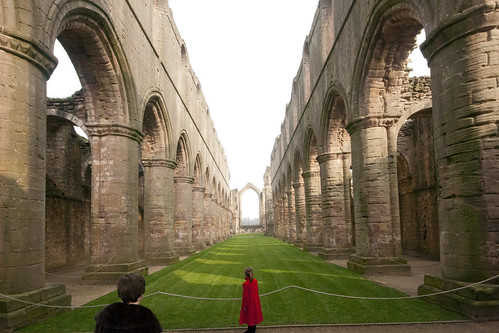
In a very real sense, this represents a great renewal of the Church. Don't you agree?
There is a similar phenomenon  at work in the debate about abortion. Women who have had abortions, men who have helped or bullied women into it, are often desperately, indeed pathetically, eager to convince others, but most of all themselves, that abortion in similar circumstances is inevitable and right. Such people are naturally at the forefront of the pro-abortion movement, and dealing with them is one of the great challenges of pro-life work. They are trapped in a prison of suppressed guilt, from which the only escape is repentance. Repentance, ideally with sacramental confession, can transform such a person: having made that step, which in a way is always so obvious and yet seemingly so impossible a thing to do, can suddenly make the entire world look different. Suddenly they can see things as they are.

In the Church, the people who wrecked the altars and burned the old vestments and introduced guitars and told the children that Jesus is only alive in our hearts, as these people grow older, they are frequently not quite confident that they did the right thing. They were, after all, brought up with the old catechism and the old Mass. The great vindication of their work of destruction would have been a reciprocal appreciation of the Faith by the World, and the enthusiasm of new generations for the free and easy Church they tried to create. But after an initial flush of apparent success, this vindication has stubbornly failed to materialise. A horrible suspicion in their minds needs to be constantly squashed, that perhaps, just perhaps, they made a mistake.

So it is intolerable to them above all to hear the young questioning these changes, and even beginning to undo some of them. Those young people, often in their innocence of the historical significance of what they are doing, must be humiliated, ridiculed, and persecuted. After all, a reviled subculture of young people in the Church doesn't have much significance, does it? They've just been watching too much Brideshead Revisited on TV.

But it gets worse, we have a Pope now who seems to sympathise with them, and however many young men are thrown out of seminary for appearing to believe in the Real Presence or liking the Traditional Mass, there seem to be more knocking on the door every year. And the intellectual tide too seems to be turning, there are more and more books being published by conservative Catholic scholars showing that one after another of the innovations was poorly thought through, or based on mistakes, mistakes about anything ranging from human psychology to the archaeological record left by the early Church.

I should say, in passing, what a joy it is to meet and work with the older generation of the traditional movement. People sometimes characterise them as embittered and battle weary, but that is not my experience. Of course, things are beginning to go their way, which always helps. But these are people who maintained their integrity, or have rediscovered it, who lived through the horrors without giving in to the horror. Their obedience has been learnt by suffering. They have much to teach us, and are more than willing to pass it on. This is how the Church is supposed to work. (Here's one illustrative obituary, and here's another.)
Quarantine zone for retired liberals.

The Catholic Church is inevitably run by the old. The retirement age is far higher than in the secular world, if it exists at all, and seniority usually implies, simply, seniority. This is normally a good thing: the Church moves slowly, and should do so. The flip side of this is that the Church cannot recover from a fashionable mistake as quickly as other organisations. In music, fashion, architecture, and government, the silly fads of the 1960s have left their mark, sure, but they aren't still being officially enforced: the people who stuffed them down our necks have long since headed for the golf course. This process has only got going in the Church in the last decade, but because of the importance of discussion and ideas, we have an even longer time to wait, with septuagenarian and octogenarian columnists and letter writers who are clearly going to shut up only when the coffin lid is nailed down.

I feel sorry for these angry old men (less often women), but opposing them is, unfortunately, necessary. Since they are engaged, to a greater or lesser extent, in an endless stream of attacks on the traditionally-minded young, to stand by and do nothing, when you can do something, would be to consent to the ridiculing and marginalisation of another generation of Catholics. It is true that these oldies have zero clout on the internet (with the partial exception of Paul Inwood), but they dominate much of the Catholic dead-wood media, and there is a pool of offline Catholics who still read that stuff, and non-Catholics go there to see who is who among Catholic intellectuals.

It is important that young Catholics today get to see and hear reasoned responses to the liberal attack on them and their Catholic instincts. Apart from anything else, it is important for their mental health. Yes, you are not mad: other people have noticed too, that there is indeed something very rum about the fact that every church you go into has had the altar ripped out and replaced with some kind of table in a different place. That mainstream Catholic books don't refer to any document published before 1962 apart from Rerum Novarum and the Bible. That there seems to be a lot of evasion on certain topics where we desperately need crystal clarity, like the morality of contraception, the necessity of baptism for salvation, and Church-state relations. And that influential Catholics of a certain age become puce with rage if you so much as mention words like 'mantilla', 'indulgence', and 'infallibility'.
Ronald Reagan says “Shut Up Hippie!” Round Sticker
When these angry old men are given the prestige of publication in the Catholic press, and when they use this to to attack traditional Catholics, undermine the teaching of the Church, or distort the meaning of her documents, I will continue to respond. Yes, it a pathetic attempt at self-affirmation, but it is harmful to souls, and personally hurtful as these writers may find being contradicted, they must be opposed.

So here's my message to the over-seventies liberal Catholics with an itch to write in the press: you are not going to get everyone to agree with you and thereby sooth your uneasy consciences. On the other hand, if you want a quiet life, all you need to do is shut up.
Wednesday, November 28, 2012

The same old rubbish from Paul Inwood

Paul Inwood is at it yet again (see previous posts here and here): writing (on Pray Tell) what would be deliberate falsehoods about the Traditional Mass, and its supporters, if it were clear he had the integrity to read the documents properly. As it is I suspect wishful thinking has got the better of him.  His comment in red, my responses in blue.
This, I am afraid, is a very commonly-encountered misunderstanding.
(1) The provision is there for members of a parish to petition their pastor for Masses in the extraordinary form if they have previously been used to having it, and feel that their spirituality is lacking without it. It is not a blanket permission. Benedict XVI himself said that this will only apply to a very small number of people, and that for most people the Ordinary Form will continue to be the norm. (Interview en route for France, September 12, 2008)
Rubbish. The Instruction Universae Ecclesiae 15 explicitly says that the groups asking for the EF need not have existed before, and places no great hurdle for the importance of the EF to their spiritual lives: it talks of groups which 'even after the publication of the Motu Proprio, come together by reason of their veneration for the Liturgy in the Usus Antiquior,' The Holy Father explicity says in the Letter to Bishops accompanying the Motu Proprio that 'that young persons too have discovered this liturgical form, felt its attraction and found in it a form of encounter with the Mystery of the Most Holy Eucharist, particularly suited to them. Thus the need has arisen for a clearer juridical regulation which had not been foreseen at the time of the 1988 Motu Proprio.' Few such young people can have been 'used to it', since they weren't born before 1970 and the EF wasn't widely available before the Motu Proprio.
It is a 'blanket permission', since any priest anywhere in the Latin Rite can now say the EF: pastoral reason or no pastoral reason. It is simply allowed: as the MP says
In Masses celebrated without the people, each Catholic priest of the Latin rite, whether secular or regular, may use the Roman Missal published by Bl. Pope John XXIII in 1962, or the Roman Missal promulgated by Pope Paul VI in 1970, and may do so on any day with the exception of the Easter Triduum. For such celebrations, with either one Missal or the other, the priest has no need for permission from the Apostolic See or from his Ordinary.' (Oh and people can come to these Masses: see article 4.)
(2) It does not give permission to proselytise in an attempt to draw in new adherents. It is only for existing adherents who feel deprived.
But there is no need to give permission to 'proselystise': how could such activity, by which Inwood presumably means the encouragement of a legitimate form of the liturgy and spirituality, possibly be banned? If the idea were not so preposterous, one could point to the establishment of the Traditional Orders back in 1988 as evidence that the Holy See is perfectly happy with people promoting the EF.
(3) It does not give permission to claim that the Extraordionary Form is on a par with the Ordinary Form. The EF permission is only, once again, for a small number of people who have not been able to let go of that form. It is, as its title declares, extra-ordinary (i.e. abnormal). It is not “half of the Roman Rite”; it is a minority manifestation of the Roman Rite.
It is on a par with the OF in the sense that 'each Catholic priest of the Latin rite, whether secular or regular, may use the Roman Missal published by Bl. Pope John XXIII in 1962, or the Roman Missal promulgated by Pope Paul VI in 1970'. And in the sense that religious communities can adopt it as their proper rite (Article 3). And in the sense that the Faithful can freely attend one or the other. And in the sense that the EF should be taught in seminaries (Universae Ecclesiae 21). So what, exactly, is your point, Mr Inwood?
(4) Similarly, it does not give permission to claim (as most of its adherents seem to do) that the Ordinary Form is merely tolerated, and that the Extraordinary Form is the only true form, which should replace the Ordinary Form whenever possible. The Ordinary Form is normative; the Extraordinary Form is the exception, not the rule.
If 'most adherents' of the EF claim that the OF is 'merely tolerated', it will be easy to quote them, won't it, Mr Inwood? So let's have names, quotes, and urls. I'm intrigued to know what this means.
And if the EF replaces the OF as time goes on, in part or (unlikely as it seems today), wholly, because of laity and clergy voting with their feet, what exactly would be wrong with that? The 1970 Missal was promulgated for the good of the Church: not as a prison. If the good of the Church can be served in other ways, half a century and more later, then no one has any cause for complaint.
If only people were clear about all this, a lot of arguments could be avoided.
 How true that it.
I love this phrase of Inwood's: the Mou Proprio was for 'a small number of people who have not been able to let go of that form'. It puts his own feelings so well: he is part of a small and diminishing group of people who can't let go of the 1970s, who can't let go of their power in the Church and give way to a new generation who think a bit differently. Well I'm sorry but there'll be no Motu Propro for you: no Pope is going to enforce your tyranny over everyone else just so you can pretend it is still 1976.

Tuesday, May 10, 2011

Organic Abuses?

The Pray Tell blog recently had a bizarre post about how liturgical development arises through people breaking liturgical law. Paul Inwood, who had the nerve to say that people attached to the traditional Mass were disobedient and that Summorum Pontificum was a 'reward for disobedience', has done an extraordinary back-flip to suggest that such rewards are not only a good thing, but an established part of the way the Church develops the liturgy.

He writes:
Fritz is absolutely right. This is the Church’s common modus operandi — practice supersedes edict, and edict eventually catches up with practice.
It happened with Communion in the hand and female altar servers, as Fritz points out. It also happened with Communion under both kinds and lay Ministers of Communion. (Interesting that so much has centred on the distribution of Communion.) It also happened with some gestures and some words (”in these or similar words”) in the main rites.
These are words of a man who clearly knows and cares only about what has been happening in the Church since about 1950 - a period characterised not by healthy development, but by 'accelerated decomposition' and 'self demolition' (Paul VI), liturgical abuses which cause 'profound grief' (Bl John-Paul II), 'a manufactured liturgy' and 'the collapse the of the liturgy' (Benedict XVI). If this is liturgical development, give me liturgical sclerosis.
How, in fact, does organic development actually work, in the history of the liturgy?
First, while Inwood and his friends have grasped the idea that organic development is about incremental changes, not sudden and radical ones; they simply ignore the possibility that such changes to the liturgy could be made by people with the authority to make them. This may not necessarily only be the Pope: it could be the religious superiors of religious orders, bishops, or even priests, depending on the change and depending on the legal situation at the time. Today, a new feast, for example, even one only for local celebration, would have to be approved by the Holy See, but this clearly wasn't the case in the 4th Century. Even today, the practice of having the Angelus before Mass starts, when Mass is scheduled for 6pm, or the practice of singing a Marian Anthem after Mass ends, is a matter of the preference of the priest, and such practices could one day spread to the point that they are an established custom of a part, or the whole, of the Latin Church, and be regarded for practical purposes as part of the Mass.
(On issue which may be confusing the Pray Tell writers is that rubricists and writers of liturgical manuals over the centuries often condemn practices which they don't like, but it does not follow that those practices were actually illicit. These liturgical experts, even if their work is recommended by bishops and the Pope, don't have episcopal or papal authority, and their views are not decrees.)
Second, they also ignore the possibility that development can take place by the increasing use of one legitimate option over another, until one becomes universal and the other disapeers.
Third, they ignore a key feature of the vast majority of the liturgical developments in the history of Catholic liturgy, which is that features of the liturgy which become mandated for universal use were first licit practices locally, or, alternatively, something which is introduced into one Rite was a longstanding, licit feature of another, or, again, something is made universal which was previously a feature of the liturgy on a particular feast or during a particular season. (On the last of these, think of the Preface for Trinity Sunday, now used throghout the year with some exceptions, and the Gloria, a Christmas devotion also used throughout the year except in penitential seasons.)
In all these ways organic development can take place without the classic move of the totalitarian liberal: that what was previously everywhere forbidden is now compulsory. This move never fails to cause scandal and upset to the faithful, and to sow dismay and confusion among those foolish enough to abide by the rules. It punishes the orthodox and rewards the rebel. Contributors to the Pray Tell blog seem to be in love with this way of doing things, until the boot is on the other foot, as with the new Missal translation...
To illustrate, here are a few examples of liturgical development.
1. The fusion of the Roman and Gallican Missals and Chant traditions under Charlemagne and Alcuin. This is one of the most important developments of the first millennium of the Latin Rite, and it happened with the acquiecence of the authorities of the day. The process was a long, complicated and to some extent adventitious, rather than planned, but it did not involve committees writing new texts or priests making things up on the hoof, nor did it involve introducing elements into the Catholic liturgy which were up to then utterly foreign to it. Rather, the decision was made to use particular parts of existing, legitimate, and living texts and chant traditions, and to discontinue others.
2. The incorporation of features of Eastern rites into the Latin liturgy in the High Middle Ages. The Crusaders were deeply impressed by the liturgy they found in the East, and we can thank them for the use of Greek in the Easter Vigil, for example. There was no making up of half-witted novelties by self-appointed liturgists incapable of understanding what is conformable to the Catholic liturgy and what is not.
3. The spread of feasts and devotions, some with important doctrinal significance, from the Immaculate Conception to the Sacred Heart. Such things were made universal after they had been legitimate local practices for many years, in many cases for centuries. Another example of this is the rise and then the decline (under the influence of the liturgical movement) of votive Masses, vis-a-vis the sanctoral and temporal cycles. This was and remains to a large extent a matter of legitimate choice by priests but it reflects, and influences, the liturgical devotion of the faithful.
So no, Mr Inwood, the 'Church's modus operandi' of organic development is not that a few priests or lay liturgical planners too full of themselves to be content with the overwhelming riches of the Church's liturgical patrimony decide to force on the faithful some practice which has been universally forbidden for centuries as undermining the faith - no, that's not how it works. Instead, practical and devotional reasons suggest a development which is either already legitimate or which can be made so by appropriate authority.

Tuesday, April 05, 2011

Paul Inwood on the persecution of Goliath by David

On the Pray Tell blog Paul Inwood has repeated his claim that certain parish priests priests have - wickedly - made their parish's 'principal Mass' a traditional one.

He writes:

...the question of whether a bishop can step in and say that the vast majority of the flock are being denied what they clearly have a right to, just because of the personal preferences of an individual priest. The answer to that is surely Yes, he can. The instances where a priest has changed the principal Mass on a Sunday morning to EF for a minority, thus forcing OF worshippers (the majority) to move elsewhere, has been disedifying, to say the least.

Challenged to say where this has happened, he replies:

Just for a start, the dioceses of Leeds, Southwark and Clifton have examples where this happened. They are not by any means the only ones.

And again:
We’re talking in some cases about the principal Mass, the one with the largest attendance, being switched so that those parishioners either had to attend another Mass at an inconvenient time (or even the evening before) or go elsewhere, in other cases about wholesale switching to Tridentine rite usage. ['wholesale switching to Tridentine rite usage'? What does that mean? Where has this happened? 'Cases' plural?]
I’m not going to name names because in one case the parish has now been closed down as a result of the ruckus, the priest’s refusal to comply, and the consequent departure of most of the parishioners; in other cases the Bishops asked the priests in question to consider the welfare of the vast majority of their flocks, and they agreed to do so and rescheduled the Tridentine Mass; while in yet others the priest still continues in defiance. It would be wrong to tar them all with the same brush.

A number of cases have received publicity on blogs and even in the national Catholic press, so it should not be difficult to identify them if you are that interested.

Notice how he backs down from saying that he's talking about 'the principle Mass' to saying that only 'in some cases' it is the principal Mass.

He can't substantiate this claim for a simple reason.

IT ISN'T TRUE.

The Latin Mass Society knows a good deal about the development of the provision of Traditional Masses in the dioceses of Leeds, Clifton and Southwark - and elsewhere of course - and I can say categorically that what Paul Inwood says is false. In not a single case in Leeds or Clifton has the 'principal Mass' been changed from OF to EF, and the claim does not stand up to scrutiny in Southwark either. If Paul Inwood can give us the details I will of course eat my words. If he cannot he should cease from repeating a libel, against the pastoral sensitivity of traditionally-minded priests.
2011 04 03_0041
(Mass last Sunday at Blackfen; h-t Mulier Fortis.)

He says it would be easy to work out the parishes at issue, because some cases have received publicity. (Why then, is he so shy about specifying them?) In some cases it is indeed easy to work out what he has in mind. But the facts of the cases don't back up his claim.

What's been going on in Leeds, for example? 'in one case the parish has now been closed down as a result of the ruckus', says Inwood. We all know what that is about: the sad case of Allerton Bywater, a year ago. Everyone knows that this was a parish in Leeds diocese which provided the Traditional Mass was closed down. You can read all about it on an old post of Damian Thompson's here. Inwood cannot possibly be talking about any other case: I know of no other parish offering the TLM which has been closed down, certainly not with a 'ruckus'. But if Inwood had the smallest regard for the truth of the matter, he would have discovered that the closure of the parish had nothing to do with the fact that the priest offered the Extraordiary Form: it was part of a programme of parish closures - rather a large programme of closures, in fact - and none of the other churches closed down offered the TLM.

Did the priest in that parish alienate his parishoners by making the principal Mass on a Sunday a Traditional one? No, Inwood is wrong there as well. The main Mass was at 10am; the parish priest did what most priests do, when they can: he introduced an EF Mass at a new time, in this case at 12noon. So much for the diocese of Leeds.

What's been happening in Clifton? In this case, Inwood seems to be relying entirely on his overactive imagination; I am not aware of any public discussion of these issues in that diocese. There are three Sunday TLMs in different parts of the diocese, but NONE of these replaced another Mass: all are in addition to the pre-existing schedule of Masses.

So, what's been going on Southwark? Has there been a public fuss about Mass becoming EF there? Well, of course we all know there has been: just over two years ago the synthetic outrage of The Tablet was poured out on Fr Tim Finigan for having a Traditional Mass at a reasonable time on a Sunday: you can read his response here. (The Tablet's long-suffering subscribers can read the original article here.) The Tablet had a large number of mostly laughable accusations, and these included parishoners complaining that they had to go to other parishes or other Mass times to avoid the EF Mass just as Inwood describes, but The Tablet article doesn't mention the question of which Mass time was used for the TLM, and the phrase 'principal Mass' does not occur. The reason for this is simple: they would have been equally outraged whichever Mass time had been used for the Traditional Mass.
2011 03 12_0114
(Fr Tim's enraged parishers stampeding out of his church - or perhaps not. H-t Mulier Fortis.)

Here we have a situation faced by a number of priests in parishes with a busy schedule. It is simply impossible to add an extra Mass, partly because there is no time for one at a time people would actually be able to attend, and partly because there is a limit to how many Masses a priest can physically say in the course of 24 hours, even if there is pastoral need for them. So in order to introduce a Traditional Mass on a Sunday, a parish priest has sometimes to use a slot previously occupied by a Novus Ordo Mass.

The notion of the 'principal Mass' is often a meaningless one today, because the popularity of different liturgical options (singing of one kind or another) or times (Saturday evening, Sunday evening etc.) mean that in many busy parishes two or three Masses are equally well attended, and there is usally little to distinguish them in terms of liturgical solemnity. Fr Finigan cannot be accused of marginalising the Novus Ordo, and leaving it only some unpopular time, such at 7am: in reality three out of the four 'Sunday' Masses are according to the 1970 Missal, and they continue to flourish, at 6pm on a Saturday, 9am and 6pm on Sundays. It is entirely appropriate that 10.30am, which traditionally would have been the time for the most solemn liturgy in the parish schedule, should be the Sung Traditional Mass. Prior to the change this Mass was not noticably the best attended, which seems to be Inwood's definition of 'principal Mass'.

In short, though this might look like the best example for Inwood's claim, it doesn't stand up. The Blackfen 10.30am was no better attended than the other Sunday Masses before the change.

Inwood and his friends have stacked the cards in advance, of course. If priests make a superhuman effort to add to an already busy schedule in order to provide the EF to their parish, they are criticised for saying too many Masses. If they use an existing Mass time, they are criticised for displacing people who don't want what is now offered.

But the absurditly of this latter criticism is obvious. It is something which happens all the time: when the style of liturgy at a particular Mass changes, when Masses have to be cut in number, when Mass times are moved around - let alone when churches are closed or parishes merged - for any practical reason, some people will be inconvenienced. Have their rights been trampled upon? Of course not.

As a matter of fact many bishops in England and Wales in recent years have been trying to get their parish priests to say fewer Masses, taking the view that priests are wearing themselves out and that there is simply no point in (say) having four half-empty Masses instead of three somewhat fuller ones. Is Paul Inwood enraged by this? Have the rights of parishoners been trampled upon? Of course not.

So why is this different? Only becuase it is the traditional Mass. Any stick is good enough with which to beat the priests who are brave enough to exercise their rights, or to accede to the rights of their parishors, in respect of the Traditional Mass. Inwood's special pleading is pathetic, and should stop.

Tuesday, February 15, 2011

Paul Inwood on Disobedient Traditionalists

Paul Inwood, Director of Liturgy for the diocese of Portsmouth, rarely lets a chance to attack traditionalists go to waste; here he remarks artlessly 'Summorum Pontificum was a reward for disobedience: Discuss'.

Very well. The first thing to note is that if SP was a reward for disobedience, it would have plenty of company. Famously, Paul VI's Memoriale Domini, which gave permission for communion in the hand, was a reward for disobedience; as the document says explicitly, the practice was permitted only because, and where, it had become established by disobedience.

But more generally it is clear that the permission for altar girls, communion under both kinds, Mass celebrated facing the people, etc. etc. were rewards for disobedience, since all these practices were instituted disobediently either during the chaotic period after the Second Vatican Council or before it. Indeed, Paul Inwood might like to consider the permission for parts of the liturgy to be in the vernacular, in Sacrosanctam Concilium itself, to be a reward for disobedience, since disobedient priests had been experimenting with vernacular liturgy since the early decades of the 20th Century, not to say the 16th Century. The practice of breaking rules in the hope of getting them changed was so established among liberals after the Council they even had a special phrase for it: 'anticipatory obedience'.

There is a great difference between SP and many of these other documents, however. In Memoriale Domini Paul VI takes the opportunity to issue what is in effect a final condemnation of the practice he is reluctantly permitting, and urges Catholics to continue to receive on the tongue. The permissions for many other abusive practices take a similar form. Extraordinary Ministers of Holy Communion, for example, were permitted only in restrictive circumstances; so was communion under both kinds and altar girls. It is easy to forget these restrictions but there they are. By contrast, there is nothing reluctant about the freeing of the Traditional Mass in SP: it is described (in the accompanying Letter to Bishops) as constituting 'riches' for the Church; even back in 1988, John-Paul II told bishops to be 'generous' in allowing the Traditional Mass, not a word he used in relation to their right to permit altar girls or EMHCs.

But there is something altogether missing from the parallel, and that is the disobedience which SP is supposed to be rewarding. Presumably Paul Inwood means disobedience by priests who were saying the Traditional Mass before 2007. But according to SP, they weren't being disobedient: the Traditional Mass had never been forbidden. Even on the more restrictive interpretation common before SP, they had permission under Ecclesia Dei Adflicta to say the TLM.

Now here is something for Paul Inwood to ponder. The Latin Mass Society and the whole Una Voce movement argued from the very beginning that the TLM had never been abrogated. Anyone can read the argument in Michael Davies' book 'Pope Paul's New Mass' (1981). Our opponents argued that, no, it was only permissible by indult, that is, by special permission. So what was the practical policy of the LMS? We continued to make the argument for the less restrictive position, but acted on the more restrictive one. We always got permissions for the Masses we organised, even though we thought permission was not necessary. This was not disobedience, not anticipatory obedience, but obedience of a heroic, supererogatory kind.

So during the long years of the 1970s, 80s, and 90s, what was Paul Inwood doing? Was he obeying the Church's liturgical laws? When he was Music Director of Portsmouth Cathedral (1995-1999) and now he is Director of Liturgy for Portsmouth Diocese (since 2000), did he implement the Council's decree that Gregorian Chant have pride of place in the liturgy, or that Latin be retained? Did he ensure that the rules of successive editions of the General Instruction of the Roman Missal, forbidding all manner of abuses, were strictly obeyed? Did he enforce the norms of the Instruction Regarding Certain Questions on the Collaboration of the Non-Ordained Faithful, in 1997, or Redemptionis Sacramentum in 2004, each of which again condemned countless abusive practices?

Well, not exactly. A culture of disobedience has in fact become endemic across the entire Church since the Council, and it has often been observed that the only people expected to obey the rules are those who want the Traditional Mass - at least this was so when the rules were restrictive. But we now see a new generation of priests coming up who are rebelling against this culture. And what does Paul Inwood say?

He says they are disobedient.

Thursday, December 09, 2010

Paul Inwood: Tablet report on number of Masses wrong

Paul Inwood,the (lay) Director of Liturgy for the Diocese of Portsmouth, and not someone especially keen on the Traditional Mass, has admitted on an on-line discussion forum that The Tablet article I recently posted about was wrong about how the number of churches offering the Usus Antiquior in his diocese. They said it hadn't increased since Summorum Pontificum, but (he says) it has.

Unless The Tablet is deliberately misreporting, they clearly weren't talking to anyone with access to the facts. As I remarked in my letter to The Tablet (in a passage they chose not to print) the responses they had from dioceses were off-the-cuff remarks, and hardly a proper basis for contradicting the detailed facts and figures anyone can download from the Latin Mass Society Mass Listings.

Here is Paul Inwood's post:

-----

#9 by Paul Inwood on December 6, 2010 - 4:11 pm

In my diocese (mentioned in the Tablet reportage but with a lower number of churches than is actually currently providing the EF), we already had a fairly generous provision of EF Masses before SP. Now we have more of them, but it is the same 30 or so people who are simply travelling round to more places to attend (apart from those on the Isle of Wight). There is no discernible increase in numbers. More Masses, same tiny uptake. I wonder how many other diocese mirror this?

-----

Notice he says that it is 'the same 30 people' as before the Motu Proprio, spreading themselves more thinly across more churches in the diocese. As Director of Liturgy he may know how
many churches have the TLM, but he has clearly never been to the FSSP Mass in Reading.

Five years ago about 40 people used to go to these Masses. Since then a lot has happened, including the Motu Proprio, and the number has more than doubled. On a good day we have 100 people; numbers never dip below 60.

This is at the same time as other churches have started to offer the Mass. Plus people in the northern part of the diocese can easily pop over the diocesan boundary to Oxford, where numbers have also doubled since the Motu Proprio. Plus there is an important centre for the SSPX down the road in Newbury.

So how many people regularly attend the Traditional Mass in or from the Portsmouth Diocese? It's a lot more than 30, Mr Inwood!

- Posted using BlogPress from my iPhone

Now I'm back at my desk I can add this photo to the post
2010 10 03_7625

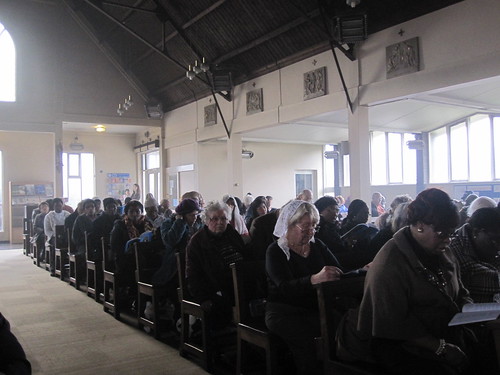
I can count 60 lay heads in this photograph. You can't see the back row, of course, or the people in the choir loft (there were six singers and a bunch of small children); more importantly through the opening on the right there is a sort of annex where between 20 and forty people usually sit. This photo was taken in October 2010.

Happy now, Mr Inwood?