Wednesday, June 08, 2016

Annoying arguments about the EU

For some reason I wanted a picture of Charlemagne to go with this post.
I like the fact that the Traditional Catholic movement in the UK and the Latin Mass Society are politically (as well as geographically and socially) diverse, but I get the impression that it tends to swing towards 'Brexit' in the current referendum debate. This is not surprising, as being governed by the laws of our own nation-state (or four-nation state, depending on how you count) is in accord with the kind of human tradition which we Catholic traditionalists understand is important in maintaining stability, consent, and the kind of dense political culture which only stability and consent can bring, over centuries. What I mean is the kind of instinctive understanding of parliamentary democracy, and many other aspects of our political institutions, which come from it being part of the fabric of national life since, well, the Middle Ages.

Obviously human customs and customary ways of doing things can and should be changed for a sufficient reason. So there is a sensible debate about possibly sufficient reasons to consent to the progressive destruction of British political institutions as bearers of real power. The importance of environmental legislation covering the whole of the EU, the need for a common response to various other challenges - this is what we need to talk about. The difficulty many have with these arguments is that it is precisely the continent-wide problems that the EU seems too often to have made worse, or even created, the refugee crisis and the euro/financial crisis being Exhibits A and B.

Tuesday, June 07, 2016

Does the Church want Catholic men to be weeds?

This blog post purportedly about the 'traditional Catholic wife' quickly degenerates into 'man up' man bashing, and now I've started noticing this phenomenon I think I ought to attack it, especially since it creeps into traddy blogs and FB feeds.

My challenge to people who write like this is simple. Are you man enough to say what the Church actually teaches about the role of the father in the family? If you aren't, I suggest you stop writing on the subject.

Here's a post from my recent series of posts on the subject, in February this year. Click on the labels 'masculinity' and 'patriarchy' to see more.

-------------------------------

In some of the earlier posts of the series, I referred rather vaguely to things being said by Catholics about these matters which I thought unhelpful, so it behoves me to give some detail.

All kinds of things can be found in the more marginal sources (in which category I place this blog, for example). Looking at the more mainstream sources - blogs, bishops' statements, magisterial documents and the like - we find, in the more conservative ones, a pattern.

First, there is here and there a recognition that there is a problem of manhood. The Tablet had a minor breakdown when Cardinal Burke made his statement about the loss of men to the Church, and the underlying social causes, but the observation has been made before. The bare fact of male absence is lamented in Pope St John Paul II's 1988 Christifideles laici. In 2014 Mgr Charles Pope, in a much-linked to blog post, explicitly links the problem with feminism.

Sunday, June 05, 2016

Rogue bishops and Traditional Institutes: Letter in The Tablet

IMG_0938
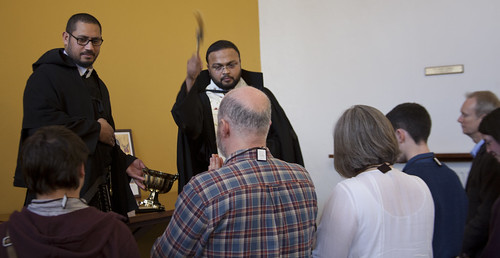
Fr Magdala Maria and Fr Jean Marie of the Sons of the Most Holy Redeemer (F.SS.R.) based in the Orkeneys.
It is an Institute of Diocesan Right in Aberdeen Diocese and also in Christchurch, New Zealand.
Last weekend The Tablet's man in Rome, Christopher Lamb, noted that Pope Francis was taking away the prerogative of bishops to found religious institutes, orders, and communities, or at least circumscribing it, by insisting that in each case they get permission from Rome.

It sadly reflects the intellectual and journalistic standards of The Tablet the Lamb goes on to try to make this a stick to beat the Traditional Institutes and orders, and uses the Franciscan Friars of the Immaculate to do so.

This ruling is clearly targeted at the large number of traditionalist religious orders that have sprouted up in recent years, many of them exclusively celebrating the sacraments in the pre-Vatican II Old Rite. Many of them do good work but there are suspicions about others.  

Saturday, June 04, 2016

Esperanto vs. Latin

IMG_8459
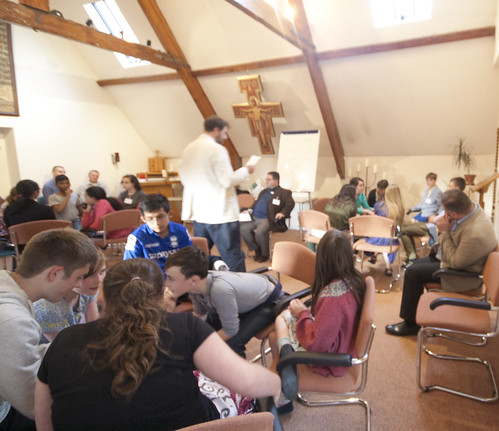
Last year's Summer School - a bit of Latin is included, naturally. Details for this year are here.

The weekend The Catholic Universe has printed quite a long letter of mine on the subject of Latin and Esperanto, in response to an equally long letter praising Esperanto in last week's Letters.

Last time I mentioned Esperanto on this blog - as an aside - I got some rather irate comments, so this time, well, come and get me! My sympathy with the idea of an artificial language of any kind is simply zero. If people want to learn Elvish, Klingon or Esperanto, they are, I suppose, no more wasting their time than if they were playing patience on their IPhones (which seems to be de rigour on the commuter trains out of London these days). I don't want to criticise such harmless recreations. But to propose it as an educational task for children is as insane as suggesting it as a substitute for Latin (or any other language) for comunication within the Church. Artificial languages are languages without a history, culture, or literature, or at least without one going back before (in the case of Esperanto) 1870.

Friday, June 03, 2016

Church statistics: what happened to the young men?

IMG_9108
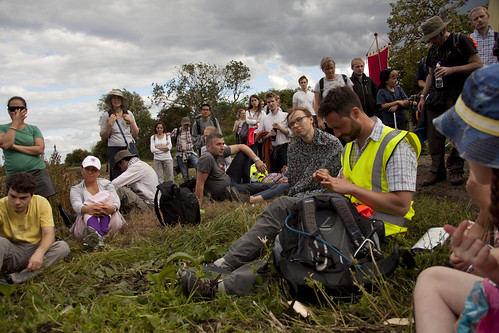
A break on the LMS Walsingham Pilgrimage last year.
In my last post I noted that the figures for lapsation from the Church given by Stephen Bullivant, which originated with the British Attitudes Survey, are systematically distorted by attitudes to Church membership and motives for getting babied baptised, which themselves vary over time and between regions. The inclusion of people in the category of 'self-identified Catholic' who have only a nominal or tribal affiliation increases the number of 'Catholics', but not the number of church-goers. If they felt that they shouldn't call themselves Catholics, the rate of practice would increase without any increase in the numbers of bums on pews. For this reason, I think that saying that 39.2% of 'Catholics' never or practically never go to Church is pretty meaningless.

Thursday, June 02, 2016

Stephen Bullivant's lapsation statistics: methodological problems

IMG_0338
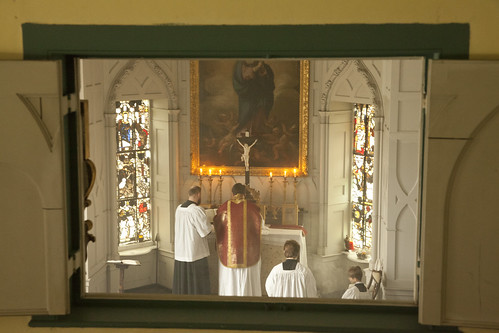
A window into what is going on in the Church.
Stephen Bullivant of the Benedict XVI Centre for Religion and Society has produced a study based on the British Social Attitudes Survey, focusing on the Catholic Church in England and Wales.

It is marred by some typographical errors, for example referring back to the wrong diagramme at one point, and saying 'somewhat under two in five [cradle Catholics] attends religious services once a week or more' (p14) when the figure is 17.1%. Thelittle video they've produced to go with it fails to explain what the percentages they are quoting are percentages of.

A general methodological point is we get individuals' views of whether they are Catholic, Anglican, or whatever, rather than any objective judgment based on belief and practice. An interesting result of this comes out with Baptists. For some reason Baptists are much less likely than Catholics and Methodists to say that they are Baptists if they aren't practicing. This means that the lapsation rate for Baptists is the highest of the groups identified: only 28.9% of cradle Baptists identify as Baptists. Conversly, the percentage of nominal Baptists who practice is also high: 58% go to church at least weekly, another 6% at least monthly. We've all met people who think of themselves as Anglicans, by contrast, even if their family has hardly set foot in church for generations. Accordingly, 51.7% of cradle Anglicans identify as Anglicans, but only 8.9% of self-identified Anglicans actually get themselves to a service once a week, with another 10% going at least once a month.

Wednesday, June 01, 2016

The Inquisition: something everyone should expect

The latest from Lux, made for EWTN.

'The series will be premiered by EWTN in October of 2016 and is a four episode docudrama. It was filmed across Europe in 2015 and was completed in early 2016. It is perhaps our most ambitious yet with live action.'


The Inquisition - a four part mini-series for October 2016

EWTN's new docudrama series explores the history of the Inquisitions. What they were, why were they set up, and why have they acquired such a bad reputation today? Indeed if the modern media are to be believed the Inquisitions, particularly the Spanish Inquisition, are laced with images of cruelty, terror and religious fanaticism. However, these images are false, a misrepresentation developed over four centuries ago by Protestant Northern Europe as part of the propaganda campaign against the Catholic Church, and perpetuated ever since. This new four part original film was shot on location in six countries across Europe. It uses drama sequences and interviews with leading historians and churchmen to reveal the truth.


Support the work of the LMS by becoming an 'Anniversary Supporter'.