Monday, May 05, 2014

Priest Training at Belmont Abbey

IMG_7429

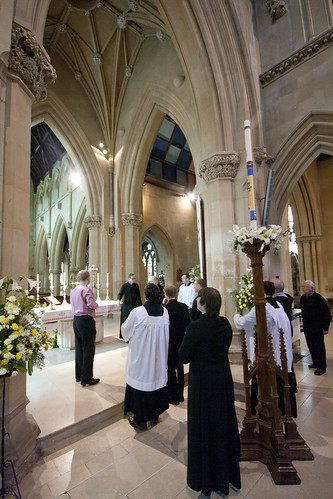
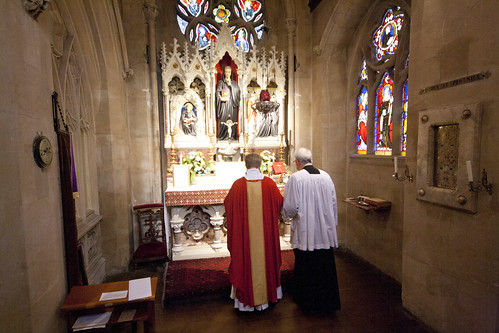
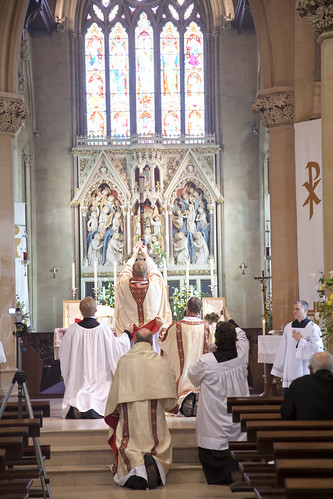
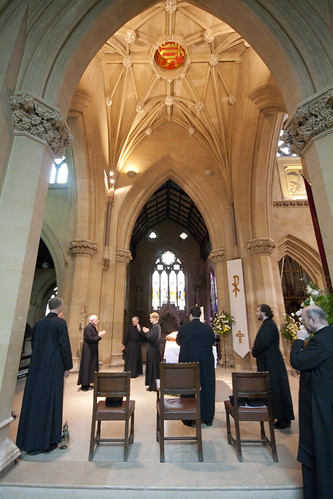
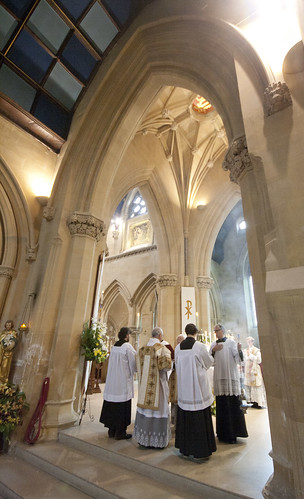
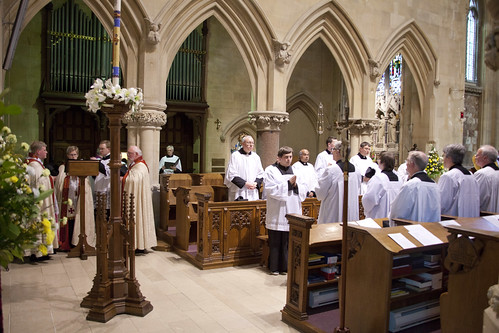
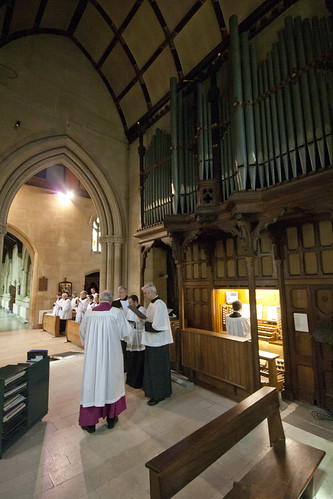
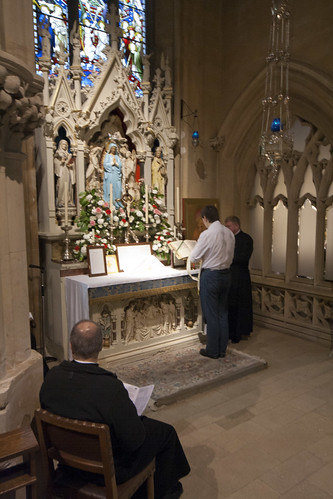
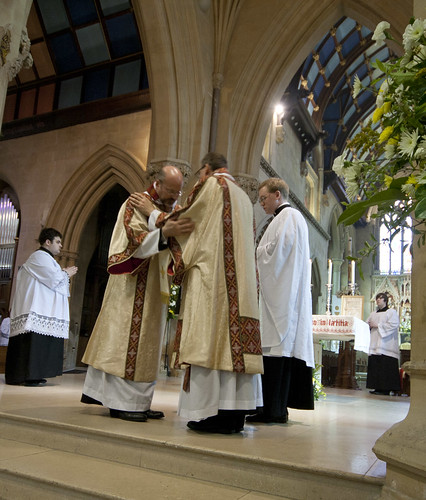
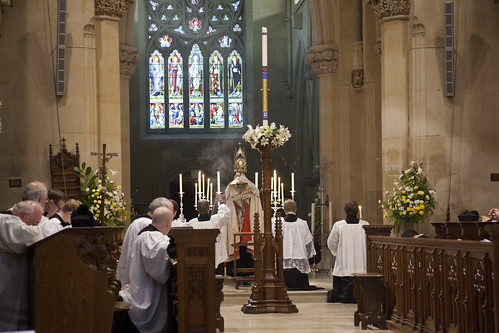
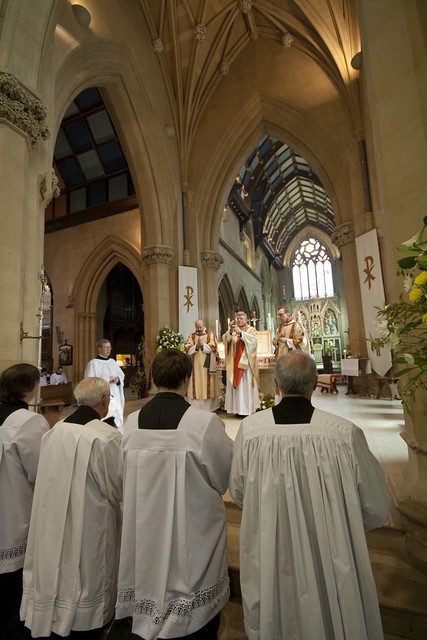
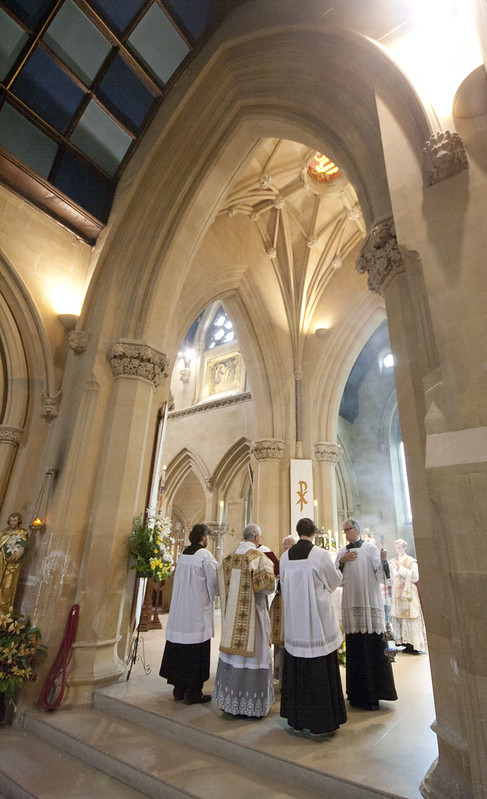
As promised, here are some pictures of the Priest Training Conference which took place last week at Belmont Abbey, organised by the Latin Mass Society.

IMG_7212

Not for us carping from the sidelines about the state of the Church. We are actually doing something about it: priests and deacons, actual and in training, who wish to learn how to say the Traditional Mass, and to perform the various functions of High Mass, and servers and Masters of Ceremonies, are all welcome at our training conferences are hugely subsidised rates. Seminarians, in fact were free this year. There couldn't be a more concrete contribution to the liturgical, and therefore spiritual, renewal of the Catholic Church in England and Wales.

IMG_7224

This year's conference has been the most successful for many years - perhaps ever. The venue is lovely, and we overflowed the onsite accommodation and were booking up nearby B&Bs. Numbers were up on recent years.

IMG_7304

We had a good mix of old and new faces, diocesan clergy, including two from Scotland, members of the Ordinariate, a permanent deacon or two, a seminarian, and a variety of servers at different stages. I was there for two days, and saw two lovely High Masses, two Vespers, including a 'three cope' Solemn Vespers for St Joseph the Worker, Benediction, and lots of private Masses and training sessions.

IMG_7321

In the past few years it has been Clifton Diocese which has sent the most people; this year it was the turn of Plymouth Diocese.

IMG_7274

Many priests learn the ancient Mass in whole or in part in one-to-one sessions with a friendly local priest who knows it. This may be the only practical way, but it does have its limitations: not only those of the local priest himself, but of the nature of one-to-one tuition: it is simply impossible to see or practice the ceremonies of a High Mass, involving celebrant, deacon and subdeacon, plus MC and servers, with only two people.

IMG_7302

As well as having some very experienced priests to teach the clergy, we have a number of excellent MCs and singers. For part of the week Fr Guy Nichols Cong Orat, the founder of the Newman Institute of Sacred Music, was on hand.

IMG_7351

IMG_7253

Our services were accompanied by the Rudgate Singers under Mike Forbester, with Christian Spence playing the organ.

  IMG_7273

These conferences are a very important opportunity for clergy to meet like-minded people, and the round of services gives it something of the character of a retreat.

IMG_7260

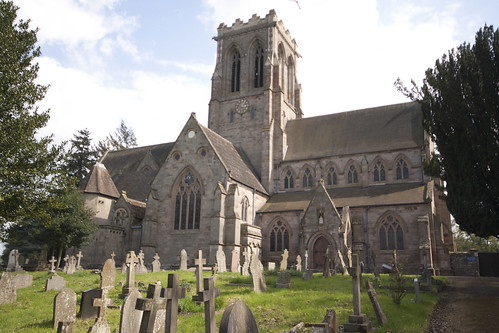
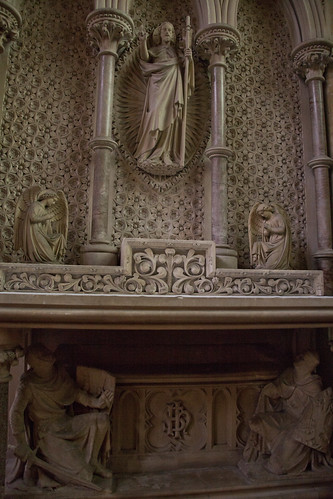
For me, as I'm sure for others, the chance to get to know one of England's really superb neo-Gothic masterpieces, Belmont Abbey, was also very welcome. The stunning Abbey Church was designed by Edward Pugin and consecrated in 1860.

  IMG_7253

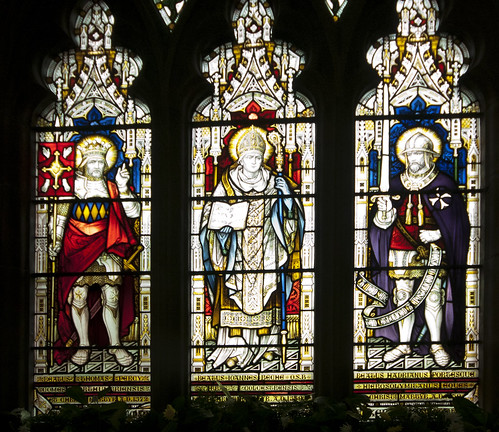
It has survived the 'changes' pretty well, although the high Altar was, sadly, destroyed at an early stage. One of the things which I particularly admired was the stained glass windows, produced by Hardman, the firm which usually collaborated with the Pugins. They show a lot of English martyrs, and other English saints, including many I have not seen depicted before.

IMG_7216

The full set of my photos is here; I have created subsets for the art and architecture, and for the training sessions and private Masses.

Sunday, May 04, 2014

Protect the Pope: double standards, Part 3

IMG_7302
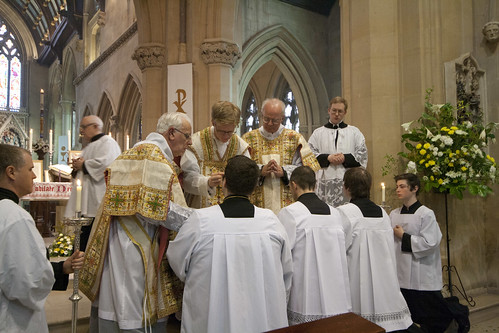
High Mass in the Extraordinary Form, at the LMS Priest Training Conference,
Belmont Abbey.

I explained in my last post the sorts of things even quite conservative bishops, religious superiors, and curial officials might say to explain why grass-roots conservative activism worries them, even as they cheerfully tolerate the likes of Basil Loftus and Tina Beattie. It rocks the boat. It makes - as the Holy Father might say - a mess. It complicates their careful plans. And, looking at the situation strategically, they may think that it is more important to seek after the lost sheep of liberal dissent, than the 99 sheep in the fold of orthodoxy. Especially as the dissidents seem to represent the wider culture - by being nice to them, they are opening the door to everyone outside the Church.

I should say right away that I completely understand the fear of conservative bishops that groups of conservative activists will make prudential mistakes, strategic blunders, and even theological errors. The Holy Ghost does not prevent good people seeking good things from being counter-productive. But the position of these conservative hierarchs is itself based on a number of prudential misjudgments. Let me list some.

1. If we are nice to the dissidents, we have some hope of saving them for the Church. By which they mean: allow the dissidents to keep their positions of prestige and influence, and make them feel valued. This is a mistake because this treatment simply reinforces the idea that dissident views are the new orthodoxy, both for the dissidents themselves, and for those who see them treated in this way.

2. If we sideline conservatives, they will at any rate stay in the Church and continue to support us. Wrong: Catholics who might be described as naturally conservative have joined the SSPX, become sede vacantists, or joined Evangelical Protestant churches; they have lapsed, they've taken to drink, and clerics have abandoned their vocations; in a talk of Michael Davies he mentions one he knew driven to suicide. They are deserving of pastoral concern just as much as other folk.

3. We can solve the problems behind the scenes more easily if conservative activists aren't making a fuss in public. This may sometimes be true, but it is hard to see how it could be in very many instances. If there is no fuss, then it is assumed there is no scandal. If there is no scandal, then it is assumed there is no problem. We can all think of examples of serious problems, well known to apparently conservative bishops, which were never publicised and - what do you know? - never addressed, sometimes for decades. The sex abuse scandals, of course, exemplify this.

4. These activists are out of control and poorly led. Sometimes: but if the conservatives in authority went to even a little trouble, they could gain the trust of the most important activists and exercise some guidance over them. This does indeed happen sometimes, but only when the bishops or officials throw off the attitude that error should not be publicly opposed, because without that they are not going to gain the trust of anyone.

5. Unity is more important than the purity of our orthodoxy. What those who say this actually mean is that any Catholics who still have the Faith should stop opposing attempts to teach a pack of lies to Catholic school children, trainee teachers, seminarians, and the Faithful. That may make for a quiet life, but it doesn't make for the unity for which Our Lord prayed.

6. By avoiding conflict, we keep doors open for dialogue. In practice, it is easier to have dialogue when people aren't pretending that they and others don't have the differences of opinion that they have. Basil Loftus sends out smoke signals that he's in favour of women priests: how can you have a meaningful discussion on that basis? If I pretended not to notice the smoke signals, the question of dialogue wouldn't even arise.

7. Evangalisation is about not scaring liberal non-Catholics away by talking about hard doctrines. I've addressed this before. To reiterate, evangelisation is, on the contrary, about offering something distinctive which non-Catholics don't already have.

The underlying misjudgment, in my view, is a failure to understand how much damage dissent does. The Faith is passed on, the life of grace is developed, nearly always in the context of institutions: the home, the school, the parish. This is logical because Catholic institutions manifest the community of the Church, the Mystical Body of Christ, in a tangible way, to us as individuals. These institutions can be turned into a nightmare of conflict, or just rendered completely useless, by a minority of dissidents, if they are given a free hand. I have in mind things like a few teachers who mock the Faith in the classroom, or parish busybodies who show no respect for the Blessed Sacrament. If they are left to get on with it, no one in the institution can take seriously the Catholic claims of those nominally in charge. It can no longer inculcate a Catholic culture, a Catholic perspective on the world, because it no longer manifests one. In a very short time, it is no longer a Catholic institution, though it may remain one where some Catholics work, or where some sacraments take place, which can have an effect on individuals as individuals. To repeat, this is not the unity for which Our Lord prayed.

In the destruction of these local, tangible institutions, as manifestations of the Mystical Body and as channels of grace, we see the destruction of the Catholic community. Those who have authority over these institutions have the obligation to exercise it for the common good - not just for the good, as they see it, of a few dissident intellectuals. Generally speaking, over the last half a century, they have not exercised this authority. When conservative activists talk about this, the get the sort of welcome which was extended to Elijah and Jeremiah.

This may start changing, but it is going to be very slow. Personally I admire these conservative activists, and I have made my own contribution to this work, such as in my posts on Mgr Loftus. I also acknowledge their limitations and mistakes - and my own, in this department. What I would say to them, and to their supporters, is that as well as criticising dissent, we need to start building things up from the grass roots in a positive way. I personally think that this has got to include a recovery of the ancient liturgy.

This is why tomorrow I will post about the Latin Mass Society's Priest Training Conference in Belmont Abbey, and from now until September my life is going to be dominated by a succession of devotional and educational events involving the traditional Mass. My readers may be less interested in these than they are about the latest episode of ecclesiastical politics, but, sub specie aeternitatis, from the perspective of eternity, these events may have more effect on the future of the Church. And they will, at any rate, keep me sane.
IMG_7313

Saturday, May 03, 2014

Protect the Pope: double standards, Part 2

IMG_7228'
Bare-knuckle Catholics, immortalised in the Hardman stained glass of Belmont Abbey Church:
left to right, Bl Thomas Percy, martyred leader of the Northern Rising,
Bl John Beche, martyred Abbot of Gloucester, and
Bl Adrian Fortescue, martyred Knight of Malta.

Since the first post in this series Bishop Campbell has issued a press release explaining the reasons for his action. A key sentence is this:

It is my view that bishops, priests and deacons of the Church – ordained and ‘public’ persons – are free to express themselves and their personal views, but never in a way that divides the community of the Church i.e. through ad hominem and personal challenges.

The word 'personal' is italicised in the original, and the phrase is repeated later in the statement. It would seem that Bishop Campbell would be happy for Deacon Donnelly to write about the teaching of the Church, but not to name those who appear to dissent from this teachings, in order to raise questions about them or warn Catholics against them.

It is not for me to criticise Bishop Campbell's decision, and of course he is not Mgr Loftus' ordinary, so the contrast I have drawn between these cases does not imply any personal inconsistency for Bishop Campbell. I want, nevertheless, to understand the institutional culture which has tolerated Loftus' column for more than two decades, but exhibits such discomfort about blogs.

Deacon Donnelly's blog was bad, we're told: fine. But what about this newspaper column? In a newspaper with episcopal approval, sold in the back of churches. Do Loftus' columns not 'divide the church'? Do they not include 'ad hominem and personal challenges'?

When Loftus called, in a letter to the Tablet in June 2013, for 'anger' about a sermon preached by Bishop Mark Davies?

When he described Cardinal Ranjith, in November 2013, as 'the Sri Lankan cappa magna fetishist and Tridentine-rite devotee'?

Did it not 'divide the Church' and make use of 'caricaturing or stereotyping' (phrases used by Bishop Campbell) when Loftus described the Roman Curia as having a 'culture of ‘Vatican II-bashing’ in May 2012, and of 'Legalism in law, overly-literal interpretations of Scripture, rubrical straightjackets round the liturgy, fossilisation of what should be living doctrine, and general over-objectification of faith and morals' in June 2012?

 Examples could be multiplied. 

The suggestion of my last post was that, since it is perfectly obvious that no one could suggest that Protect the Pope was less orthodox, or less respectful of bishops and prelates, or more scornful and uncharitable towards its opponents, than Basil Loftus' column - and the same is true of all the other Catholic blogs worth mentioning - lack of orthodoxy and lack of respect for persons cannot be the reason for bishops' unease about blogs.

But my next claim, which is perhaps more shocking, is that I don't think it is necessarily a liberal conspiracy among bishops which led to Protect the Pope's closure. I don't think it shows that Bishop Campbell, or anyone else in the hierarchy who has expressed unease about blogs, like Cardinal Müller, are at heart sympathisers of the likes of Loftus.

Those who have been involved in Catholic activism over they years know the pattern of behaviour very well. Bishop X is attacked by dissidents, who support attacks on his public positions by the state and the secular media, who defy his commands, and who dissent from his teachings. Groups of loyal Catholics go on a counter-offensive: they make public responses defending the teaching of the Church in the media, they engage in hand-to-hand struggles with the dissidents in forums such as boards of school governors, they gather information which would make it possible for Bishop X to apply canonical penalties against the dissidents, if he wanted to. And you know what? It is the dissidents who have cosy chats over tea with Bishop X. They get appointed to jobs and committees. They get space in the diocesan newspaper and links from the website. The loyalists, on the other hand, are frozen out. This has happened again, and again, and again, most famously after the publication of Humanae Vitae, when Pope Paul VI refused to support bishops who disciplined dissenters.

What is going on? I shall identify three minor reasons, and one major one. Minor ones first.

'Leave it to us, chaps.' Many bishops, religious superiors, and people in the Curia who are basically rather conservative, and would like to steer things in the direction of sanity, find themselves involved in a very complicated game of chess with their opponents. The last thing they want is interventions from third parties, even if those parties are essentially on their side. Suppose that, say, conservative activists suddenly publicised the dissent of a liberal who for tactical reasons was helping to deal with an even worse liberal. The bishops are worried that anything they aren't in complete control of will make their lives more complicated, their jobs harder, and their prospects of success dimmer. 

'I don't know what effect they have on the enemy, but by God they terrify me.' The more conservative side of the discussion in the upper reaches of the hierarchy doesn't necessarily look like the more conservative side of the discussion on the blogs. Conservatives in the former may well have perfectly sincere misgivings about the views and tactics of the latter. They have, after all, spent a lifetime adapting themselves to liberals, whereas the orthodox crusaders have spent a lifetime trying to enthuse the troops about how bad things are. That doesn't mean that the more conservative bishops have lost the Faith, but they may well not only not want to distance themselves from the conservative activists, but, when possible, actually get them to shut up.

'Did I really say that?' What conservative Catholics tend to do is look for authoritative statements from Rome, or from local bishops, which show as clearly as possible that the words and actions of the dissidents are wrong. Making such statements is easy, however; enforcing them is hard work. Many essentially conservative prelates adopt softly-softly approaches to dealing with problems - say, removing a dissident from a sensitive post by offering him a more senior and better paid job elsewhere. The last thing the prelate wants to be reminded of in the midst of this kind of task are the less nuanced statements he or others have made: they have the potential to make him look, and perhaps feel, a fool. I mean heck, he's trying to deal with the problem, ok? Just let him get on with it.

But the biggest reason is this.

'Dissidents must be attracted with honey, not forced into open schism.' To adopt a political parallel, the conservatives are regarded as the core vote, and the dissenters as the people who could be lost, or won, depending on how cleverly and charmingly the bishop handles them. The parallel seems apt since the dissidents tend to have the support of the secular media, and this makes it look as though what pleases the dissidents pleases the whole non-Catholic world. If only, the bishop thinks, I can, without compromising on theological principles, but just by being nice, establish friendly relations with these dissidents, then I can draw not just them but to an extent the whole culture towards the Church's orbit, where of course they can be influenced in a positive way by all sorts of things. To condemn them would just force them into more extreme positions, more open opposition to the Church, and ultimately either into schism or lapsation. And that can't be good, can it?

The net result of this sort of reasoning is that, everywhere you look, conservatives are sidelined, and dissidents are made much of. Liberals who want conservative faithful to think they are on their side, when actually they aren't, can use these arguments to explain their lack of action. I am convinced, however, they are also used by those who are genuinely conservative in theology. 

But I am also convinced that the lines of reasoning I have outlined are wrongheaded. This I must explain in another post.

Friday, May 02, 2014

Protect the Pope: strange double standards. Part 1

IMG_7263
High Mass at the LMS Priest Training Conference at Belmont Abbey: just to cheer us all up.

What has Deacon Nick Donnelly done which Loftus has not done? I haven't kept such close tabs on the Protect the Pope blog as I have on Loftus' Vatican Counsel column, but I challenge anyone to give examples of bad things which can compete with my examples of what Loftus has done.

Has he denied any Catholic doctrines? I don't think so, but Loftus has: the Resurrection of Our Lord, the Real Presence, the Inerrancy of Scripture, the Indissolubility of Marriage (at least indirectly), Original Sin (as the Church understands it), the impossibility of the Ordination of Women, and, on morality, the limitation of sex to marriage.

Has he sought to bring the Church's institutions in disrepute? I don't think so, but Loftus has: the Congregation for Divine Worship, the Pontifical Commission Ecclesia Dei, the Office of Papal Celebrations, the Congregation for the Doctrine of the Faith, the Curia as a whole, and the Ordinariate of Our Lady of Walsingham.

Has he attacked prelates by name? Nick Donnelly has criticised some, or called for them to act, but Loftus has gone in for vitriolic personal abuse: Cardinal Nichols, Bishop Davies, Cardinal Ranjith, Cardinal Burke, Cardinal Müller. Not by name, but unmistakably: Archbishop Roach, Bishop Hugh Gilbert, and Mgr Marini, the Papal MC.

Has he undermined the discipline of the Church by intemperate attacks on binding decisions? I don't think so, but Loftus has: the new translation of the liturgy, the limitations placed on the use of General Absolution, and a vast number of provisions of liturgical law. And of course he has attacked clerical celibacy.

What is clear is that, despite this, the bishops are much more comfortable with Loftus than with bloggers like Nick Donnelly. On bloggers, we have had a whole series of signals of concern, including one from the Prefect of the Congregation for the Doctrine of the Faith, Cardinal Müller, to the Ordinariate, that they should 'exercise vigilance over blogs of their members'.

Hang on a minute: the clerical bloggers of the Ordinariate weren't attacking Müller, or the Curia; for the most part, they were defending them. Similarly, I don't think Bishop Campbell is a liberal who has more in common with Loftus than with Nick Donnelly: he is the man who has given one of the most stunning churches in the country to the Institute of Christ the King, and he can expect to be a target for Loftus' vitriol soon enough. What we are seeing is a deliberate policy, where conservative-leaning people in authority attack their friends and protect their enemies.

This is strange, but it is neither unprecedented nor incomprehensible. First, a little clue: it is the same policy that was applied by Pope Paul VI with regard to dissent over Humanae Vitae. I will explain more in another post.

Thursday, May 01, 2014

Loftus, Modernism, and the Resurrection

IMG_5947
I think it is particularly appropriate to post this in the days after the permanent suppression of Deacon Nick Donnelly's blog 'Protect the Pope'. I will have more to say on the contrast between the cases of Mgr Loftus and Deacon Donnelly in another post. 

----

While most Catholics are celebrating Christ's victory over death, Mgr Basil Loftus is desperately playing it down, as he has year after year at Easter time in his Catholic Times column.

The Catechism of the Catholic Church tells us that

643 Given all these testimonies, Christ's Resurrection cannot be interpreted as something outside the physical order, and it is impossible not to acknowledge it as an historical fact.

But it is precisely this which Loftus wants not to acknowledge. In 2010 he distinguished 'facts' from non-factual elements in the Gospel accounts of the Resurrection, in order to deny that the Resurrection on the third day was a 'fact'. In 2011 he wrote:


Yes, there is mention of the empty tomb. But that doesn't historically mean that Christ rose from the dead - just that his body was not there. All that historical science can say about Christ's resurrection is that the disciples believed in it and witnessed to it. The Scripture account of the resurrection is merely an account of that witness.

Again: 'the New Testament is not a historical account of the resurrection.'

Having dealt successively with facts and historical matters, in 2012 he denied that it was an event in the physical order.

Christ's Resurrection from the dead means that a fully-fledged member of the human race, a man like us in all things but sin, has entered into the glory of God and taken on a new spiritual existence.

This year he tells us that all the things in the Gospels which support the Catechism and contradict him are merely 'artistic licence'. They weren't factual, historical, or physical. This seems almost obsessive: what's going on?

What is going on is a classic Modernist mindset at work. Modernists are motivated above all by fear of Science. The worry is that Science deals with facts. Science is on the march. Science is against Religion. Any facts, anything historical, anything physical, is the domain of Science, and any theologian foolish enough to make factual, historical claims, claims about physical things, is exposing himself to contradiction by Scientists. The way to defend the Faith from the onward march of the Men of Science is by saying that none of the things which are important to the Faith are inextricably connected with any factual, historical, or physical claims.

IMG_5952You have to remember, of course, that this way of thinking was developed in response to the scientific triumphalism of about 150 years ago, and even this depended on philosophical developments in the 18th century. It is about as 'modern' as the horse-drawn cab or gas lighting. It is not, however, so much a theory or a claim, as an instinctive cringe towards Science; as I have called it, a mind-set. This makes it all the harder to dislodge. You can say the Modernist: look, really, no scientist is going to provide evidence that the Resurrection didn't happen, at this distance of time that particular worry just doesn't come into it. But he will just just give a little nervous titter and insist that it really is so much better, yes believe me my dear fellow, not to leave any hostages to fortune by making historical claims which look so implausible. I mean, a man rising from the dead. That kind of thing has hardly ever been known to happen: as a matter of historical science, it is unlikely, therefore, to have happened on this occasion.

Yes, that really is how they argue. You can point out that there is nothing actually impossible about walking on water, we are just talking about God applying a force to counter-balance gravity at a particular time and place, and if we believe in God at all surely this is the kind of thing He can do. The Modernist will just wring his hands quietly and say that you can't appeal to that kind of intervention in Science. The Men of Science don't allow it. We can talk about Jesus walking on water, yes of course we can, it's a nice story, but what's important, surely, what is really important, is not the physical side of it but the spiritual lesson Jesus was trying to teach, or better still what the Evangelists were trying to teach when they made up the story (oops, did I really say that?).

The Resurrection is a tough one because it is particularly clear in this case, as it is in fact often the case with miracles, that the spiritual significance of the event depends upon the physical reality of it. As St Paul says, if Christ did not rise from the dead, our Faith is in vain (1 Cor. 15:14) But the idea that the whole of the Christian Faith depends on the historical truth of an event so prima facie unlikely as a man rising from the dead gives the Modernists the vapours. They just have to do something to give the Faith a more secure foundation - as they see it. Never mind about conjuring tricks with bones, what's really important is that Jesus' message is alive in our hearts. What does it matter, after all, what happened to Jesus' physical body? And at this point you realise that abandoning the realm of 'facts' to Science also entails a complete abandonment of incarnational theology: the theology of God becoming flesh, and indeed of human beings being physical beings and not just gibbering ghosts temporarily associated with a bit of skin and bone.

Loftus gets particularly vague at this point, clinging on to the Incarnation but saying that the rest of it is just a 'mystery'. But if the Incarnation was a historical event, and the Virgin Birth which went with it, why not the Resurrection?

Loftus wants to lift a burden from his readers: the burden of having to believe and defend unnecessary historical, factual, physical claims. Freed of that crushing burden, they can enjoy the life-giving spiritual lessons of the Gospels. The problem is that, without the factual stuff, the spiritual stuff doesn't make sense: to paraphrase St Paul, if Christ has not risen, we've been duped. The Church agrees with St Paul, and Modernism has been condemned up hill and down dale, and, on top of that, is now thoroughly old hat. Loftus continues to beat the dead horse, pathetically, and for some reason The Catholic Times continues to print it.

As I have said before, this madness must stop.

IMG_5955

Photos: Mysteries of the Rosary from St Dominic's, Haverstock Hill (a Dominican church).

Wednesday, April 30, 2014

St John Paul II on the liturgy.

I was in Manchester at the time of the canonisations, so I haven't had the chance to blog about it. I think Fr Zuhlsdorf makes an excellent point about these canonisations underpinning the interpretation of the Second Vatican Council proposed by Pope John Paul II: it gives St John Paul's writings greater authority.

This is important. One of the things I have understood better in the course of editing the FIUV Position Papers is just how much Pope St John Paul had to say about the liturgy, and I mean good things, obviously! Not just in documents explicitly about the Old Rite, such as Ecclesia Dei Adflicta, but all over the place. He was a Pope with a liturgical imagination.

I include below three quotations from just one Position Paper, 'The Extraordinary Form and Western Culture.' Read the paper here. He is also quoted to important effect in the paper on Silence and on Latin as a Liturgical Language.

Address to the Bishops of the North Western region of the United States, in their ad limina visit in 1998:
Active participation certainly means that, in gesture, word, song and service, all the members of the community take part in an act of worship, which is anything but inert or passive. Yet active participation does not preclude the active passivity of silence, stillness and listening... In a culture which neither favours nor fosters meditative quiet, the art of interior listening is learned only with difficulty. Here we see how the liturgy, though it must always be properly inculturated, must also be counter-cultural.

Address to the Plenary Session of the Congregation for Divine Worship, September 21, 2001.
The People of God need to see priests and deacons behave in a way that is full of reverence and dignity, in order to help them to penetrate invisible things without unnecessary words or explanations. In the Roman Missal of Saint Pius V, as in several Eastern liturgies, there are very beautiful prayers through which the priest expresses the most profound sense of humility and reverence before the Sacred Mysteries: they reveal the very substance of the Liturgy.

Apostolic Exhortation Ecclesia in Europa (2003) 60.
Nor should we overlook the positive contribution made by the wise use of the cultural treasures of the Church. These can be a special element in the rekindling of a humanism of Christian inspiration. When properly preserved and intelligently used, these living testimonies of the faith as professed down the ages can prove a useful resource for the new evangelization and for catechesis, and lead to a rediscovery of the sense of mystery. … artistic beauty, as a sort of echo of the Spirit of God, is a symbol pointing to the mystery, an invitation to seek out the face of God made visible in Jesus of Nazareth.

St John XXIII also had a lot to say, and to counter the strange view that he was some kind of free-wheeling liberal I've blogged about his writings a number of times, notably his Apostolic Constitution Veterum Sapientia on the importance of Latin. Yes, the man who called Vatican II almost simultaneously defended the use of Latin and demanded it be not only retained by restored, and teaching in it strengthened. See here and here.

Tuesday, April 29, 2014

Bishop Brain ordains for the Manchester Oratory

IMG_7088

I wasn't the only photographer present so better photographs may emerge elsewhere, but I was very pleased to be present at this very important milestone in the development of the Oratory-in-formation in Manchester. Having moved from the Holy Name to another fine (but not as big), church in central Manchester, St Chad's, which has the advantage of a large presbytery suitable for community life, the community's induction into the congregation of the Oratories of St Philip Neri is proceeding, with the support of Bishop Terence Brain.

IMG_7097

On Saturday, Bishop Brain went further and ordained one of the Brothers, Richard Bailey. As you can see they have the right to wear distinctive Oratorian habit.

IMG_7105

The development of another Oratory in the North of England is a matter of great significance. Fr Richard is also very friendly to the Church's liturgical traditions, is an excellent singer, a great Latinist, and has taught at the LMS Latin Course in Pantasaph for two years, and will do so again this year. By a providential coincidence, this was the church where Fr Richard was received in the Church, as a young convert, many years ago - he went to school down the road.

IMG_7122

St Chad's now, as the Holy Name was, is a very important centre for the Traditional Mass, having a popular Sunday celebration in the afternoon. I also attended this. Many of the regulars went this weekend to Fr Richard's 'first Mass' in the morning, but it still pulled in a good crowd.

IMG_7187

The church needs some cleaning and restoration, and a Lottery grant has been secured to help with this. It is an excellent church, lived-in in the best sense, filled with the devotional items which have enriched the lives of generations of Mancunian Catholics, and it has survived the liturgical reform better than many places. Bishop Brain seemed quite happy to celebrate ad orientem on the fine Altar.

  IMG_2021

The Catholic Church in the North of England has its problems: in many dioceses the shortage of priests is becoming very serious. Here, thanks to Bishop Brain's foresight, the planting of an Oratory of St Philip will secure the future of this church and provide something very special, liturgically, spiritually, and intellectually, in this important Catholic city, which needs re-evangelising just like St Philip Neri's Rome of the 16th century.

May they flourish!