 |
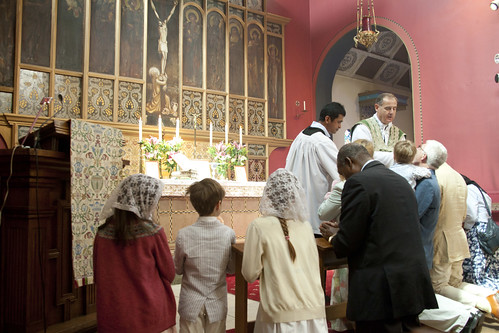
| Holy Communion at St Mary Magdalen, Wandsworth, with Fr Martin Edwards |
I want to give some greater prominence to a comment on my
last post, from someone I'd never heard of before, who has his own blog
here. Alastair Roberts is a student at Durham University, and an Anglican, presumably on the evangelical side of the debate. I think I agree with every word he has written in this comment, and indeed he has articulated things I had not articulated to myself.
What is missing from his account is reference to the sacramental realities which are connected with the issue of the complementarity of the sexes, in Catholic theology. There is a danger, however, which can be seen in Catholic treatments of these issues, of fixating on the issue of sacramental validity, and regarding everything else as unimportant. Women can't be ordained priests: that's the end of the argument, it often seems, and we might as well give way on all the manifestations of the Church's teaching other than the ordination of women itself. This is part of a legal-positive drift which I have criticised before as a feature of
neo-conservative thinking, amazingly illustrated
the other day by Cardinal O'Malley saying that, if
he had founded the Church, he would have 'loved' to have had women priests. No: it was not just an arbitrary and incomprehensible decision by Our Lord to ordain only men, which we can like or lump. Grace perfects Nature, it does not destroy or replace Nature. Leave the idea of a depraved Nature and an arbitrary Divine Will superimposed upon it to the Calvinists. This Evangelical reflection, below, ought to shame us for the superficiality of our usual discussions.
In passing I would like to note two important Catholic treatments of these issues. Manfred Hauke's classic work, 'Women in the Priesthood?' is an exhaustive investigation of the symbolic role of the feminine in the Old Testament, New Testament, and beyond. My criticisms of the work are, first, that he fails to see the full importance of the two concrete manifestations of complementarity which are contested in Catholic liturgical practice today, namely the service of the Altar and headcoverings. And second, his concern, like that of St John Paul II, is so focused on women that it tends to neglect men. You can't talk about complementarity without talking about both sides.
The other work is Leon Podles 'The Church Impotent: the Feminization of Christianity'. I have criticisms of this as well, and I intend to discuss some of his ideas in future posts. But you can
read the whole book online, and it contains a lot of fascinating material, particularly about the nature of masculinity and how that fits in with spirituality.
--------------------------
A few thoughts, from a Protestant who is mostly agreed with the post above:
1. In Scripture, the primarily command to husbands isn’t to exercise authority over their wives and families, but to love them. This, I believe, is worthy of note.